La rivista e il marketplace globale per gli appassionati di auto d’epoca, creati da appassionati.
La rivista e il marketplace globale per gli appassionati di auto d’epoca, creati da appassionati.


Filter
Faccia la sua scelta
- Automobile
-
Marca >>
-
Anno >>
-
- Motociclette
-
Ubicazione >>
- Parti e altro
-
Marca dell'auto >>
-
Produttore >>
-
Categoria >>
- Biciclette
-
Anno >>
-
Paesi


A double belt-drive mystery: the bizarre cyclecar of Barrow-in-Furness


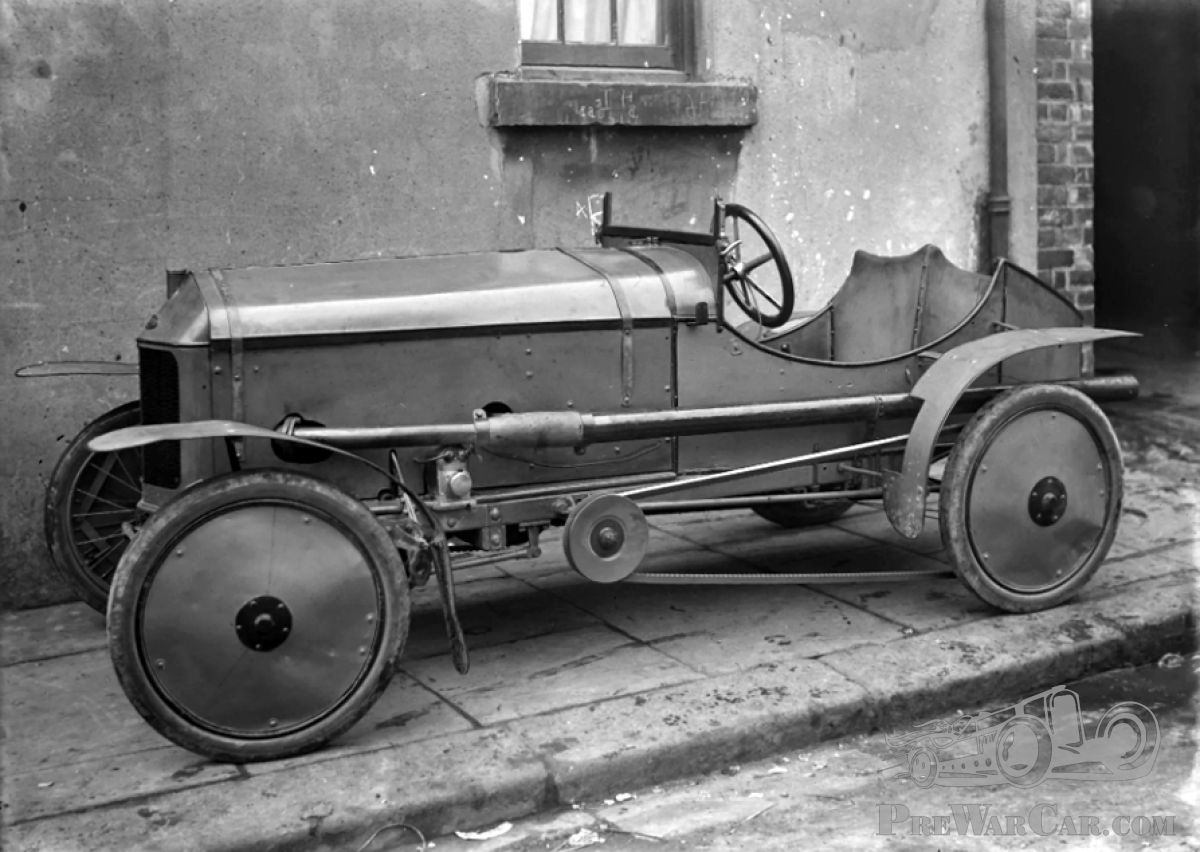


It’s good that these four pictures are clear and of an excellent overall quality, because we've got no other advantages when it comes to solving the mysery of this... well, just what is it? The images come from the Sankey Archive and show a two-seater sports car of unknown origins.
The archive itself is unaware of its background, too, adding: “Large single-seater sports car on a pavement. Car is belt-driven with solid wheels.” Yes, the long belt driving a large pulley to the rear wheels is definitely unusual, and what’s more: there are belts on both sides. The apparently solid wheels are actually just wire-spoked wheels rakishly disguised by flat discs. This is no single-seater, though—one can clearly see a seat for the "riding mechanic" set back a little, as such a narrow body would never allow for side-by-side seating. We also note the simple pointed tail made from flat metal and a dashboard with no instruments other then a gauge placed below the steering column. There’s an exhaust manifold with two outlets. What engine could it hide?
There is, however, one further clue: “Barrow registration EO 1065.” That is Barrow-in-Furness, the port town in the historic county of Lancashire, and we’ve a feeling that one clue could be enough to solve the mystery. Over to you again...
Words: Jeroen Booij
Picture: Sankey Archive
Pubblicato:
lunedì dicembre 16th, 2024
Facebook
LinkedIn
Twitter
WhatsApp
Email
Copy
Commenti



Ariejan Bos
18 Dicembre 2024, 16:30
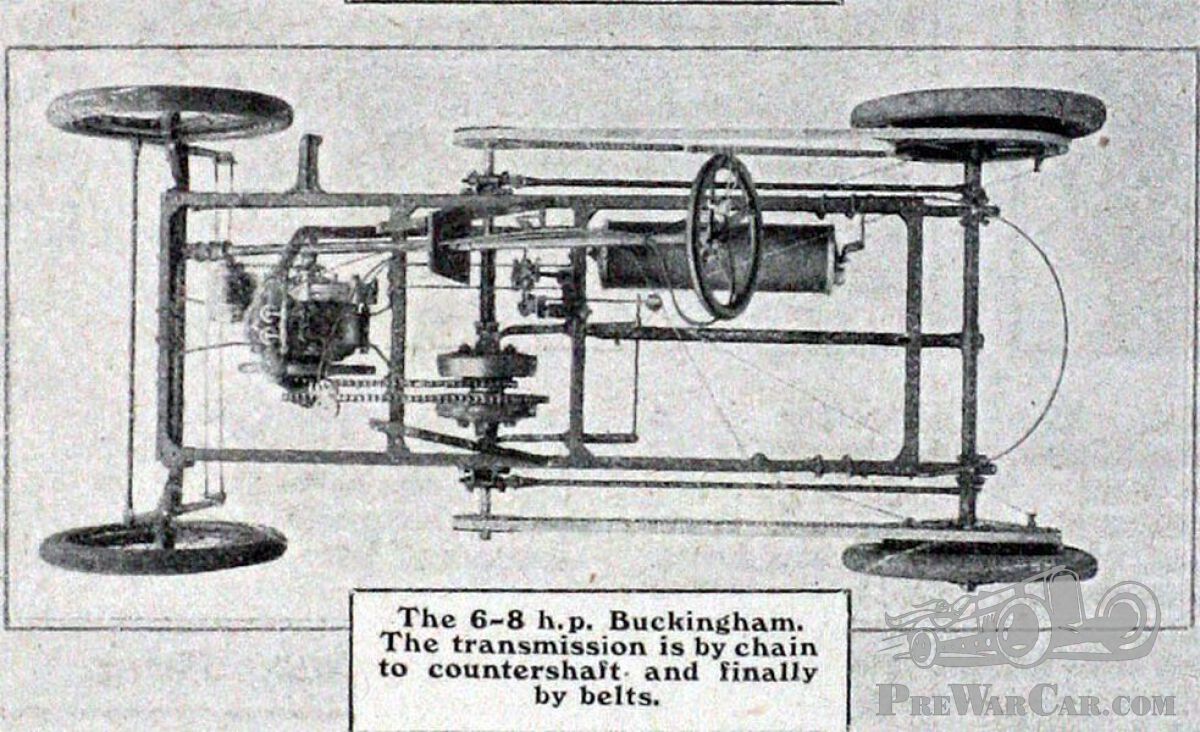
A Buckingham seems to be a good match. The accompanying photos seem to confirm this. The large transmission chain wheel between engine and gearbox is clearly visible below the frame on one of the photos. The late Michael Worthington-Williams published a five-page story on the make in The Automobile of January, 2005, with lots of pictures. However there is no sign of a Buckingham car with this lengthy bonnet combined with the double exhaust. So was this car an official product or a later modification?
Per saperne di più
Ariejan Bos
18 Dicembre 2024, 18:24
No gearbox, of course, I meant the belt drive...
Per saperne di più
David Grimstead
17 Dicembre 2024, 22:39
John A. Kent’s friend’s suggestion of a Buckingham seems like a good bet: they offered in 1913-14 a Sporting 12 h.p. Model with a special polished alloy body. That unsilenced large-bore exhaust looks like a racing-car feature. Among the dozens of series-produced cyclecars, few, if any, had the combination of features this one has, notably a water-cooled twin with twin belt drives, transverse front springing, racing body option, disc-over wire wheels, etc. The oval badge looks right too.
According to contemporary records in 1914, J. F. Buckingham of Coventry were making a water-cooled 90-degree vee-twin cyclecar with a two-chain, cone clutch-controlled two speed primary drive to a cross-shaft with twin belt final drives acting as the differential. Transmission was the same for the 89 by 120 m.m., 746 c.c. single cylinder air- and water-cooled versions—reverse was an extra. His in-house built, fore and aft-mounted, vee-twin had slightly offset cylinders of 89 by 88 m.m., giving 1,095 c.c. Just over-square, he claimed it was safe up to 5,000 r.p.m. but a too-tight turn on tarmac could throw off a drive belt.
Coincidental to the registration address, the Barrow Herald reported on the Westmorland Hill Climb at Greyhound Hill between Kendal and Sedbergh on April 18th, 1914: “Cycle-cars were a feature, the 12-h.p. Buckingham with racing body making fastest time in the big event.” It would be pushing coincidence too far to say that the older chap in the car has a moustache like J. F. Buckingham had…
But in May, 1914, J. F. Buckingham himself, drove his “hefty” belt-drive car in the Lancashire Automobile Club’s hill climb at Waddington Fells. He had a runaway win, climbing the hill at very high speed and appearing to be enjoying himself… as he did at many other such events, including at Brooklands.
Per saperne di più
According to contemporary records in 1914, J. F. Buckingham of Coventry were making a water-cooled 90-degree vee-twin cyclecar with a two-chain, cone clutch-controlled two speed primary drive to a cross-shaft with twin belt final drives acting as the differential. Transmission was the same for the 89 by 120 m.m., 746 c.c. single cylinder air- and water-cooled versions—reverse was an extra. His in-house built, fore and aft-mounted, vee-twin had slightly offset cylinders of 89 by 88 m.m., giving 1,095 c.c. Just over-square, he claimed it was safe up to 5,000 r.p.m. but a too-tight turn on tarmac could throw off a drive belt.
Coincidental to the registration address, the Barrow Herald reported on the Westmorland Hill Climb at Greyhound Hill between Kendal and Sedbergh on April 18th, 1914: “Cycle-cars were a feature, the 12-h.p. Buckingham with racing body making fastest time in the big event.” It would be pushing coincidence too far to say that the older chap in the car has a moustache like J. F. Buckingham had…
But in May, 1914, J. F. Buckingham himself, drove his “hefty” belt-drive car in the Lancashire Automobile Club’s hill climb at Waddington Fells. He had a runaway win, climbing the hill at very high speed and appearing to be enjoying himself… as he did at many other such events, including at Brooklands.
David Scott
17 Dicembre 2024, 07:31
It seems likely to me that the engine is, in fact, a flat-twin mounted fore and aft à la Douglas. The wheel discs are clearly not wood as they are distorted and bent in places, suggesting thin metal. Could the two pulleys be a simple two-speed transmission like a GN or Frazer-Nash? There doesn't seem to be a vast difference in pulley sizes although the belt seems to sit lower in one pulley than the other; maybe the distance between the flanges can be changed by screwing one side in and out at the centre, rather like a Zenith-Gradua? It looks like a modern vee-belt rather than the more common flat belt of most cyclecars, and there's scant sign of any tensioner.
Per saperne di più
Tim Hewitt
16 Dicembre 2024, 23:13
What a fantastic home-built machine! It raises the question of who was the inspiration, and who was the builder?
The young gent in the background of the first picture obviously finds it amusing, but is the young man in the car the builder, apprentice or driver? Perhaps the more mature gent in the second picture is the instigator of the project, clearly in the belief that he has created "the fastest cyclecar ever." Looking closer at the evidence of the running gear, there seems to be a chain visible under the chassis, and the two exhaust ports would appear to be way too far apart for a vee-twin. I would think that it's maybe two singles linked together, but that does raise the question of the twin-spark magneto which is clearly visible. An engineer who decides to piggy-back two engines is probably more than capable of timing them through a single mag, but why not just use the single mags of each engine and then just worry about making both engines work together?
And why the double belt-drive? Early motorcycle engines didn't have a clutch, so perhaps then, as often now, a clamping pulley, or pulleys, have been introduced to provide a "clutch" system? Picture four also shows that the rear axle is clearly just a beam, so the double belts would provide a differential affect to the drive system. Why is there an access hatch in the right-hand side of the tail?
Clearly they are spoked wheels with beaded-edge (clincher) tyres, as seen in pictures two and four, with fairly crude metal, or possibly thin plywood, outer wheel discs. The rear body could also be thin plywood.
Lastly, if it is built for speed, why have a drag-inducing full-width vertical windscreen?
I'm probably raising more questions than answers, but that's why we all find these pictures fascinating. I'm looking forward to reading any updates.
Per saperne di più
The young gent in the background of the first picture obviously finds it amusing, but is the young man in the car the builder, apprentice or driver? Perhaps the more mature gent in the second picture is the instigator of the project, clearly in the belief that he has created "the fastest cyclecar ever." Looking closer at the evidence of the running gear, there seems to be a chain visible under the chassis, and the two exhaust ports would appear to be way too far apart for a vee-twin. I would think that it's maybe two singles linked together, but that does raise the question of the twin-spark magneto which is clearly visible. An engineer who decides to piggy-back two engines is probably more than capable of timing them through a single mag, but why not just use the single mags of each engine and then just worry about making both engines work together?
And why the double belt-drive? Early motorcycle engines didn't have a clutch, so perhaps then, as often now, a clamping pulley, or pulleys, have been introduced to provide a "clutch" system? Picture four also shows that the rear axle is clearly just a beam, so the double belts would provide a differential affect to the drive system. Why is there an access hatch in the right-hand side of the tail?
Clearly they are spoked wheels with beaded-edge (clincher) tyres, as seen in pictures two and four, with fairly crude metal, or possibly thin plywood, outer wheel discs. The rear body could also be thin plywood.
Lastly, if it is built for speed, why have a drag-inducing full-width vertical windscreen?
I'm probably raising more questions than answers, but that's why we all find these pictures fascinating. I'm looking forward to reading any updates.
John A. Kent
16 Dicembre 2024, 22:20
According to a friend who is an expert on cyclecars, he says it is a Buckingham, circa 1914. The body is not typical and the fitment of a twin cylinder engine is also unusual.
Per saperne di più
Keith Kuehn
16 Dicembre 2024, 19:50
I have no idea what make it is, but it's more than likely a one-off. What I do know is, I'd love to have it!
Per saperne di più
Robert Mager MacWhirter
23 Dicembre 2024, 10:19
Keith Kuehn, it's a very long queue. Get in line!
Per saperne di più
David Liepelt
16 Dicembre 2024, 16:06
Clearly it has a vee-twin engine by the exhaust pipes. The make of the engine should be hinted at by the placement of the magneto coming through the bonnet side below.
Keep up the great work folks!
Per saperne di più
Keep up the great work folks!