La rivista e il marketplace globale per gli appassionati di auto d’epoca, creati da appassionati.
La rivista e il marketplace globale per gli appassionati di auto d’epoca, creati da appassionati.


Filter
Faccia la sua scelta
- Automobile
-
Marca >>
-
Anno >>
-
- Motociclette
-
Ubicazione >>
- Parti e altro
-
Marca dell'auto >>
-
Produttore >>
-
Categoria >>
- Biciclette
-
Anno >>
-
Paesi


A pre-war puzzle in a post-war disguise: who was responsible for this Italian experiment?
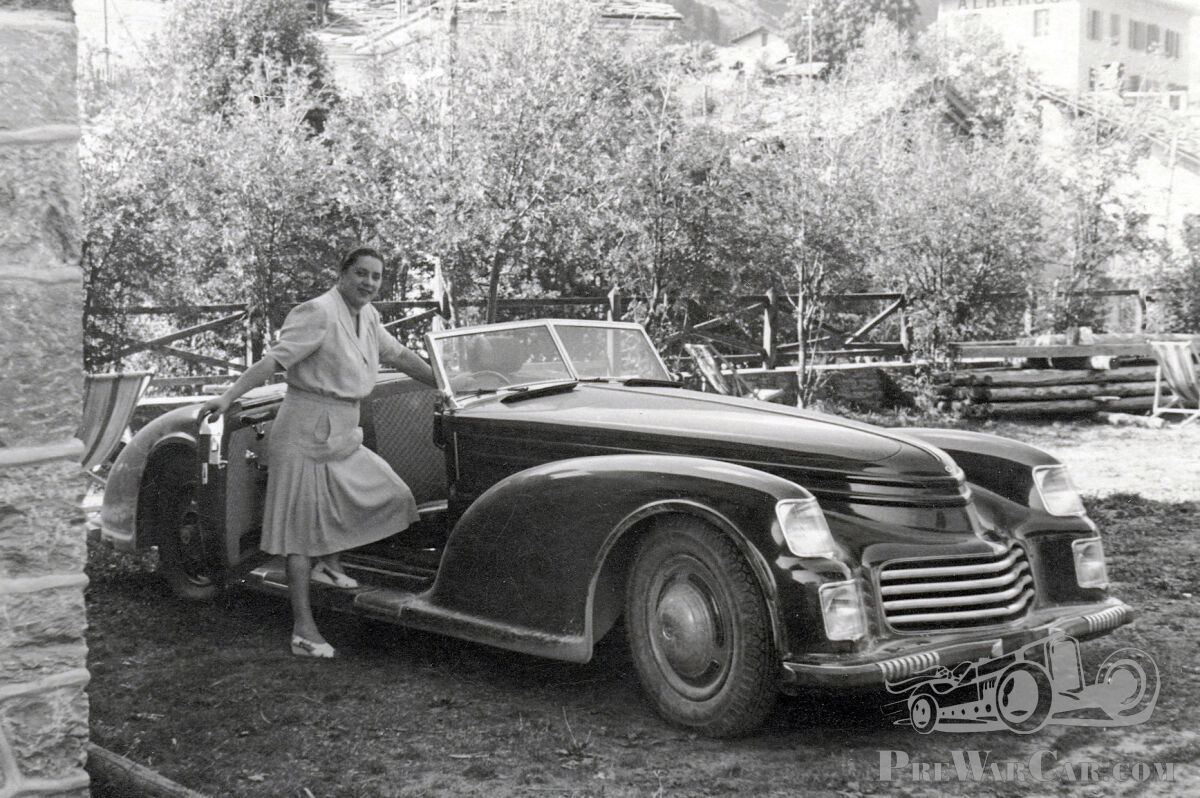

Yes, we realise the car here is more likely to date back to post-war rather then pre-war days, or its body at least. However, we have been racking our brains to the extreme and still don’t know what this curiosity and its coachbuilder could have been. The desire to find out what it is is nagging away at us, and we would very glad if someone could relieve us of our pain.
First of all, this has to be the experimental vision of an Italian designer straight after the Second World War. After the typical pre-war look of separate wings topped with round headlights, long running boards with spare wheels on both sides and upright chrome grilles, Italy's master stylists were looking for something completely different and came up with all sorts of ideas, many of them featuring pontoon shapes with integrated wings, lights and what have you. They were looking to find new shapes well before America started to influence styling trends with tail fins and tons of chrome.
If we were to make a bet, we’d say the base is likely to be an Alfa Romeo 6C 2500 or a Lancia Aprilia. There are some early post-war examples of both models with rather outrageous body styles, but it’s hard to pin this one to one particular carrozzeria. Stabilimenti Farina did some 6Cs and Aprilias with futuristic-looking wide fronts with horizontal lines all over them. There are also a few Bertone and Monviso cars with similar faces. Ghia was no exception, either—its portfolio includes a 6C with its still-round headlights hidden in integrated square housings. A new brand name for 1946 was Meteor, which was applied to a Fiat 1100-based convertible. That looked suspiciously like a scaled-down version of Ghia's Alfa 6C, including the square-cased headlights.
Looking further, perhaps we see the work of a young Giovanni Michelotti? He designed some Speciales for Farina with equally blunt fronts ánd square headlights, including an open and a closed Aprilia ‘tank’.
We can’t decide. All the cars we can find never have the double headlights in such an unusual arrangement as this one, but still we have a feeling we have seen this style somewhere before. Help!
Words: Jeroen Booij; picture; source unknown
Pubblicato:
venerdì aprile 12th, 2024
Facebook
LinkedIn
Twitter
WhatsApp
Email
Copy
Commenti
Jeroen Booij
18 Aprile 2024, 10:02
Marco Francesco Makaus
14 Aprile 2024, 10:27
I was ready to write exactly what Herr Bauer wrote... Obviously, I am not the only one lucky enough to have a copy of Tito Anselmi's or the Morlacchi-Salvetti 6C 2500 books!
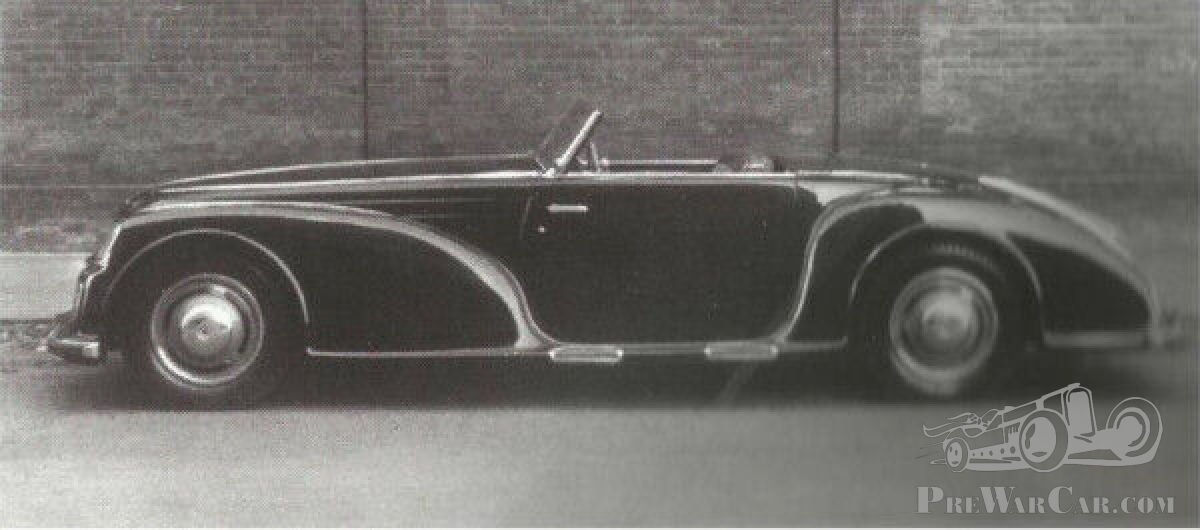
Apparently, even Revelli and Farina could have an off-day. But to be fair, that was when two big changes were taking place: the fusion of the wings on the sides of the body, and the research of a new look for the front of Alfa Romeos: the shield we now know and love was about to be born and many experiments were made by all coachbuilders.
The car had a very complex history as the long-wheelbase chassis had to be modified to match the dashboard, which was moved to the back. It was ready in 1942 and had to be hidden during the war. It was extremely luxurious with the upholstery in autharchic (i.e. made with whatever material they could find in wartime Italy) fabric, and the windshield could be bent forwards in two parts, like on an Astura Bocca.
To our twenty-first century eyes it doesn't look too good—it reminds me of that six-wheeled aberration made for a fantasy picture a few years ago...
Per saperne di più
Apparently, even Revelli and Farina could have an off-day. But to be fair, that was when two big changes were taking place: the fusion of the wings on the sides of the body, and the research of a new look for the front of Alfa Romeos: the shield we now know and love was about to be born and many experiments were made by all coachbuilders.
The car had a very complex history as the long-wheelbase chassis had to be modified to match the dashboard, which was moved to the back. It was ready in 1942 and had to be hidden during the war. It was extremely luxurious with the upholstery in autharchic (i.e. made with whatever material they could find in wartime Italy) fabric, and the windshield could be bent forwards in two parts, like on an Astura Bocca.
To our twenty-first century eyes it doesn't look too good—it reminds me of that six-wheeled aberration made for a fantasy picture a few years ago...
Hergen Deuter
12 Aprile 2024, 23:31
I agree that this should be the St. Farina-built Alfa Romeo 6C 2500 designed by Mario Revelli di Beaumont.
Per saperne di più
Wilfried Brunner
12 Aprile 2024, 16:26
Hi, I think this special is much bigger than a Lancia Aprilia, and the 6C Alfas would have been rare cars for a base. It may be a Fiat 2800 chassis. The Fiat had a wheelbase of 3,000 mm or 3,200 mm, artillery wheels like this one at rear, and a 2.8-litre six-cylinder engine. The wheels are big, maybe 17 or 18-inch. These Fiats also existed as Kommandocars during the Second World War.
Per saperne di più
Alfred Bauer
12 Aprile 2024, 15:37
Well, I guess this must be #913018, an Alfa Romeo 6C 2500 Turismo on a 3.20 m wheelbase, built by Stabilimenti Farina in 1939 to a design by Mario Revelli for his brother-in-law Michele Ansaldi. While many people think that this is a grotesque design, I personally always liked it. It has a folding windscreen and built-in luggage. The interior is almost Art Déco. Anyway, a very individual design and certainly not in line with the common taste.
Two pages of pictures can be found in the excellent book of Fabio Morlacchi- and Stefano Salvetti (Alfa Romeo 6C 2300-6C 2500)
Per saperne di più
Two pages of pictures can be found in the excellent book of Fabio Morlacchi- and Stefano Salvetti (Alfa Romeo 6C 2300-6C 2500)
Thank you, gentlemen!