La rivista e il marketplace globale per gli appassionati di auto d’epoca, creati da appassionati.





Il mercato; tutte le auto prebelliche in vendita
Panoramica degli annunci correlati all'annuncio Bugatti T22
-

Brough Superior Overhead 680 1928 for sale
This Overhead 680 was originally sold in Harrogate, Yorkshire and has remained in that county all its life, enjoying only four owners from new. The machine is described as being in ‘fair-to-good’ overall condition but has been kept in storage since undergoing restoration 12 years ago and thus will need re-commissioning and the customary safety .. -
Austin Seven Chummy 2-door Tourer 1927 for sale
This 4-Seater Chummy was manufactured at Austin’s Longbridge factory 15 July 1927. During what might have been a final journey to a breaker’s yard in the 1950s. While still complete and largely original on acquisition, sensitively applied refurbishment carried out during the last year has included repainting the bodywork in Kingfisher Blue, tri.. -
Hispano-Suiza H6B 7.2hp 6.6-litre Coupe de Ville by J Saoutchik 1924 for sale
BS 9588 is undoubtedly one of the most original surviving Hispano-Suizas with formal coachwork. J Saoutchik of 46 Rue Jacques Dulud, of Neuilly in Paris, were the favoured coachbuilders for this chassis, the quintessentially French Coupé de Ville coachwork demonstrating that the original owner spared no expense in the specification dictated to J S.. -
Aston Martin International 2/4 ,1 1/2 Litre Sports Tourer 1930 for sale
The ‘matching numbers’ International had remained in highly original condition and great pains were taken to preserve this originality during restoration. Still containing its original crankshaft, the engine was fully stripped and rebuilt. An exceptionally well presented motor car, meticulously restored by father and son International specialis.. -
Rolls-Royce Springfield New Phantom Piccadilly Roadster 1927 for sale
Finished in black with red leather upholstery, including the rumble seat, the car features imposing dual side-mount spare wheels, mahogany running boards, and correct drum headlamps, tubular bumpers, period trunk and triple lamp rear light. Paintwork, interior and the cloth-covered top bows are in excellent order, while all instruments are correct .. -
Rolls-Royce Phantom I, 40/50 HP Cabriolet 1928 for sale
Phantom I chassis number ‘94FH’ was originally delivered with ‘faux cabriolet’ coachwork by Thrupp & Maberly to first owner, one A J Newberry.Restored at date unknown, the car is currently fitted with a Barker-style cabriolet body while other noteworthy features include twin Grebel lights and an additional ‘emergency’ horn. We are a.. -
Bugatti 30 Tourer by Lavocat et Marsaud 1926 for sale
The car offered here – chassis number ‘4724’ – is one of only two known surviving examples of the Type 30 bodied by favoured coachbuilders Lavocat et Marsaud. According to factory sales records, ‘4724’ was produced in December 1925, invoiced to Dubuisson, of St Quentin, near Lille, presumably the local Bugatti agent, and delivered on 28.. -
Wolseley 16/20 HP Five Seat Tourer 1919 for sale
This Wolseley dates from those immediate post-war years and is most handsomely presented in dark green livery with black wings and Rudge-Whitworth wire wheels, the mahogany door cappings adding a pleasing Edwardian flavour. It is equipped with a two-piece, folding, mahogany-framed windscreen and further weather protection is afforded by a beige hoo.. -
Lancia Dilambda Tourer 1930 for sale
Unlike its revolutionary Lambda V4 predecessor, the Dilambda did not use a stress-bearing body but reverted to a separate chassis. A new design, the latter possessed exceptional torsional rigidity, a virtue necessitated by its independent front suspension. Narrow-angle vee-configuration engines were a Lancia speciality, the Dilambda’s 3,960cc ove.. -
Rolls-Royce 20 HP Tourer 1929 for sale
‘This model was introduced to meet requests for a smaller, less expensive car in keeping with the trend after the First World War towards smaller cars for a wider market. Construction was simplified - but standards of workmanship were not compromised.’ - Edward Eves, Rolls-Royce, 75 Years of Motoring Excellence. Chassis number ‘GVO45’ was d..



In primo piano
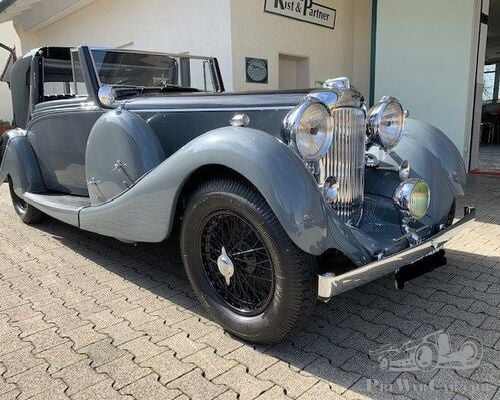
Lagonda LG 45 Coupe de Ville Sedanca di Mayfair
Successore della M45, la LG45 venne sviluppata attorno allo stesso eccellente sei cilindri in linea Meadows da 4,5 litri, già ampiamente collaudato..

wanted 1923 Peugeot 163 br worm drive differential and torque tube
Hi, I'm looking to buy a worm drive differential and torque tube for a 1923 Peugeot 163 br also a windscreen frame, my car is a roadster cabriolet..

Cercasi motore S.P.A da 6 litri
Desidero acquistare un motore S.P.A. a 4 cilindri da 6 litri, con alesaggio/corsa 110x160. Sono interessato anche ad altri ricambi SPA (Società Pie..