La rivista e il marketplace globale per gli appassionati di auto d’epoca, creati da appassionati.





Il mercato; tutte le auto prebelliche in vendita
Panoramica degli annunci correlati all'annuncio 1935 Ford Pickup
-

Ford Model A Roadster Deluxe 1931
Lovely Roadster in a beautiful / attractive color combination,Nice accessoires like: dual side mounted spare wheels, wind wings , a trunk , stone quad and step platesBody off restored around 20 years ago in DenmarkEuropean car with Kilometer speedometerIn good running order.With trafficators and warn lightsDan.. -
1925 Ford Model T Torpédo | Selections from the Mullin Collection Auction | Gooding & Company | April 26, 2024
As the automobile that firmly put North America on wheels, Henry Ford’s Model T stands proudly as one of the most versatile and historically important motor vehicles ever built with over 15 million units being sold over the production run. The Ford Model T on offer here was previously part of the Schlumpf Reserve Collection. A copy of a .. -
1937 Bugatti Type 57 Galibier | Selections from the Mullin Collection Auction | Gooding & Company | April 26, 2024
Introduced in 1934, the Type 57 is widely regarded as a masterpiece by the hand of Jean Bugatti. The successor to the popular Type 49, the new Bugatti was powered by a jewel-like 3.3-liter twin-cam, straight-eight engine and represented the ultimate in automotive design. Like all Bugattis that preceded it, the Type 57 handled with finesse and po.. -
1932 Delage D8S Cabriolet | Selections from the Mullin Collection Auction | Gooding & Company | April 26, 2024
An engineer by trade, Pierre Louis Delage began building automobiles in 1905, in Levallois, outside Paris; their quality of construction and stylish designs allowed the company to gain popularity quickly. Always pursuing innovation through competition, four-, six-, and finally eight-cylinder Delage engines were produced for the cars over the ens.. -
1937 Delahaye Type 135M Competition Court Chassis | Selections from the Mullin Collection Auction | Gooding & Company | April 26, 2024
The talk of the 1936 Paris Auto Salon was unquestionably the spectacular 135M Torpédo Cabriolet bodied by Figoni et Falaschi. It featured bold pontoon fenders that enveloped the wheels, with curves that dazzled the senses, and was displayed on a raised, circular rotating plinth on Delahaye’s show stand. This car’s fold-flat windscreen, cut-down .. -
1938 Citroen 11CV Traction Avant 'Challenger' Roadster | Selections from the Mullin Collection Auction | Gooding & Company | April 26, 2024
Designed by André Lefèbvre and developed in just 18 months, the Citroën Traction Avant debuted at the October 1934 Paris Motor Show and saw production, interrupted by WWII, across several variants to the mid-1950s. The world’s first mass-produced, front-wheel-drive automobile with steel monocoque construction, the Traction Avant was an engineeri.. -
1939 Peugeot 202 Berline | Selections from the Mullin Collection Auction | Gooding & Company | April 26, 2024
At the 1937 Paris Auto Salon, Peugeot staged a massive “referendum” among attendees to better understand what the public demanded from a contemporary motorcar, marking one of the earliest examples of an automotive manufacturer conducting market research. Many of their findings were incorporated in the all-new model 202, which formally debuted in.. -
1931 Bugatti Type 40A Roadster | Selections from the Mullin Collection Auction | Gooding & Company | April 26, 2024
Replacing the Brescia as Bugatti’s new four-cylinder road car in 1926, the successful Type 40 was known for its sporty designs and nimble handling characteristics, and about 750 examples were built. The model provided the first opportunity for Jean Bugatti’s talents to be put on full display as he began to succeed his father, Ettore. This smalle.. -
1938 Avions Voisin Type C30 Cabriolet | Selections from the Mullin Collection Auction | Gooding & Company | April 26, 2024
The 1938 introduction of the Voisin Type C30 in stylish coupe and cabriolet form would prove to be the marque’s final appearance at the Paris Motor Show, and indeed the last Voisin cars produced. In this final iteration of cars bearing the Voisin name, they received a 3.5-liter Graham-Paige engine with a centrifugal supercharger, and a Graham dr.. -
1931 Peugeot P 107 S 'Tour de France' | Selections from the Mullin Collection Auction | Gooding & Company | April 26, 2024
In 1926, Peugeot reorganized its two-wheeled operations to be autonomous from its automobile business, creating La Nouvelle Société des Cycles Peugeot, grouping together all motorcycle and bicycle production in one entity. At the start of the 1930s, Peugeot’s range included several well-received models. The modest 350 cc P 107, populari..



In primo piano
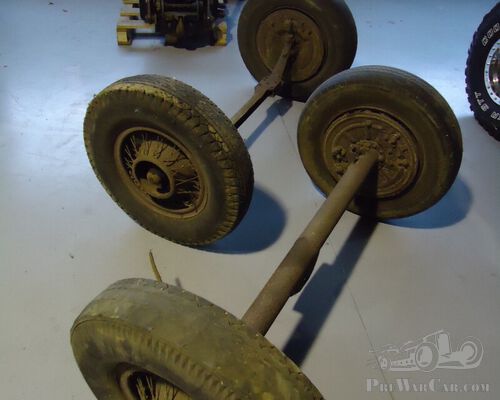
Assali Horch (anteriore e posteriore)
Ruote e assali Horch originali, provenienti da una Horch 780 del 1932. Completi di assale anteriore, fusi a snodo e quattro tamburi dei freni.
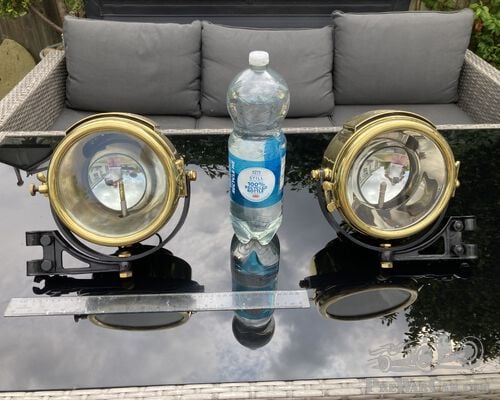
Set completo di fanali in ottone Willocq & Bottin
Fari anteriori di grandi dimensioni e 2 proiettori orientabili montati su giunto cardanico 2 serbatoi di acetilene da montare sulle pedane
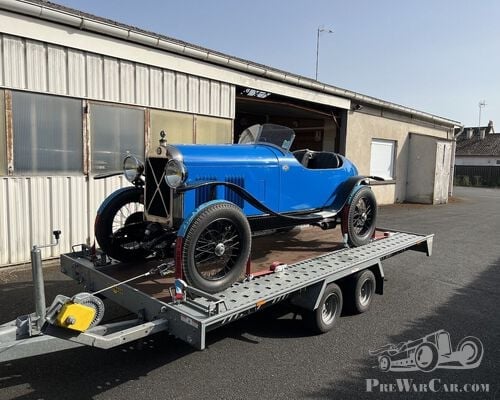
Salmson VAL 3 Séries 7
Salmson VAL3 Serie 7 del 1927. Completamente restaurata alcuni anni fa, in ottime condizioni generali, sia di carrozzeria che di meccanica. Carrozz..