La rivista e il marketplace globale per gli appassionati di auto d’epoca, creati da appassionati.




Il mercato; tutte le auto prebelliche in vendita
Panoramica degli annunci correlati all'annuncio 1929 Rolls Royce Phantom II Saloon by Mulliner
-

Invicta 4,5 l High Chassis Tourer 1928
The Invicta 4,5 ltr. was in 1928, when it was introduced, the best accelerating serial-production car worldwide. It needed only 15 sec to 100 km/h! Mentionable is also that in the same time it was possible to accelerate from 15 to 100 km/h, without changing gears! In 1928 an unbelievable speed! This records were reasoned by its light weight body in.. -
Rolls Royce Silver Ghost \"Salamanca\" 1921
This Rolls-Royce Silver Ghost was first delivered to the Belgian S. Jaquet. From the 30th the car was domiciled in the US and at the beginning of the 70th the vehicle came back to England. Since 2008 it was in the hands of a German enthusiast. Due to the Chassis Card available, old registration, invoices and Information from the Rolls-Royce Club, t.. -
Delahaye Type 97 1925
This four cylinder superb overhead cam engined Delahaye rolling chassis has been restored to a very high standard indeed and is only for sale at this stage in its rebuild because the owner has decided to reduce his car collection to a more manageable level. If you click on the website link on this page you can see around 350 photographs which rec.. -
Le Zèbre Type D Tourer 1919
Towards the end of the first decade of the 20th Century, most French car manufacturers were adding cylinders; however Le Zebre favoured a small 600 cc 5hp model that proved extremely popular in spite of having only one cylinder. Not until 1912 did a 4-cylinder Le Zebre appear. This was a 950 cc engine coupled to a three-speed gearbox. This rare Fre.. -
Delage DE Tourer 1922
The Delage type DE was produced between 1921 and 1923 featuring a 4-cylinder side-valve 2.1 litre engine. The transmission was mated to a four-speed gearbox and it incorporated an innovative multi-plate clutch mechanism. The chassis had 4-wheel brakes with Perrot-shaft linkage. In total 3,600 examples were manufactured and the Delage Club records s.. -
Swift 2P Two seater and dickie 1928
Swift’s early cars ranged from a single-cylinder car in 1900, through a twin-cylinder 7 hp light car in 1904 and then to a three litre model in 1913. During the 1920s the range of cars was simplified; the excellent 1,100 cc 10 continued and it was joined by a two litre 12 with a four-speed gearbox. A new 10 was launched in 1923 as the Q type with c.. -
Morris Model G Taxi 1928
This is the only known survivor of a total production run of 840 cabs. Back in 1926 Morris decided he would offer an export model car to boost overseas sales. The Morris Oxford was scaled up until it fitted a modified 13 cwt lorry chassis and running gear. 1,700 were built and offered for sale around the world as the Empire Oxford but unfortunately.. -
Austin 7 Gordon England Cup 1928
Gordon England became involved with the Austin Seven as a racing driver, and he designed the 'Cup' two seater as a more robust and roomy car than the standard 'Brooklands' model, and named it after his success in the Georges Boillot Cup Race at Boulogne in 1925. After initially being manufactured by Weymann, the stylish coachwork became so popu.. -
Austin 7 Swallow Saloon 1930
In 1927 William Lyons co-founder of the Swallow Sidecar Company, saw the commercial potential of producing a re-bodied Austin 7. He purchased a chassis from dealers Parkers of Bolton and employed Swallow’s talented coachbuilder Cyril Holland to produce an open tourer with a distinctive two tone colour scheme. The car proved popular and it was follo.. -
Ford Model T Model T Roadster 1926 SOLD
This is a very rare opportunity to grab one of the more sort after model T's. Barn fresh, dry stored for the last 40 years. Engine turns over and has great compression . Has had some body repairs done in the usual places , will need doing again. Wheels are in excellent condition , tyres hold air. Is fully uk registered with a V5c. Will need going..





In primo piano
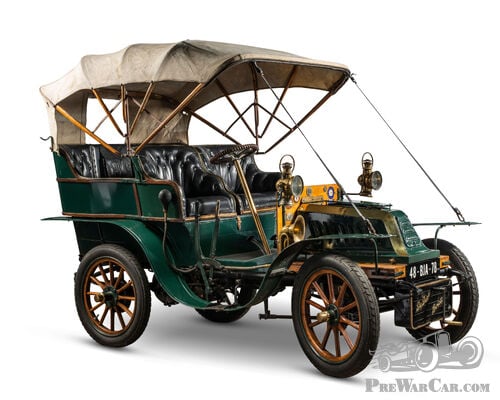
De Dion Bouton Type z in good running condition
De Dion Bouton Type Z from 1905. The car is in good condition, works and runs well. Serie number 36. Engine number 18190. French Carte grise.
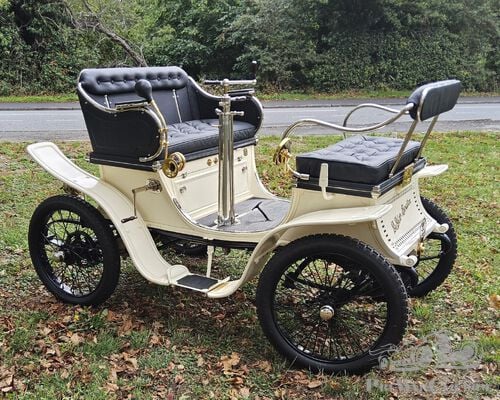
1902 De Dion Bouton Vis-a Vis 4.5 H.P. Reg No. Y123 V.C.C. Cert No. 1649
1902 De Dion Bouton Vis-à-vis 4.5 H.P.Reg. No. Y132 V.C.C. Cert No. 1649Beautifully presented and completely restored following an ex..
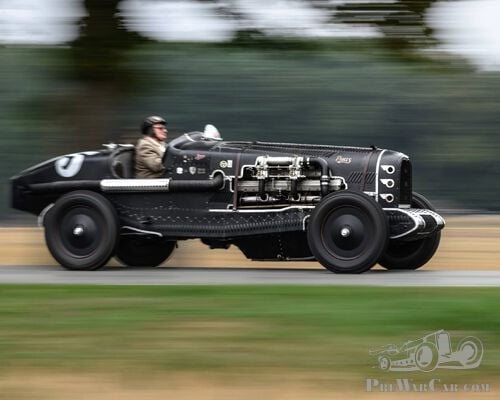
Delage DI, 1924, IL DRAGO RUGGENTE, one of few cars with an Aircraft engine and with war history.
A COLLECTOR'S OPPORTUNITY ONE-OFF. HAND-BUILT. UNREPEATABLE.A MACHINE WITH NO COMPARISONThere are special cars, there are racing cars..