La rivista e il marketplace globale per gli appassionati di auto d’epoca, creati da appassionati.
La rivista e il marketplace globale per gli appassionati di auto d’epoca, creati da appassionati.


Filter
Faccia la sua scelta
- Automobile
-
Marca >>
-
Anno >>
-
- Motociclette
-
Ubicazione >>
- Parti e altro
-
Marca dell'auto >>
-
Produttore >>
-
Categoria >>
- Biciclette
-
Anno >>
-
Paesi


Broken down in Bristol? Help is at hand...


Breaking down is never any fun at the best of times, but for classic motorists it can be especially frustrating. After all, we've all heard stories about the AA men who have turned up after two hours of waiting, only to be completely flummoxed by the idea of points and condensers. If only there was a dedicated breakdown service specialising in historic vehicles...
For the time being, there isn't, but we can always dream and think about what vehicles such a service might keep in its fleet. Fordsons, Commers, Leylands, Dennises and Bedfords would all be sensible candidates, but so too would any decent-sized passenger car of, say, 16hp or more. After all, half the garages in the country in the 1930s were rescuing stranded motorists with old Rolls-Royces which had had their back halves chopped off and replaced with a crane. That would make for a very interesting sight today.
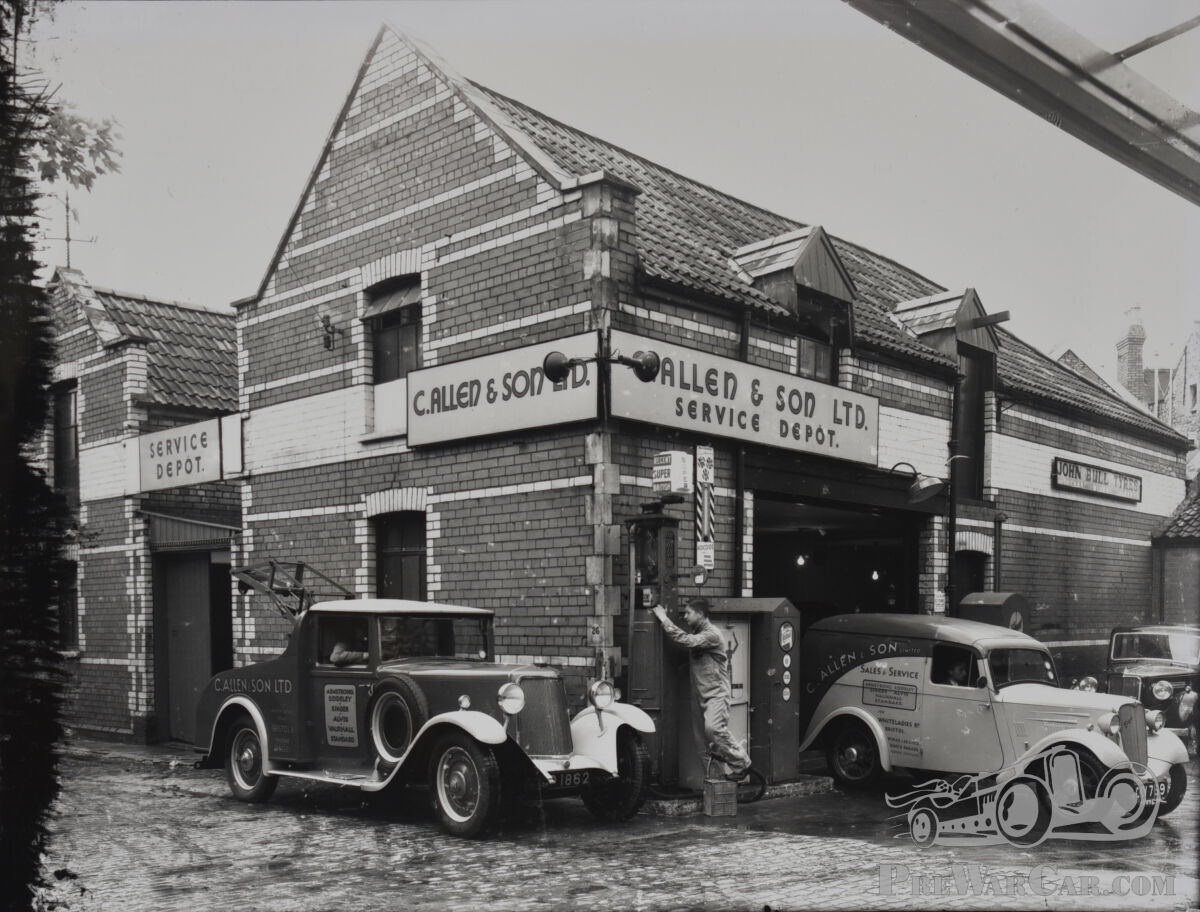
Let's have a look at the fleets of the two garages we see here, both of which are in the city of Bristol. We see the address of C. Allen & Son given as 199 Whiteladies Road, but in fact the building in question is the works and service building on King's Parade, about 350 yards away. Half of it, unfortunately, is no longer standing. C. Allen was responsible for sales of Armstrong Siddeley, Singer, Alvis, Vauxhall and Standard, which explains the vehicles we see in the photograph.
The recovery vehicle is a large Armstrong Siddeley of some description, and appears to have been bodied to an unusually handsome and professional-looking standard, which is more than can be said for other car-derived conversions. With Allen being an Armstrong Siddeley agent, we think it likely that it was built as a recovery lorry from new, rather than being a rebodied saloon. The little van is a Singer Bantam, and very attractive it looks with its stylish 1930s paint scheme, although it is a pity that paint divide doesn't quite align with the top of the door, or else it could simulate the appearance in profile of an airline coupé. The car in the background is a late 1930s Armstrong Siddeley 14 or 16.
Just as car design changed enormously between the 19th century and the 1930s, so too did architecture. What a contrast we see with the Cathedral Garage at College Green, with its rather austere and minimalist æsthetic. While C. Allen had a prettier building, the Cathedral Garage at least had the advantage of being a purpose-built garage, whereas Allen's building probably originated as a carriage works, livery stable or a general engineering shop.
There's a distinct Rootes theme going on, with all the vehicles being Commers of one sort or another. The two vans are Commer 8cwts, to all intents and purposes just Hillman Minx vans, the one on the left being from the 1936 and the other a 1937-39 model. The bigger one, of course, is Commer through and through and intriguingly sports a sign reading 'Cathedral Garage Ambulance'.
We hope you enjoyed that trip down memory lane. Until our fantasy breakdown fleet becomes a reality, let us wish you many miles of happy, breakdown-free motoring.
Words: Zack Stiling; photographs: Stiling Collection
Pubblicato:
martedì luglio 18th, 2023
Facebook
LinkedIn
Twitter
WhatsApp
Email
Copy
Commenti
Peter Maguire
08 Agosto 2023, 11:26
David Grimstead
24 Luglio 2023, 15:55
C. Allen and Son Ltd started as a Taunton metal-casting, fabricating and general engineering business established c.1796. From then until perhaps WWII, it offered a broad catalogue of transport, agricultural and municipal metalwork.
A 1940s obituary of MD Arthur Clifford Allen said that as early as 1900 their foundry had set up a separate division, “The Chassis Construction Company” (C.C.C.), to “make” car chassis and sell them to local coachbuilders but it seems only to have bought in French chassis and engines, the former of a make only available after 1902. One known customer for chassis parts was the nearby Taunton-based, Bridgewater Motor Company.
Complete C. C. C. cars were reportedly only made in 1906 and 1907, how many unknown but at the 1906 Cordingly Show in Islington, C.C.C. displayed two Malicet et Blin chassis with 20 h.p. and 30 h.p. Ballot engines, Hele-Shaw’s new multi-disc clutches and live axles, the 30 h.p. also available with chain drive; they were “well finished and moderately priced.” An 18-22 h.p. C.C.C car competed in the June 1907s Irish trial, driven by Mr. A. R. Armitage who was associated with the C.C.C. business and was the Chairman of the Somerset Automobile Club. He achieved top marks and was 3rd and 4th in the two hill-climb sections.
The Allen family had owned an 8 h.p. Di Dion in 1904 and ran it in the 1905 Taunton carnival parade. In 1906, C. Allen and Son were listed by the Gladiator Company of 8-9 Long Acre, London as an agent for their 12 h.p. and 24-32 h.p. landaulette models and were named as the official repairers for the Somerset Automobile Club and the Automobile Club of Great Britain. By 1908, their premises at Tone Bridge, Taunton was often referred to as a motor garage and “Tone Bridge Motor Works”, was awarded the Automobile Club’s rare “Special Repairs Certificate” in 1910. General foundry work remained a priority and even in 1914 they advertised themselves as “Automobile and General Engineers and Ironfounders, Tone Bridge Foundry”. Much war work on munitions and agricultural food production was taken on.
Although the foundry continued, the company was fully into garage operations at Tone Bridge by 1920. They were agents for General Motor’s Chevrolets, Buicks and Oaklands for much of that decade. These arrived in knocked-down form and were built up on the premises. By 1924 they had opened a garage at 16 Tavistock Road, Plymouth, which became the regional Armstrong Siddeley service depot, at 105 Tavistock Road by 1927 a Chevrolet commercials depot and shortly premises at Park Street, Plymouth, before opening at 159 Whiteladies Road, Bristol in 1929. There for 1930 they were promoting Armstrong Siddeleys and in that decade were official stockists of Vauxhall, Austin, Morris, Singer and Standard, plus Bedford Trucks. Post-WWII, Standard was a prominent marque but servicing and spares for all their pre-war models were advertised.
A sales address for Bristol became Berkeley Square in 1948 and in the 1950s also “top of Park Street”, where new Fords were sold. The Berkeley premises was joined by one on Blackboy Hill and a new one ex-Taylors near the cinema in Whiteladies Road in 1960 when new Armstrong Siddeleys and Singers were for sale. Disc-braked Triumph Heralds were for sale in 1962 and Singer Chamois at Berkeley Square in 1966 but the business ceased advertising by 1973.
The Cathedral Garage business was not as old as C. Allen’s but with its proprietors starting Edwardian car businesses, it became one of the biggest in Bristol. Howard Stephens was a local pioneer motorist said to have started in Rupert Street but he had a garage on St. George’s Road, College Green by 1913, selling a wide range of second-hand cars and held agencies at Berkeley Avenue, Park Street for Swift, Siddeley-Deasey, Hupmobile and Standard.
His business partner to be, Mr. F. G. Cox, opened a garage in 1905 in Perry Street, Bristol where he lived above his workshop. Cox was a successful competitor in local motoring events in his Morgan Runabout, winning the only Gold Medal in the 1914 Bristol-Land’s End-Bristol Trial. He was an agent for Ford, Morgan, Trumbull and more in 1915 and was selling Cubitt cars from the Colston Garage, Colston Street in 1919. In that year he and Stephens joined there and at Berkeley Avenue, top of Park Street while a larger garage was being built for them on more land the two had obtained between St. George’s Road and Anchor Street. They moved into their newly constructed and named Cathedral Garage in 1923.
At first advertised by “F. G. Cox and Co. with Howard Stephens Ltd.” it held agencies for Armstrong Siddeley, Standard and Lagonda but also advertised a wide range of second-hand cars, motorcycles, combinations and commercials. It became Cox and Stephens Ltd., Cathedral Garage during 1924 and was a Hillman agency during the later 1920s. At the beginning of the 1930s, agents for Standard cars, Cathedral sold over 600 in 1932. Taking on more Rootes products, Commer commercials appeared mid-1930s and Humber was added in 1939.
The garage had a 265-foot frontage and two floors with pillarless roof span on St. George’s Road and by the end of the 1920s employed 100 staff. It was progressively enlarged to Anchor Road behind, which gave it extensive covered workspace and access there. In 1939 a £100,000 expansion to four acres was completed, including a new Anchor Road showroom. The business survived WWII, the '50s, '60s and '70s, and was still advertising up to 1988 when it became Swan National Motors.
From the 1920s Cathedral maintained a fleet of rescue and recovery vehicles, including what they described in 1928 as a “breakdown motor ambulance”, a tow-truck “equipped to deal with every kind of smash-up.” In the photo these may be parked outside the later Anchor Road buildings that opened onto College Road.
Armstrong Siddeley may connect these two garages. During the 1920s A-S advertised its “Bristol Service Depot, Anchor Road, Lower College Green”, then in the 1930s its service depot was at Greville Road, North Street, Bedminster, Bristol, which appeared on C. Allen’s adverts and when A-S closed that in September 1932 C. Allen’s 26-28 Kings Parade Avenue depot took over, start-dating that photo.
Per saperne di più
A 1940s obituary of MD Arthur Clifford Allen said that as early as 1900 their foundry had set up a separate division, “The Chassis Construction Company” (C.C.C.), to “make” car chassis and sell them to local coachbuilders but it seems only to have bought in French chassis and engines, the former of a make only available after 1902. One known customer for chassis parts was the nearby Taunton-based, Bridgewater Motor Company.
Complete C. C. C. cars were reportedly only made in 1906 and 1907, how many unknown but at the 1906 Cordingly Show in Islington, C.C.C. displayed two Malicet et Blin chassis with 20 h.p. and 30 h.p. Ballot engines, Hele-Shaw’s new multi-disc clutches and live axles, the 30 h.p. also available with chain drive; they were “well finished and moderately priced.” An 18-22 h.p. C.C.C car competed in the June 1907s Irish trial, driven by Mr. A. R. Armitage who was associated with the C.C.C. business and was the Chairman of the Somerset Automobile Club. He achieved top marks and was 3rd and 4th in the two hill-climb sections.
The Allen family had owned an 8 h.p. Di Dion in 1904 and ran it in the 1905 Taunton carnival parade. In 1906, C. Allen and Son were listed by the Gladiator Company of 8-9 Long Acre, London as an agent for their 12 h.p. and 24-32 h.p. landaulette models and were named as the official repairers for the Somerset Automobile Club and the Automobile Club of Great Britain. By 1908, their premises at Tone Bridge, Taunton was often referred to as a motor garage and “Tone Bridge Motor Works”, was awarded the Automobile Club’s rare “Special Repairs Certificate” in 1910. General foundry work remained a priority and even in 1914 they advertised themselves as “Automobile and General Engineers and Ironfounders, Tone Bridge Foundry”. Much war work on munitions and agricultural food production was taken on.
Although the foundry continued, the company was fully into garage operations at Tone Bridge by 1920. They were agents for General Motor’s Chevrolets, Buicks and Oaklands for much of that decade. These arrived in knocked-down form and were built up on the premises. By 1924 they had opened a garage at 16 Tavistock Road, Plymouth, which became the regional Armstrong Siddeley service depot, at 105 Tavistock Road by 1927 a Chevrolet commercials depot and shortly premises at Park Street, Plymouth, before opening at 159 Whiteladies Road, Bristol in 1929. There for 1930 they were promoting Armstrong Siddeleys and in that decade were official stockists of Vauxhall, Austin, Morris, Singer and Standard, plus Bedford Trucks. Post-WWII, Standard was a prominent marque but servicing and spares for all their pre-war models were advertised.
A sales address for Bristol became Berkeley Square in 1948 and in the 1950s also “top of Park Street”, where new Fords were sold. The Berkeley premises was joined by one on Blackboy Hill and a new one ex-Taylors near the cinema in Whiteladies Road in 1960 when new Armstrong Siddeleys and Singers were for sale. Disc-braked Triumph Heralds were for sale in 1962 and Singer Chamois at Berkeley Square in 1966 but the business ceased advertising by 1973.
The Cathedral Garage business was not as old as C. Allen’s but with its proprietors starting Edwardian car businesses, it became one of the biggest in Bristol. Howard Stephens was a local pioneer motorist said to have started in Rupert Street but he had a garage on St. George’s Road, College Green by 1913, selling a wide range of second-hand cars and held agencies at Berkeley Avenue, Park Street for Swift, Siddeley-Deasey, Hupmobile and Standard.
His business partner to be, Mr. F. G. Cox, opened a garage in 1905 in Perry Street, Bristol where he lived above his workshop. Cox was a successful competitor in local motoring events in his Morgan Runabout, winning the only Gold Medal in the 1914 Bristol-Land’s End-Bristol Trial. He was an agent for Ford, Morgan, Trumbull and more in 1915 and was selling Cubitt cars from the Colston Garage, Colston Street in 1919. In that year he and Stephens joined there and at Berkeley Avenue, top of Park Street while a larger garage was being built for them on more land the two had obtained between St. George’s Road and Anchor Street. They moved into their newly constructed and named Cathedral Garage in 1923.
At first advertised by “F. G. Cox and Co. with Howard Stephens Ltd.” it held agencies for Armstrong Siddeley, Standard and Lagonda but also advertised a wide range of second-hand cars, motorcycles, combinations and commercials. It became Cox and Stephens Ltd., Cathedral Garage during 1924 and was a Hillman agency during the later 1920s. At the beginning of the 1930s, agents for Standard cars, Cathedral sold over 600 in 1932. Taking on more Rootes products, Commer commercials appeared mid-1930s and Humber was added in 1939.
The garage had a 265-foot frontage and two floors with pillarless roof span on St. George’s Road and by the end of the 1920s employed 100 staff. It was progressively enlarged to Anchor Road behind, which gave it extensive covered workspace and access there. In 1939 a £100,000 expansion to four acres was completed, including a new Anchor Road showroom. The business survived WWII, the '50s, '60s and '70s, and was still advertising up to 1988 when it became Swan National Motors.
From the 1920s Cathedral maintained a fleet of rescue and recovery vehicles, including what they described in 1928 as a “breakdown motor ambulance”, a tow-truck “equipped to deal with every kind of smash-up.” In the photo these may be parked outside the later Anchor Road buildings that opened onto College Road.
Armstrong Siddeley may connect these two garages. During the 1920s A-S advertised its “Bristol Service Depot, Anchor Road, Lower College Green”, then in the 1930s its service depot was at Greville Road, North Street, Bedminster, Bristol, which appeared on C. Allen’s adverts and when A-S closed that in September 1932 C. Allen’s 26-28 Kings Parade Avenue depot took over, start-dating that photo.
Nick Simpson
25 Luglio 2023, 13:12
David Grimstead’s piece on Bristol and West Country car dealers and the mention of Whiteladies Road caught my eye. The Bristol and West Country area of the U.K. appears to have had its share of innovative engineers in its day!
There was the Straker-Squire car engineered by Roy Fedden (of Bristol aero engines fame) who also backed the unsuccessful Fedden car. There were Bristol cars and buses, the Brabazon aircraft, Rolls-Royce aero engines and Concorde, to mention a few. Further west there were Donald Healey and Harry Weslake from Cornwall….
In particular I am researching Jim Bosisto, also of Bristol who constructed a most unusual and exotic cabriolet on an Alvis Fourteen (TA14) chassis in 1948. He had teamed up with Dick Caesar, Joe Fry and Malcolm Sayer (later of Jaguar) to form the Gordano Car Company which was located at Whiteladies Road in Bristol. They constructed replacement coachwork and 500cc racing ‘specials’ (Iota and Arengo) and the Gordano Sports Car in the immediate post-war period.
I would be interested to make contact with David Grimstead to compare notes.
Nick Simpson.
Per saperne di più
There was the Straker-Squire car engineered by Roy Fedden (of Bristol aero engines fame) who also backed the unsuccessful Fedden car. There were Bristol cars and buses, the Brabazon aircraft, Rolls-Royce aero engines and Concorde, to mention a few. Further west there were Donald Healey and Harry Weslake from Cornwall….
In particular I am researching Jim Bosisto, also of Bristol who constructed a most unusual and exotic cabriolet on an Alvis Fourteen (TA14) chassis in 1948. He had teamed up with Dick Caesar, Joe Fry and Malcolm Sayer (later of Jaguar) to form the Gordano Car Company which was located at Whiteladies Road in Bristol. They constructed replacement coachwork and 500cc racing ‘specials’ (Iota and Arengo) and the Gordano Sports Car in the immediate post-war period.
I would be interested to make contact with David Grimstead to compare notes.
Nick Simpson.
David Grimstead
27 Luglio 2023, 20:02
Nick, pleased it caught your eye - not sure I can further your research; there seems to be quite a lot about Bosisto, Caesar, Fry and the Gordano, Arengo and Iota cars readily web-accessible.
Missing from your list of innovative Bristol and West transport engineers is the sadly under-recognised Weight Patent Automobile Brake Company of Bristol, the engineers of which had by 1908 designed, patented, installed and demonstrated that most important-of-all motoring safety features, the world’s first pedal-operated four-wheel hydraulic car brakes; that’s a decade before others were accorded this invention…
Per saperne di più
Missing from your list of innovative Bristol and West transport engineers is the sadly under-recognised Weight Patent Automobile Brake Company of Bristol, the engineers of which had by 1908 designed, patented, installed and demonstrated that most important-of-all motoring safety features, the world’s first pedal-operated four-wheel hydraulic car brakes; that’s a decade before others were accorded this invention…
Nick Simpson
31 Luglio 2023, 11:36
Thanks David - very interesting. I picked up possibly all there is to be gleaned from the internet on Bosisto et al - pleased to know more if anything emerges - you appear to be knowledgable on Bristolian transport history! I am an 'Alvis car' historian and came by the Bristol motor stuff through investigating Mr Bosisto who created that curious 1948 Alvis - I was hoping to find out why it was created and for whom?
Nick Simpson
Per saperne di più
Nick Simpson
Jurjen Oldenboom
18 Luglio 2023, 21:45
I know that my grandfather had a salvage yard in the east of the Netherlands. When he died in the ‘80s, my dad and brothers had to clear the place. There was a Studebaker Big Eight tow-truck conversion with Carl Seisz headlights (from the Grosser Mercedes) and a weaver-crane on the back. Next there was a Presto chassis with a Model T engine and massive wood wheels and a big crane on the back. For easy cranking there was a four-speed Model A truck gearbox. As a kid, those where big, massive trucks. The pitiable thing is I have no pictures. Those where the days when every clever guy was an engineer.
Per saperne di più
From the peak over the windscreen and the windscreen itself, it is almost certainly a rebodied saloon, though this was almost certainly done professionally.
The wings (front and rear) and running boards appear to be original.
Thank you to my friend Bill Smith for his invaluable input.
Regards, Peter Maguire.