La rivista e il marketplace globale per gli appassionati di auto d’epoca, creati da appassionati.
La rivista e il marketplace globale per gli appassionati di auto d’epoca, creati da appassionati.


Filter
Faccia la sua scelta
- Automobile
-
Marca >>
-
Anno >>
-
- Motociclette
-
Ubicazione >>
- Parti e altro
-
Marca dell'auto >>
-
Produttore >>
-
Categoria >>
- Biciclette
-
Anno >>
-
Paesi



The rakish Rover of New Barnet


As we all know, the early days of motoring witnessed hundreds of small firms establish themselves, build just a small handful of cars, and then vanish without a trace. What's more, for every motor manufacturer, or would-be motor manufacturer, there were even more businesses specialising just in automotive engineering, repairs and coachwork.
Rover, of course, was by no means a small firm. Founded in 1878, it quickly rose to prominence as a cycle-maker, started building tricars in 1903 and made its first four-wheeler in 1904, ultimately surviving until its rather sad demise in 2005. As a car-maker, its success was more or less instantaneous. Its first four-wheeler was the single-cylinder 8hp, and that was joined the next year by the 6hp. Both were very popular in their day, providing a relatively cheap means of transport for people who either couldn't afford or simply didn't need a large touring car or anything more extravagant than a functional, capable and comfortable two-seater.
The 8hp was remarkably long-lived for an early car, remaining in production until 1912, by which time single-and twin-cylinder engines had generally fallen by the wayside except in cyclecars. There was no relation to the cheap and economical but notoriously sluggish flat-twin Rover Eight of the early Vintage era.
It's an 8hp or 6hp that we see in this photograph, and while that's interesting enough by itself, we're more inclined to study the bodywork. Looking at other 8s and 6s, they all seem to sport similar bodies, but we haven't seen any which are exactly identical, so we wonder if most were bodied by different local and long-forgotten coachbuilders. This one seems to have been - the photograph carries the name of Taylors (Finchley) Ltd., 'Coachwork Specialists, 21, Victoria Rd., New Barnet, BAR. 0870'.
This one has a certain something about it which appeals to us enormously. It may be similar to many others, but it's the details which make the difference. With a low windscreen, connected wings, a little rear deck and the absence of a tall hood, it looks just a little bit longer and lower than we know it really is. The elegant contours of the doors also look a cut above the rest. It may only have been an 8hp single, but it looks ever so slightly sporty and rakish.
If you know more about Taylors, or Rover coachwork generally, this is your opportunity to tell us. We'd just like to hope that there's an 8hp chassis out there somewhere in need of restoration, because we'd love to see it modelled on this.
Words: Zack Stiling; photograph: Stiling Collection
Pubblicato:
mercoledì giugno 21st, 2023
Facebook
LinkedIn
Twitter
WhatsApp
Email
Copy
Commenti
David Grimstead
27 Giugno 2023, 18:32
Jan Bue David-Andersen
21 Giugno 2023, 22:51
Car B 1337 and 1132 are both 1908 models
Per saperne di più
Ariejan Bos
21 Giugno 2023, 19:28
Although I'm not a Rover specialist, after looking at my collection of early Rovers it seems clear that all 6hp Rover cars had (very thin!) dumb-irons, whereas all 8hp models had a transverse spring at the front. So the car on this photo must be an 8hp model.
As for the bodywork, I have several period photos both of 6hp as well as 8hp models with exactly identical bodywork including the nicely curved half-door (to prevent cold feet presumably). So the body seems to be factory made, although I don't know if Rover had their own coachbuilding department or that an external party nearby was hired for this.
Per saperne di più
As for the bodywork, I have several period photos both of 6hp as well as 8hp models with exactly identical bodywork including the nicely curved half-door (to prevent cold feet presumably). So the body seems to be factory made, although I don't know if Rover had their own coachbuilding department or that an external party nearby was hired for this.
Haakon Rodtwitt
21 Giugno 2023, 11:58
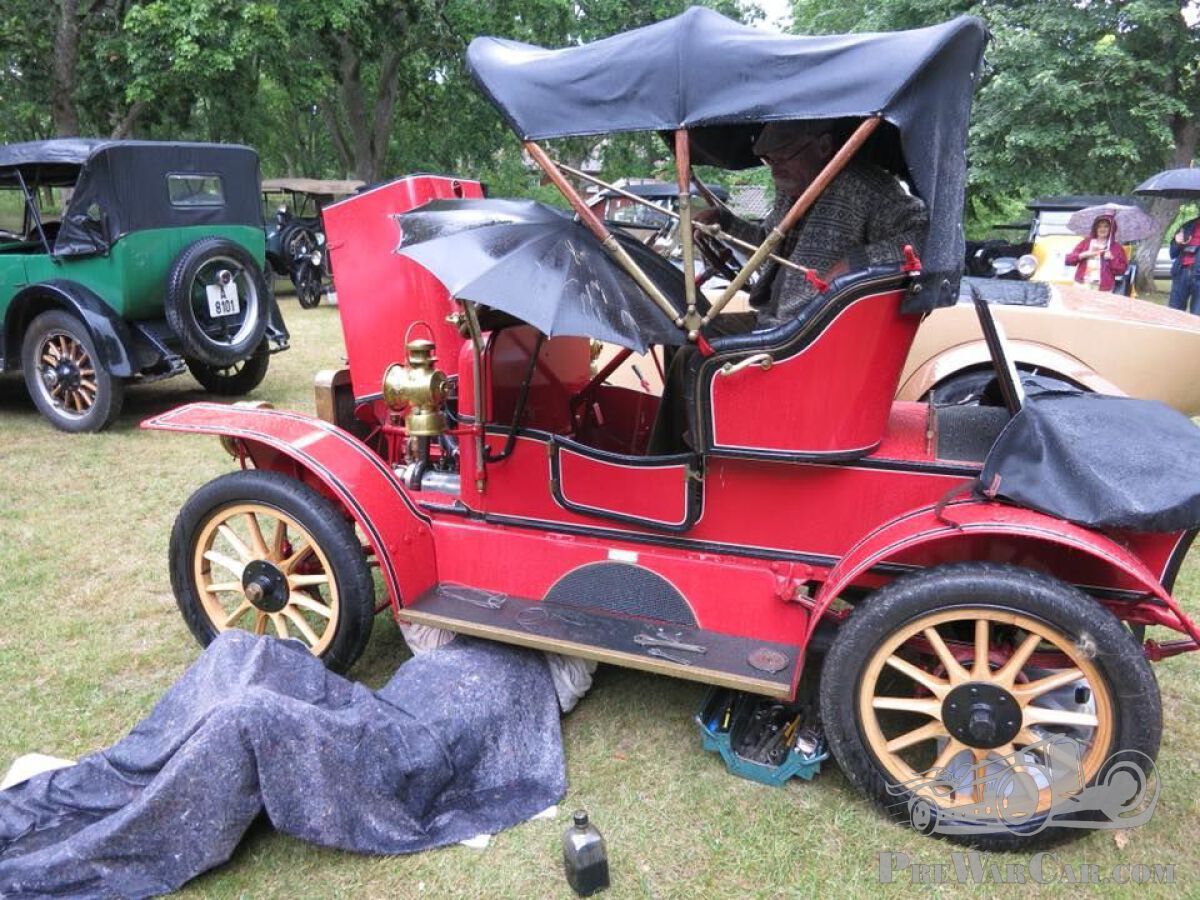
This is an 8hp, the 6hp has conventional front springs with leafs on both sides while the 8hp has only one traverse. Thie car in the photo also have the gear-lever on the stearingcolumn which indicates 1907 or earlier, the gear was moved as a "new feature for the 1908-model" according to the Autocar in 1908. Excellent drivable cars, there are actually four 8hps here in Norway, one of them being owned by the Veteran Car Club of Norway (NVK). Attached a photo of our car, clutch being adjusted during lunchbreak in a rally a few years back, in pouring rain...
Per saperne di più
Who operated there earlier or if it had any connection to other Burlington companies, undiscovered but there were no coachbuilders, coachworks, garages or motor works in New Barnet or Finchley advertised by anyone called Taylor at the time the Rover was new (c.1905-12) but in July 1925, an Edwin H. Taylor, reportedly “well-known in the coachbuilding world”, became the manager of H.H.H. Ltd. at the Woodside Works, High Road, North Finchley, which had been coachbuilding mainly for De Dion Bouton – did he run that and Victoria Road?
The photograph is embossed with the name “Hocketts”, presumably the studio of Samuel William Hockett, who was a photographer living in Potters Road, New Barnet, half a mile from Victoria Road, from before 1890 until at least 1936 when he was 72. The Rover looks most likely parked in front of the gap between Nos. 21 and 25 Victoria Road that gave access to Victoria Park recreation ground and beyond it is the largest Albert Road gasometer, not built until 1934, decommissioned c.2009 and still there.
That and the road-fund tax disc holder attached to the nearside screen pillar - not a legal requirement until 1921 - suggests this Rover had been restored and painted by Taylor’s coachwork specialists mid-1930s or even later. If it survived until then, where is it now?