La rivista e il marketplace globale per gli appassionati di auto d’epoca, creati da appassionati.
La rivista e il marketplace globale per gli appassionati di auto d’epoca, creati da appassionati.


Filter
Faccia la sua scelta
- Automobile
-
Marca >>
-
Anno >>
-
- Motociclette
-
Ubicazione >>
- Parti e altro
-
Marca dell'auto >>
-
Produttore >>
-
Categoria >>
- Biciclette
-
Anno >>
-
Paesi



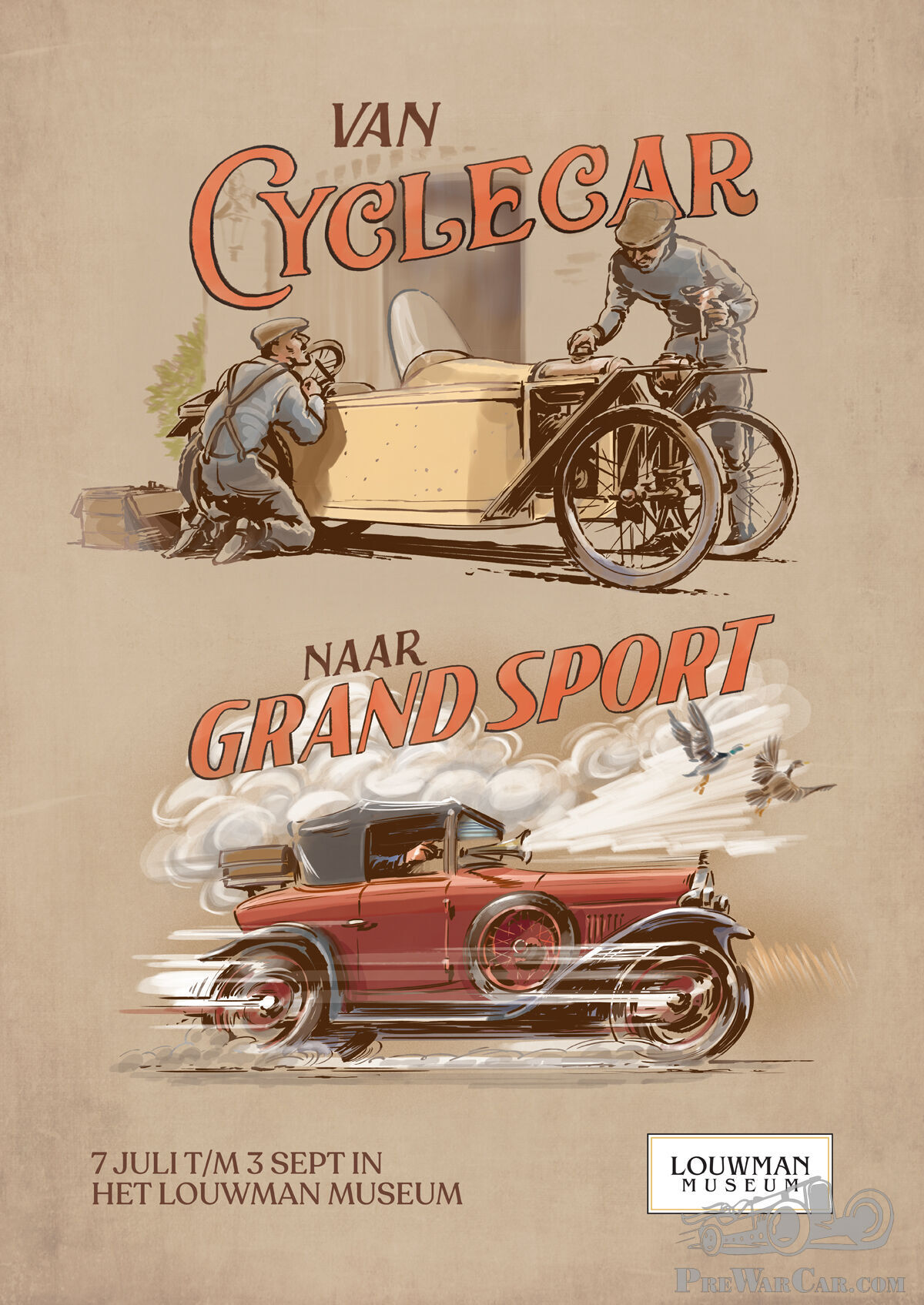
Exhibition 'From Cyclecar to Grand Sport' at the Louwman Museum



Press release
From 7 July to 3 September, the Louwman Museum is dedicated to Cyclecars and Grand Sports. No fewer than 30 vehicles provide a wonderful overview of mobility in the period from 1914 to 1930. A period when minimalist, fragile vehicles could grow into thoroughbred racers, even competing in Grand Prix.
After World War I, Europe lacked almost everything, including means of transport. To promote mobility, several European countries introduced a favourable tax on cars weighing up to 350 kg and 1100 cc engine capacity. These so-called cyclecars offered space for no more than three people. Little factories, workshops, garages and barns sprang up everywhere, producing a huge variety of little vehicles. There were more than 100 large and small car manufacturers in and around Paris alone.
Vehicles that complied with cyclecar legislation often had very sporty characteristics due to their low weight and relatively powerful engine. Every make of cyclecar therefore had at least one special racing version.
Not all cars were fitted with bodywork from the factory in the 1920s. External coachbuilders also made handmade bodies for them. Of course, these were according to the latest fashion. Like the wooden skiff; a very luxurious and sporty body style that was very much in vogue in the exuberant 1920s - the era of the Charleston. A skiff particularly appealed to the (rich) youth. It was a voiturette for the happy few!
The exhibition shows the evolution from an extremely simple cycle car to fully-fledged racing cars fitted with all kinds of, sometimes peculiar, bodywork.
Pubblicato:
martedì giugno 6th, 2023
Facebook
LinkedIn
Twitter
WhatsApp
Email
Copy