La rivista e il marketplace globale per gli appassionati di auto d’epoca, creati da appassionati.
La rivista e il marketplace globale per gli appassionati di auto d’epoca, creati da appassionati.


Filter
Faccia la sua scelta
- Automobile
-
Marca >>
-
Anno >>
-
- Motociclette
-
Ubicazione >>
- Parti e altro
-
Marca dell'auto >>
-
Produttore >>
-
Categoria >>
- Biciclette
-
Anno >>
-
Paesi


How a chauffeur was to bring peace to the world



It was a review for a new novel that we read. A novel named ‘Archivist of the world’ about a superlative plan from the early 20th century. It’s a true story, too. In 1908 the opulent rich French banker Albert Kahn hands over a state-of-the-art camera to his chauffeur Alfred Dutertre and tells him to learn how to use it. Kahn trusts him his paramount plan: capture all the tribes of the world in full colour to create his ‘Archive of the Planet’. The greater idea behind it is that these pictures are capable of taking away all the fear and prejudices for strangers and thus bring people together. The eventual purpose is cross-cultural peace and understanding. Peace to the world through photography, six decades before John Lennon thought of it through music.
Our first thought: would he have driven the world by car? And if so, were there any images of Dutertre and his motor? Until recently, the massive collection of 72,000 autochrome pictures and 183,000 meters of film taken in 22 years time remained relatively unknown with the majority of the material unpublished. Chauffeur Dutrertre had not been on his own, as Kahn commissioned several more people to go out and discover 50 countries of the world. In 1986, the archives were nationalized and came to form a museum in Boulogne-Billancourt, Paris. When the BBC got hold of them some years ago for a then-new book and television series, the incredible collection became better known to the public.
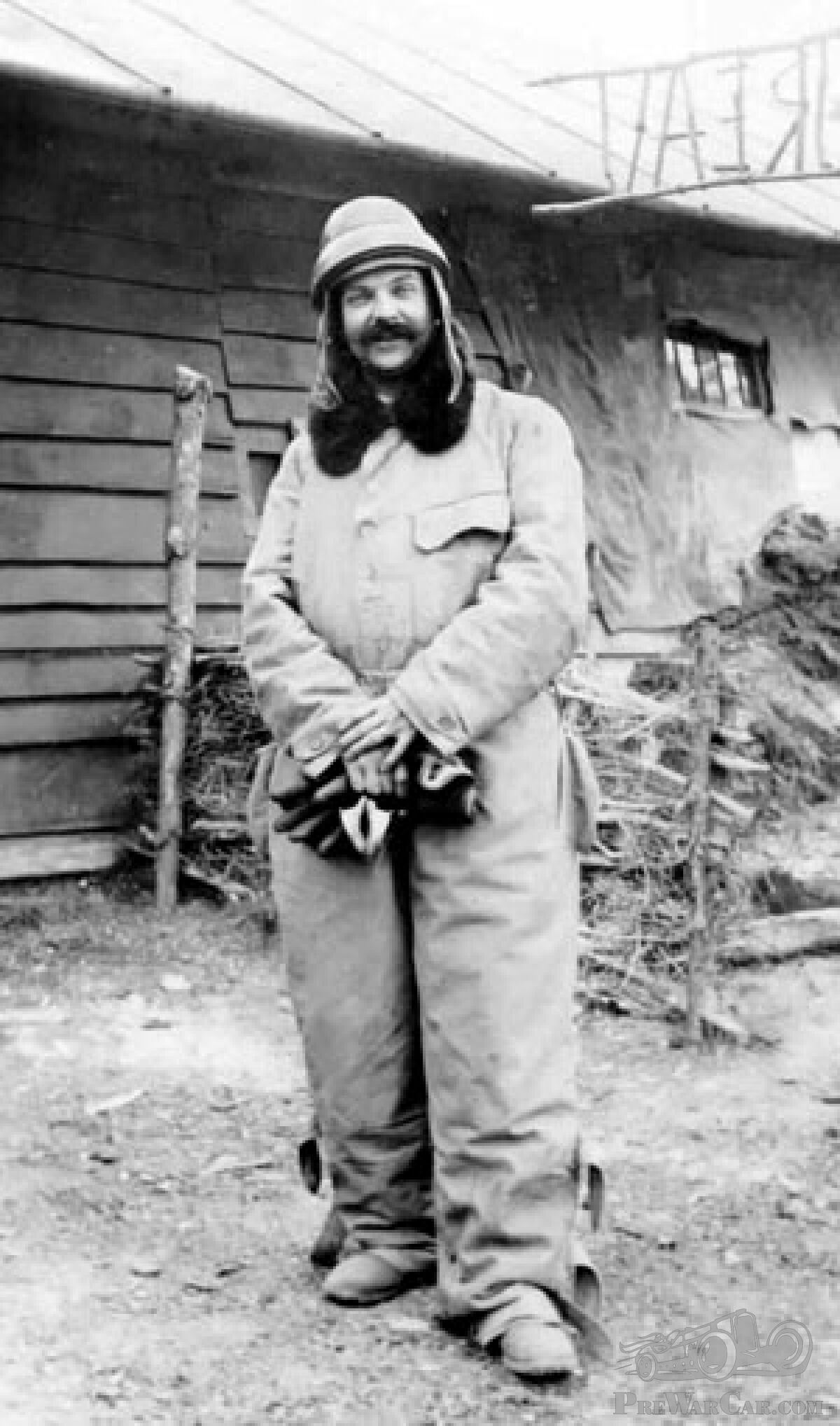
It is now known as the most important collection of early colour photographs in the world, as Kahn and his men documented France’s everyday life before the outbreak of World War I, the collapse of both the Austro-Hungarian and Ottoman empires and the last traditional Celtic villages in Ireland to name just a few. His team took the earliest-known colour photographs in countries far away, showing people in their natural habitat before the industrial revolution. Some examples here. Sadly Kahn died in 1940 during the Nazi occupation of France, when peace to the world seemed further away then ever. And his chauffeur Dutertre? There’s not much to be found, but this appears to be him on one of his travels somewhere cold. The picture above, from the Albert Kahn Museum, could also well be him, possibly with the car he chauffeured Kahn in? You may even know the make? Dutertre died in 1959 having travelled the world in order to bring peace for his boss. He didn’t succeed.
(Words Jeroen Booij, pictures Albert Kahn Museum)
Pubblicato:
sabato dicembre 23rd, 2017
Facebook
LinkedIn
Twitter
WhatsApp
Email
Copy
Commenti
Josef
24 Dicembre 2017, 13:00
Thierry
24 Dicembre 2017, 08:11
Of course, the Albert Kahn Museum worth a V
visit! But, what a surprise to see this open tourer 4 litres Voisin and its driver emerging from their archives! Great find! Thousand thanks for that.
Per saperne di più
visit! But, what a surprise to see this open tourer 4 litres Voisin and its driver emerging from their archives! Great find! Thousand thanks for that.
Luk Martens
24 Dicembre 2017, 08:07
The car is a Voisin, no doubt. Probably model C5, early to mid 1920s.
Per saperne di più
Anders Svenfelt
24 Dicembre 2017, 06:27
An Early Voisin, 18 CV or C3. Merry Christmas to all of you!
Per saperne di più
Craig Gillingham
24 Dicembre 2017, 06:19
I think the car is a Voisin, possibly a C1?
Per saperne di più
A beautiful car anyway and I like to see the blue colour.
Many thanks for the find and Merry Christmas!