La rivista e il marketplace globale per gli appassionati di auto d’epoca, creati da appassionati.
La rivista e il marketplace globale per gli appassionati di auto d’epoca, creati da appassionati.


Filter
Faccia la sua scelta
- Automobile
-
Marca >>
-
Anno >>
-
- Motociclette
-
Ubicazione >>
- Parti e altro
-
Marca dell'auto >>
-
Produttore >>
-
Categoria >>
- Biciclette
-
Anno >>
-
Paesi



Introducing the automobile to Austria-Hungary

Hatschek pictured with his Velo in 1895

The 1893 photograph of Zardetti aboard his 4hp Benz Viktoria

The three-wheeled Patent-Motor-Wagen illustrated in the 1893 Benz catalogue
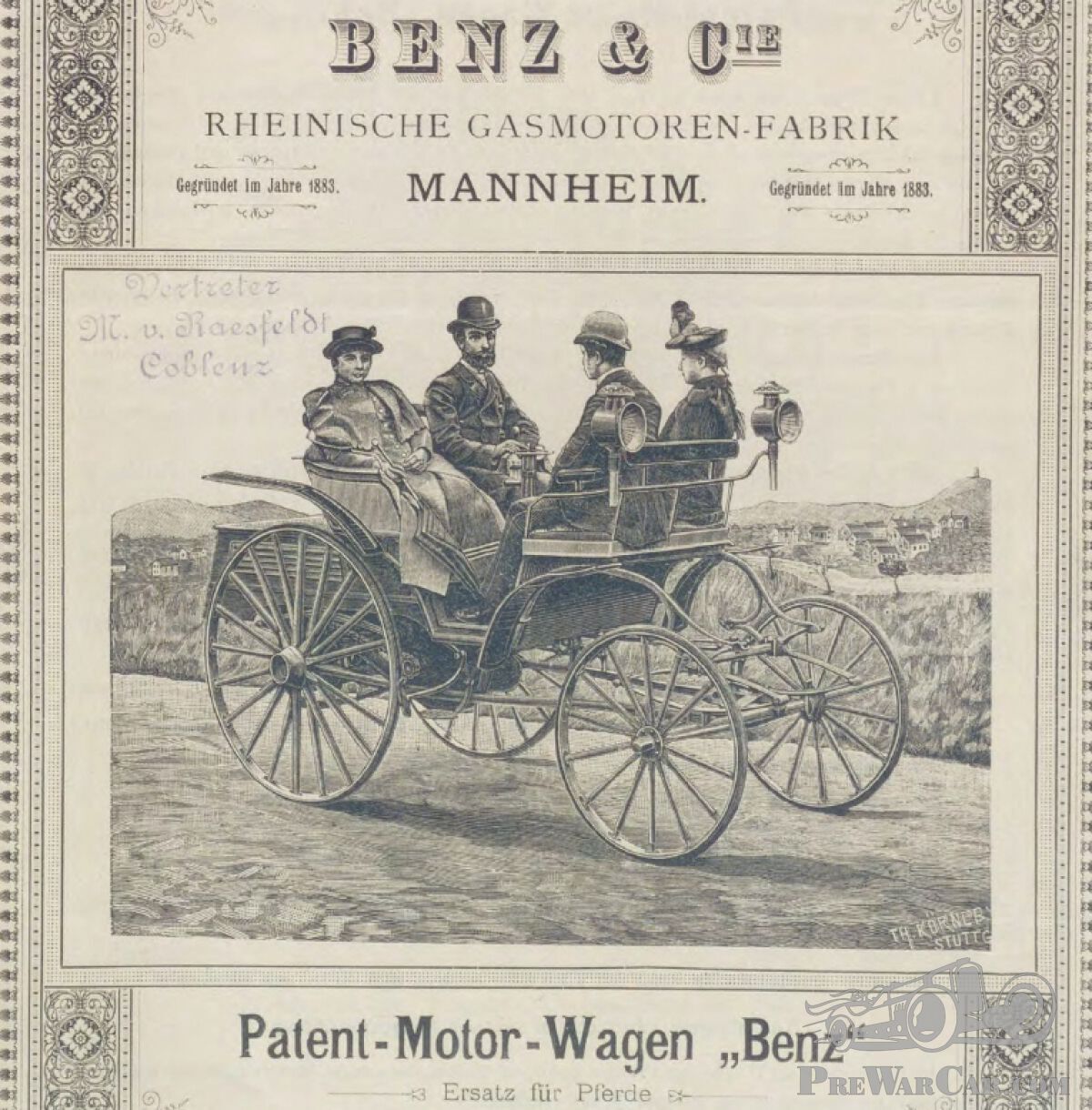
The catalogue also shows a four-wheeled Benz Viktoria similar to Zardetti's
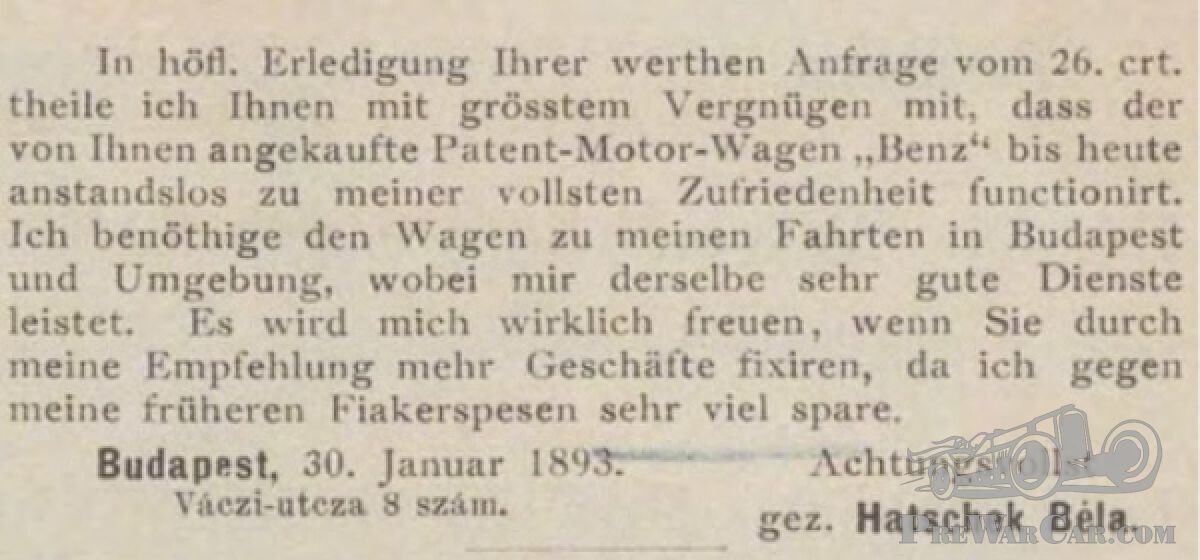
Hatschek's glowing review of his Benz as it appeared in the marketing catalogue


We're not sure how much our Austrian and Hungarian readers know about the motoring past of their respective nations, but most people will know very little about it except that Archduke Franz Ferdinand was assassinated while travelling in a Gräf & Stift. We know a bit more, of course, and can think of Austro-Daimler and Lohner-Porsche, the origins of which transport us back to 1898.
We couldn't have told you what the first car ever to appear in Austria-Hungary was, but it's only natural that it should have been a Benz, and so it was. Historians have, for many years, accepted an article published by the Allgemeine Automobil Zeitung (General Automobile Newspaper) in 1911 entitled 'The Oldest Automobile in Austria-Hungary' which concluded that it was a Benz purchased in March 1893 by Eugen von Zardetti, a Swiss painter then domiciled in Austria.
Thus was the 'fact' established for 111 years until Dr. Christian Klösch, a researcher at the Vienna Museum of Science and Technology, stumbled upon an interesting document in the library last year. Perusing an edition of the Neuen Wiener Abendblatt (New Viennese Evening Paper) dated 3rd November 1892, he discovered a passage about 'the first automobile journey of a carriage without horses', naming the pioneering motorist as Julius Jalowetz, a Viennese chemist who travelled all the way to Mannheim to buy his car from Karl Benz directly. When Klösch sought more information, Mercedes-Benz helpfully provided him with a copy of a brochure from early 1893 in which the Benz Patent-Motor-Wagen was praised by Jalowetz.
The brochure also contained a review from Béla Hatschek, an optician in Budapest who later became a maker of false eyes. Hatschek's review, dated 30th January 1893, read: 'It is with great pleasure that I inform you that the "Benz" Patent-Motor-Wagen I purchased has been working flawlessly to my complete satisfaction to this day. I need the car for my trips in Budapest and the surrounding area, and it serves me very well. It will really please me if you secure more business through my recommendation, as I save a great deal on my previous fiacre expenses.'
With this new lead, Klösch did further digging and ultimately discovered from the Budapest City Archives that Hatschek had been awarded a permit for motor-car use on 26th November 1892. Hatschek's name, incidentally, was not unknown to motoring historians. In 1895, the Royal Automobile Club of Hungary published a photograph in its anniversary yearbook of him seated aboard his new Benz Velo in 1895.
There we have it - a major discovery which we hope will do a lot to encourage interest in early horseless carriages in Austria and Hungary. If you live in either of those countries and are the owner of a Victorian car, why not meet with some like-minded enthusiasts and stage a little road run to commemorate the pioneering efforts of Jalowetz and Hatschek?
Words: Zack Stiling; pictures: CE Auto Classic
Pubblicato:
lunedì maggio 1st, 2023
Facebook
LinkedIn
Twitter
WhatsApp
Email
Copy
Commenti
Robert Simons
12 Giugno, 16:36
Horváth Ferenc
17 Maggio 2023, 10:07
I am reporting from Hungary. Yes, we know the story of the optician Béla Hatschek with the first Budapest car.
There are almost no vehicles from the time of Kaiser Franz Josef I. in Hungary, even the museum examples were destroyed during the Second World War and the rest became victims of the politics of the 1950s.
Therefore we can't organize a road run to commemorate the pioneering efforts of Jalowetz and Hatschek. :o/
Per saperne di più
There are almost no vehicles from the time of Kaiser Franz Josef I. in Hungary, even the museum examples were destroyed during the Second World War and the rest became victims of the politics of the 1950s.
Therefore we can't organize a road run to commemorate the pioneering efforts of Jalowetz and Hatschek. :o/
Michael Schlenger
01 Maggio 2023, 09:12
It's a mystery to me why the author of this article doesn't mention the "Marcus-Wagen" from 1888/89 as "the first car ever to appear in Austria-Hungary". It had its flaws, wasn't particularly powerful and remained a prototype. Yet, it was without doubt an automobile with a four-stroke petrol engine and even the first one using a magneto-operated ignition. The best thing is: it still exists in running condition!
Per saperne di più
Jeff Perkins
01 Maggio 2023, 04:32
Great story… thank you Mr. Stiling for this and the other excellent articles you write!
Per saperne di più
Lars Legaard
02 Maggio 2023, 13:08
I totally agree, regarding Mr. Marcus. But as most old car people know, due to the fact that he had Jewish origins, the Nazis wanted the car being invented by Mr. Benz, and it is fantastic that the car could be kept hidden during WWll, but as far I know most of the Marcus archives were destroyed by orders from Himmler
The lesson is: You can never twist history!
Per saperne di più
The lesson is: You can never twist history!
Michael Schlenger
03 Maggio 2023, 00:18
I don't know or care what the National Socialists wanted some 80 years ago. I simply expect that a plain fact which is easily available today is taken into account, in particular if an author boasts that he knows "of course" more than the ordinary prewar enthusiast. I am pretty sure that the "Marcus car" is something the veteran car aficionados in Austria are pretty proud of - and rightfully so.
Per saperne di più
Pal Negyesi
26 Agosto 2024, 08:58
The Marcus car is not part of this story and the reason for that is very simple. Both Dr Klösch who did the initial research and I, who did the research in Hungary, were focusing on imports. Yes, the Marcus vehicle was around—we are perfectly aware of this fact (Dr Klösch works at the Technisches Museum where the Marcus vehicle resides). The fact remains: Siegfried Marcus tinkered with his engine-powered device, but nothing came out of his experiments. Then in 1900 his prototype was dragged onto the "stage" and paraded as the first car built before Benz/Daimler in 1875. This enduring myth elevated the significance of his efforts. Just to explain further: Carl Benz did not invent the petrol-engined car, but he was the first to a) construct an automobile (not a motorized handcart, carriage or any other device but a well-thought out and patented transportation device) b) which became commercially successful. Siegfried Marcus and a lot of others before and after him (Hammel car anyone?) built motorised devices. So when we look at the first car in the Austro-Hungarian Monarchy we study whether Daimler, Benz, Peugeot, Panhard, etc. arrived first.
Per saperne di più
I'd be fascinated to see more of the 1893 brochure which is mentioned. Is it available anywhere?