La rivista e il marketplace globale per gli appassionati di auto d’epoca, creati da appassionati.
La rivista e il marketplace globale per gli appassionati di auto d’epoca, creati da appassionati.


Filter
Faccia la sua scelta
- Automobile
-
Marca >>
-
Anno >>
-
- Motociclette
-
Ubicazione >>
- Parti e altro
-
Marca dell'auto >>
-
Produttore >>
-
Categoria >>
- Biciclette
-
Anno >>
-
Paesi


“It’s a Duesy”


Always wanted to own a classy Duesenberg yourself? This is your chance! On Thursday the 23rd of August 2018 at 5 pm Worldwide Auctioneers will start auctioning a fine collection of automobiles at The Pacific Grove Auction. Among which three different Duesenberg cars. About these Duesenbergs we would like to tell you a little bit more.
1931 Duesenberg Model J SWB Sport Convertible Sedan
The first one under the hammer, well not literally, of course, will be lot number 53. A 1931 Duesenberg Model J SWB Sport Convertible Sedan. Yes, you hear it correctly! “It’s a Duesy”, a legendary Duesenberg Model J has come up for sale and can be all yours. “A truly mighty chassis with many leading-edge features and powered by a highly advanced and race-derived eight-cylinder engine with dual overhead cams, four valves per cylinder, and hemispherical combustion chambers developing 265 HP – some 100 horsepower more than its nearest competitor – the Model J was priced from $8,500 for the bare chassis alone. Fitted with bodywork and ready for delivery to the customer, it was America’s grandest and most expensive car by far,” as described by Worldwide Auctioneers in the catalogue. You can, of course, argue whether the price really supported the car`s features, but we leave that up to you.
The high-quality design and engineering of the Model J shown has its original 32-valve inline eight-cylinder engine with double overhead camshafts delivering 265 HP. A remarkable performance at the time. The original chassis (no. 2486) has a wheelbase of 142 inches, with on top, its original very elegant and luxurious body by Derham Body Co. Derham built nearly 40 bodies for the Duesenberg J and SJ chassis, but relatively few were open cars. Of which this Sport Convertible Sedan on the short-wheelbase Duesenberg Model J chassis can be considered as one of the firm's crowning achievements. It is one of the just five Derham Sport Convertible Sedans were manufactured. The four other Derham Sport Convertible Sedans were J-488, J-505, J-170 (engine only remains), and J-469 (scrapped).
J-475 shown here is now offered from over 45 years of single ownership, and it is one of the only two cars in this select group originally equipped with a dashing and exceptionally attractive “V” windshield. The car has a well-known and unbroken history which is documented. A wonderful opportunity to acquire probably one of the finest examples of a true automotive icon. This 1931 Duesenberg is estimated between $1,300,000 - $1,600,000.
1936 Duesenberg Model JN LWB Tourster
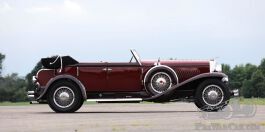
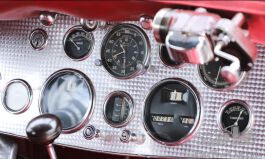
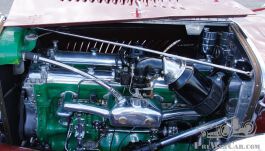
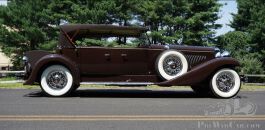
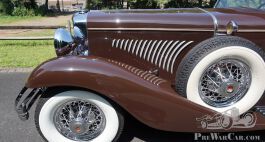
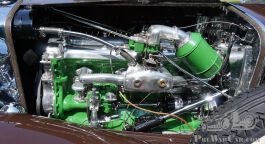
The second Duesenberg looking for a new owner on the 23rd of August is a 1936 Duesenberg Model JN LWB Tourster. Lot no. 57. A luxurious car with very fine coachwork also in the style of Derham is built on the original chassis no. 2599. It is one of the three long wheelbase examples ever built. The car still has its original 420 cid DOHC inline eight-cylinder engine. With single Stromberg downdraft carburettor and original three-speed manual transmission. The four-wheel hydraulic drum brakes, live-axle suspension with semi-elliptic leaf springs and double-action hydraulic-lever shock absorbers on a wheelbase of 153.4 inches make you drive very comfortable.
About the history of J575. It was the last long wheelbase car to leave the factory and, by several accounts, the last Duesenberg to be sold to the public. It left the factory with Rollston Berline coachwork, body number 566 and had all the JN upgrades including more modern skirted fenders, 17-inch wheels and sleeker running boards concealing the frame rails.
Under the ownership of Ken Gardner, the car was being restored. Which was around 1970. The body was taken off the chassis and the chrome, fenders, hood, chassis etc. were sent off to various specialists for restoration. But that is when it all then wrong. The building housing the (original) Rollston body caught fire and everything in the building was destroyed. Meaning that luckily enough all the remaining parts: hood, wheels, frame, engine, suspension, firewall, fenders, interior, brightwork survived intact, having been out at various shops for the restoration. Around 1971 a new Derham Tourster-style body tub was built by Carl L. Amsley. And all survived and original parts were added.
A remarkable story really. The car changed ownership several times. But always has been very well maintained as can be seen in the photographs. The estimate for this fine and luxurious 1936 Duesenberg with its rich history lays between $750,000 - $950,000. J575 is in its current state ready for many more shows and events.
1922 Duesenberg Model A Sport Phaeton
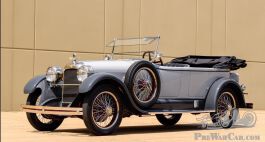
And last but definitely not least is a 1922 Duesenberg Model A Sport Phaeton. Chassis no. 798 is fitted with stylish bodywork by Millspaugh & Irish. Presented in a gorgeous tri-tone colour scheme with a dove grey main body and dark grey fenders, subtly accented with a deep red chassis and matching wheels. Body and paint are both to Concours quality with outstanding fit and finish evident.
The powerful 260 cid SOHC inline eight-cylinder engine with a single carburettor is beautifully presented against the original firewall. The car was exhibited at the Pebble Beach Concours d’Elegance in 2010, where it also participated in the Pebble Beach Tour. And has received ACD Club Level One Certification, as well as ACD Club National honours and an AACA Junior Award in 2011.
It is very rare, early Duesenbergs in such a wonderful condition like this appear on the open market. Estimated between $280,000 - $320,000 this technically advances and fabulously restored Duesenberg is ready to continue its show career with a new owner.
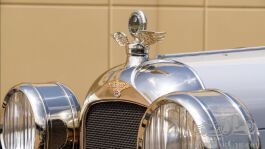
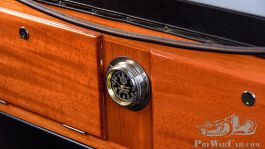
Which one of these three would you choose? We have already decided which one we would go for. But we are curious to know which one of these Duesenbergs you are interested in, please comment below. If you are really interested in buying one of these Duesenbergs. Pacific Grove, CA 93950 is the place to bid live on these beauties.
Words by the editor. Photographs courtesy Worldwide Auctioneers.
Pubblicato:
mercoledì agosto 15th, 2018
Facebook
LinkedIn
Twitter
WhatsApp
Email
Copy
Commenti
Peter Maguire
19 Agosto 2018, 15:07
Leif Ortegren
17 Agosto 2018, 22:36
You have to remember that the "J" engine was of very advanced specification (DOHC- 4 valves per cylinder supercharged) but was also 6.8 liters! The HP numbers quoted seem entirely possible given outputs of smaller contemporary engines.
Per saperne di più
Michael Schlenger
19 Agosto 2018, 01:03
Yes, the claimed output seems possible given the sheer capacity of the engine, but has it been verified recently? That was my question.
Once again: Why would anyone in the early 1930s equip a car that is not meant to be a racecar but simply a pretty heavy and bulky production car with an engine whose output would by far exceed the maximum power of a period Grand Prix car? And who would have provided the clutch and the tyres in 1931 that would have been able to transform this power into speed without destroying them?
I do understand that cars from the U.S were much more powerful in the 1920s and 1930s than European ones. Still, I don't see the point in equipping them with immensely powerful engines while the maximum speed that was attainable on public roads back then may have been approximately 80 mph.
Per saperne di più
Once again: Why would anyone in the early 1930s equip a car that is not meant to be a racecar but simply a pretty heavy and bulky production car with an engine whose output would by far exceed the maximum power of a period Grand Prix car? And who would have provided the clutch and the tyres in 1931 that would have been able to transform this power into speed without destroying them?
I do understand that cars from the U.S were much more powerful in the 1920s and 1930s than European ones. Still, I don't see the point in equipping them with immensely powerful engines while the maximum speed that was attainable on public roads back then may have been approximately 80 mph.
Jeremy Leasor
16 Agosto 2018, 12:11
Although the un-supercharged Model J was billed as developing 265hp, contemporary reports suggest that the reality was nearer 250hp. When preparing the Duesenberg Special for Ab Jenkins the standard supercharged SJ with a straight inlet manifold was found to develop 320hp at the flywheel. Rams horn manifolds (fitted to the last half dozen or so SJs) boosted this to 400hp. In the mid-1950s an SJ was put onto a Clayton rear-wheel dynamometer at General Motors calibrated to 280hp, without the knowledge of the management. It sent the power indicator off the scale and then proceeded to destroy the dynamometer itself.
Per saperne di più
Michael Schlenger
16 Agosto 2018, 20:13
Highly interesting, thank you! Still, my question is whether there are any contemporary tests that have verified these claims from the 1930s and 1950s. I mean, a Grand Prix ca of the early 1930s - say an Alfa P3 - developed just over 200 h.p. and attained a maximum speed of more than 200 km/h. Even if the Duesenbergs were much heavier and bulkier - what was the purpose of equipping them with such powerful engines (provided that the claims are correct)? The durability of clutches and tyres was a serious problem even with race cars from the mid-1930s with less than 300 hp. Hence, I have my doubts as regarding the sustainability of the outputs claimed. In my opinion, the power that was available for a sustained period of time, must have been much lower, maybe around 200 hp.
Per saperne di più
Leif Ortegren
15 Agosto 2018, 19:12
The model A...no question. The "J" was done under the strong influence of E.L. Cord, where as the "A" was pure Fred and Auggie. Those two took on the world on a shoe string budget, working long hours with the simplest of tools, and won races by innovation.
Per saperne di più
Michael Schlenger
15 Agosto 2018, 00:51
Remarkable as these cars are in every respect, I've always wondered whether the claimed output of 265 h.p. of the supercharged J model from the early 1930s has ever been verified independently in the modern age. Even if it might have been the potential maximum output for a very short time, the sustainable power would have been much lower, in my opinion - just think of the clutch and the tyres back then. If the actual horsepower would have been only half of the claimed output it would still have been enough to enable a speed of approx. 120-130 km/h with a car as big and heavy like this one. Who on earth would have tried to go faster in a supercharged Duesenberg in the early 1930s on public roads in the U.S.?
Per saperne di più
Austin 7 engines, which according to all the most accurate historical information, were tested on a 'Walton & Froude No4 Dynamometer' delivered (at flywheel) 10.2 BHP in standard form and up to 38 BHP unsupercharged in racing form. Fitting a supercharger, only really ever done for racing though a few production cars were so modified and often considered the equivalent of increasing the engine capacity by 33%, made the output around 56 BHP maximum. I ignore the 'Twin-Cams', another animal altogether, 'Moden' (1950's!) technology which could give 85 BHP at the flywheel and 8000 RPM and any figure for the BHP obtained from any source other than one using the aforementioned dynamometer. This is quite important as different makes will produce different figures.
So, perhaps a SJ did produce 265 BHP. After all this represents only 38 BHP/Litre, not the magic 100 BHP/Litre desired by and sometimes reached by those involved in the engineering of racing cars in the 1930's. Here the Alfa P3 comes to mind as it did produce that magic figure as its engine capacity was only 2.6 Litres.
In this respect, an Austin 7 with its 750cc SIDE_VALVE engine was, in terms of BHP/Litre, supercharged OR unsupercharged, far superior to the SJ! So, I have no quibble with the figure supplid by the Duesenberg factory for their cars.