La rivista e il marketplace globale per gli appassionati di auto d’epoca, creati da appassionati.
La rivista e il marketplace globale per gli appassionati di auto d’epoca, creati da appassionati.


Filter
Faccia la sua scelta
- Automobile
-
Marca >>
-
Anno >>
-
- Motociclette
-
Ubicazione >>
- Parti e altro
-
Marca dell'auto >>
-
Produttore >>
-
Categoria >>
- Biciclette
-
Anno >>
-
Paesi



Kellner Confusion Mystery (update: Hotchkiss AC6?)
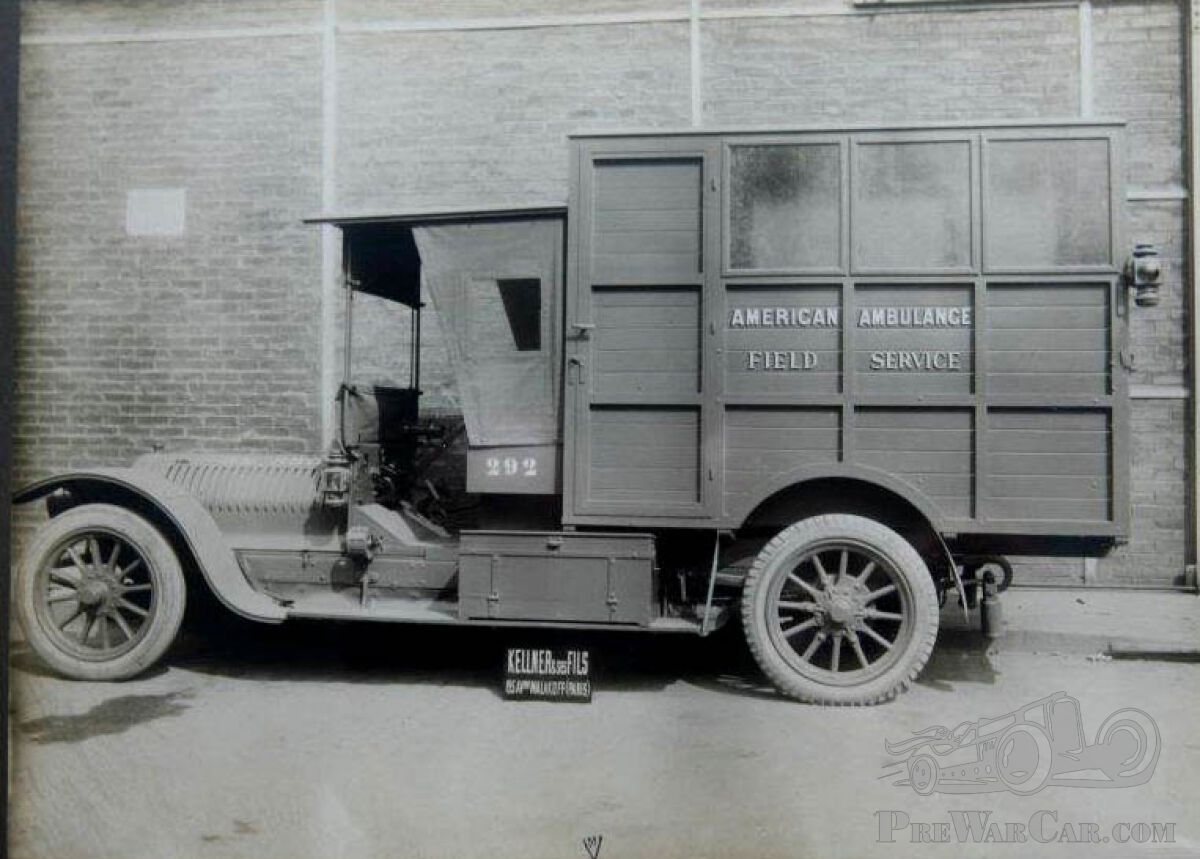


Hugo Modderman questioned whether Paris coachbuilder Kellner had built any bodies for Model T Ford ambulances during World War I. He had searched the Kellner archives, and the only photo of an American ambulance he found is shown here. We posed the question to George King, who researched and built the replica we featured in that item.
Geoge responded with several citations of period accounts of Kellner bodies on Model Ts, including the "History of the American Field Service in France", published in 1920 about the volunteer ambulances and their drivers. Driver William Seabrook is quoted as saying "It was about the first of May that our Section assembled in the General Headquarters at Neuilly-sur-Seine. The men were ready, but the cars were not. The chassis were standing in line in Kellner’s great carrosserie works, near Severs, a couple of miles beyond the Bois de Boulogne, awaiting the construction of the wooden bodies which were only half completed. Kellner was short of men, and we went to Kellner’s. Within twenty-four hours men among us who had never swung anything heavier than a mashie were working at forge and anvil, making heavy iron braces and hinges; others drilled holes in the wood and iron; still others screwed and riveting the parts together...”
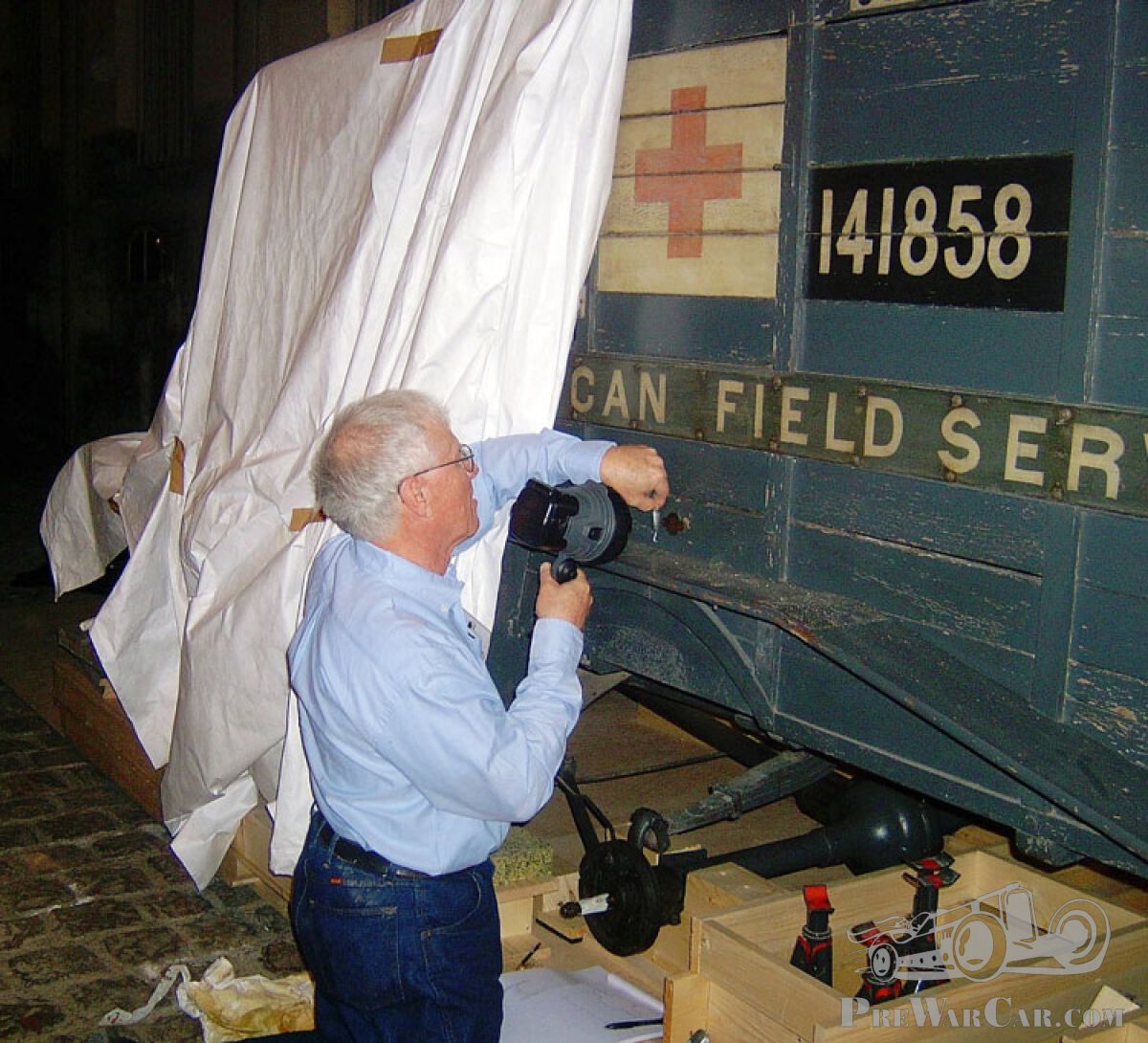
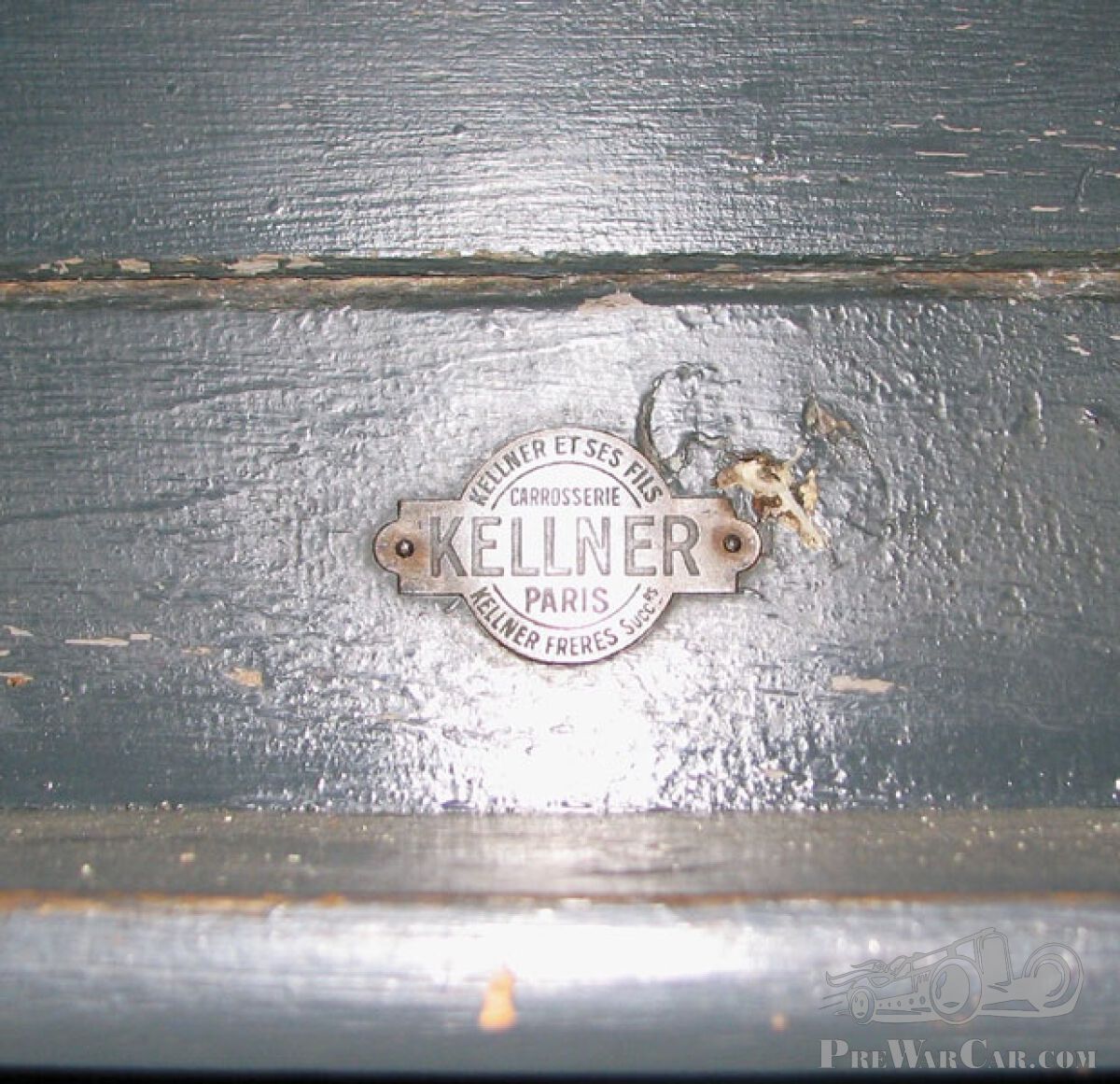
As recently as 1996, references appear: "Gentlemen Volunteers" by Arlen J. Hansen, ©1996 Arcade Publishing, New York, Pg. 108. “The carpentry was done by Kellner et Ses Fils, whose shop was located in Billancout, a suburb on the southwest edge of Paris, where the AFS operated a repair park.” Perhaps the best evidence is a survivor, presently at Musée de la Voiture et du Tourisme, in Compiègne, France. Here we see George photographing the coachbuiler's plate on what is clearly a Model T chassis. He reports "In all, [Kellner] built the bodies for 1,200 Model Ts for the American Field Service and many more of the same design for Norton and Harjes ambulances. Their design was also used as the template for the ambulances produced by Ford in 1917 and 1918."
The American Field Service survives today as a cultural organization, active in student exchange programs. Model T 255 that George replicated was donated to AFS by The Groton School in Massachusetts, alma mater of President Franklin Roosevelt and many other prominent statesmen. He's hoping to take 255 to France in the near future. You can help by clicking "donate" on his project log page. The ambulance shown in the Kellner archives as number 292 apparently post-dates it. The bonnet shape and louvre pattern seem to say "Delaunay Belleville."
Pubblicato:
sabato novembre 2nd, 2013
Facebook
LinkedIn
Twitter
WhatsApp
Email
Copy
Commenti
william hearne
04 Novembre 2013, 08:24
Sconosciuto
03 Novembre 2013, 22:28
Hello, Seeing the pictures of the left back of the ambulance with George. There is the museum concerning french-american relationship http://www.museefrancoamericain.fr/
In the WWI dept (premiere guerre mondiale) you can see the model T 270.
And for this topic , the Hotchkiss AC6 is a good idea like the following in Compiègne: http://www.google.fr/imgres?client=firefox-a&hs=9KS&sa=X&rls=org.mozilla:fr:official&biw=1432&bih=1000&tbm=isch&tbnid=ah6MXmV0LHWuQM:&imgrefurl=http://www.kitfoster.com/carport/2008/04/vive-la-compi/&docid=AWvMWPR014XvwM&imgurl=http://www.kitfoster.com/images/2008-4-30_Hotchkiss08Web-Large.jpg&w=750&h=500&ei=IM12UsfsEKOR0AXT34CQAg&zoom=1&iact=hc&vpx=4&vpy=341&dur=86&hovh=183&hovw=275&tx=170&ty=123&page=1&tbnh=134&tbnw=192&start=0&ndsp=45&ved=1t:429,r:7,s:0,i:104
Kind regards
Philippe
Per saperne di più
In the WWI dept (premiere guerre mondiale) you can see the model T 270.
And for this topic , the Hotchkiss AC6 is a good idea like the following in Compiègne: http://www.google.fr/imgres?client=firefox-a&hs=9KS&sa=X&rls=org.mozilla:fr:official&biw=1432&bih=1000&tbm=isch&tbnid=ah6MXmV0LHWuQM:&imgrefurl=http://www.kitfoster.com/carport/2008/04/vive-la-compi/&docid=AWvMWPR014XvwM&imgurl=http://www.kitfoster.com/images/2008-4-30_Hotchkiss08Web-Large.jpg&w=750&h=500&ei=IM12UsfsEKOR0AXT34CQAg&zoom=1&iact=hc&vpx=4&vpy=341&dur=86&hovh=183&hovw=275&tx=170&ty=123&page=1&tbnh=134&tbnw=192&start=0&ndsp=45&ved=1t:429,r:7,s:0,i:104
Kind regards
Philippe
Sconosciuto
03 Novembre 2013, 13:56
I wonder how the soldier built Kellners compare with the real thing
Per saperne di più
william hearne
03 Novembre 2013, 12:23
The machine in your main photograph could well be a Delaunay Belleville but it could also be a Hotchkiss and judging by the length of the bonnet may well be a 6 cylinder AC6. This of course was not the only association that Hotchkiss had with WW1 as they also supplied Hotchkiss machine guns.
Per saperne di più
Sconosciuto
03 Novembre 2013, 02:48
Nice piece of documentation! Good work! I thought it highly unlikely that the T Model had not been used as an Ambulance.
Per saperne di più
In the WWI dept (premiere guerre mondiale) you can see the model T 270.
And for this topic , the Hotchkiss AC6 is a good idea like the following in Compiègne: http://www.google.fr/imgres?client=firefox-a&hs=9KS&sa=X&rls=org.mozilla:fr:official&biw=1432&bih=1000&tbm=isch&tbnid=ah6MXmV0LHWuQM:&imgrefurl=http://www.kitfoster.com/carport/2008/04/vive-la-compi/&docid=AWvMWPR014XvwM&imgurl=http://www.kitfoster.com/images/2008-4-30_Hotchkiss08Web-Large.jpg&w=750&h=500&ei=IM12UsfsEKOR0AXT34CQAg&zoom=1&iact=hc&vpx=4&vpy=341&dur=86&hovh=183&hovw=275&tx=170&ty=123&page=1&tbnh=134&tbnw=192&start=0&ndsp=45&ved=1t:429,r:7,s:0,i:104
Kind regards
Philippe[/quote]
Philippe, Thank you for that I am now convinced that I am correct with my naming of the ambulance donor chassis as a Hotchkiss AC6.