La rivista e il marketplace globale per gli appassionati di auto d’epoca, creati da appassionati.
La rivista e il marketplace globale per gli appassionati di auto d’epoca, creati da appassionati.


Filter
Faccia la sua scelta
- Automobile
-
Marca >>
-
Anno >>
-
- Motociclette
-
Ubicazione >>
- Parti e altro
-
Marca dell'auto >>
-
Produttore >>
-
Categoria >>
- Biciclette
-
Anno >>
-
Paesi



Monday mystery: a mass-produced motor for the Minerva clan
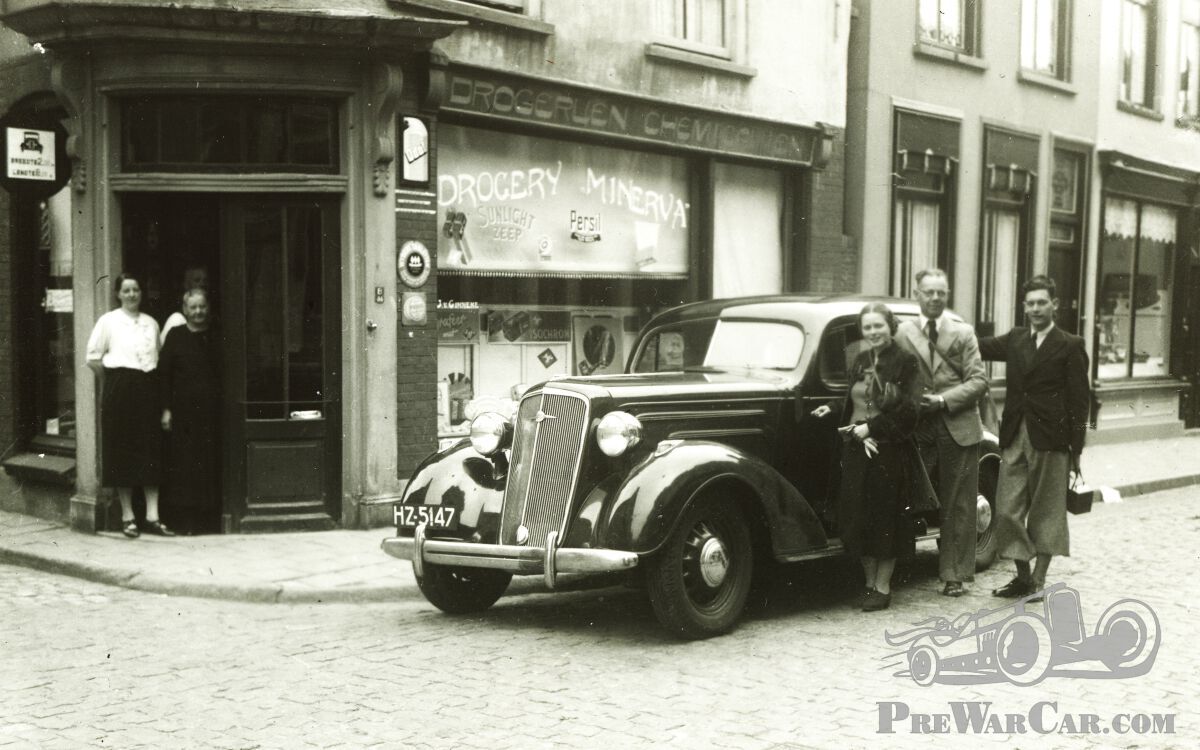

We very much like getting our teeth into these mystery car requests, and we especially like it when there's a red herring or two thrown in. It hardly needs to be said that while we see 'Minerva' writ large behind this smart saloon, the car itself certainly is not one of Minerva's sumptuous products. By the 1930s, Minerva still enjoyed a reputation as being among the first rank of the world's car-makers, known for large and expensive chassis often fitted with bespoke coachwork, and even its cheaper models were a notch or two above this mass-produced, pressed-steel sedan. As you may well have worked out, 'Drogery Minerva' is simply the name of the chemist's shop, and bears no relation to the car-maker.
We'll let Vincent van Ginneke, who sent us the photo, tell us a bit more about it: "This photograph was taken in front of the Minerva chemist's shop of my great-grandfather Ginneke, on the Blauwstraat in Steenbergen, the Netherlands. As usual, back then chemist's was the local shop for photography and you can see the Agfa-Isochrom advertisements in the shop window. Outside on the wall is a sign for Wybert liquorice pastilles and Odol mouthwash, and the window advertises Sunlight soap and Persil washing powder.
"I don't know the year, but it would be sometime around 1936 or 1937. On the left, in the doorway, are my aunt Mien van Ginneke and her parents Jan and Wilhelmina van Ginneke, my great-grandparents. The women next to the car is Irèn Kapuy. She was Hungarian and married to Dion van Ginneke, standing next to her. The young man on the far right is Jan van Ginneke Jr. The photo was possibly taken by my grandfather, Kees van Ginneke, his son Gerard (my father) or youngest son Wim. The car? I initially thought it was a Horch or Hotchkiss but I can't find one that looks exactly like it. I'm curious.
"A few years later, things were very different. My grandfather was in slavery on the Burma Railway, Jan Jr. was in England serving with the Princess Irene Brigade and Wim was on death row in Germany after being caught working for the Resistance, but the war ended just in time and as if by a miracle they all survived. Apart from my great-grandparents, I knew them all."
An American in Holland
We've taken a good look at it, and feel fairly sure it's a 1935 Chevrolet sedan—the grille, body sheel and wheels all seem to be a perfect match, as far as we can tell. It would make sense if it was a couple of years old at the time of the photograph, as it looks like the grille has sustained some light damage, but the car otherwise appears well cared-for.
We think it must have made very nice family transport for the van Ginnekes, though Vincent believes it was not actually theirs: "It was most likely rented from the local car dealer, Willy van der Kar in Steenbergen."
We wonder what it might have said about their position in society. In America, Chevrolets and Fords were among the cheapest new cars one could buy, partly because they were built on such a large scale and production costs were low, but we would think they must have been considerably more expensive in Europe, with import duties taken into consideration. The extra cost might have been justified, though—American cars were generally stronger, torquier and more powerful than their equivalent European offerings, and the van Ginnekes would have enjoyed certain perks, such as faster speeds and a cavernous interior, as were not afforded to the many Dutch families driving around in little Opels and Fiats.
Perhaps your ancestors drove an imported American car in the 1930s or later? We'd be interested to hear about it, and any more you can tell us about this Chevrolet.
Words: Zack Stiling
Photograph: Vincent van Ginneke
Pubblicato:
lunedì giugno 10th, 2024
Facebook
LinkedIn
Twitter
WhatsApp
Email
Copy
Commenti
Vincent van Ginneke
06 Ottobre 2024, 15:58
Alexander Stolpmann
16 Giugno 2024, 14:00
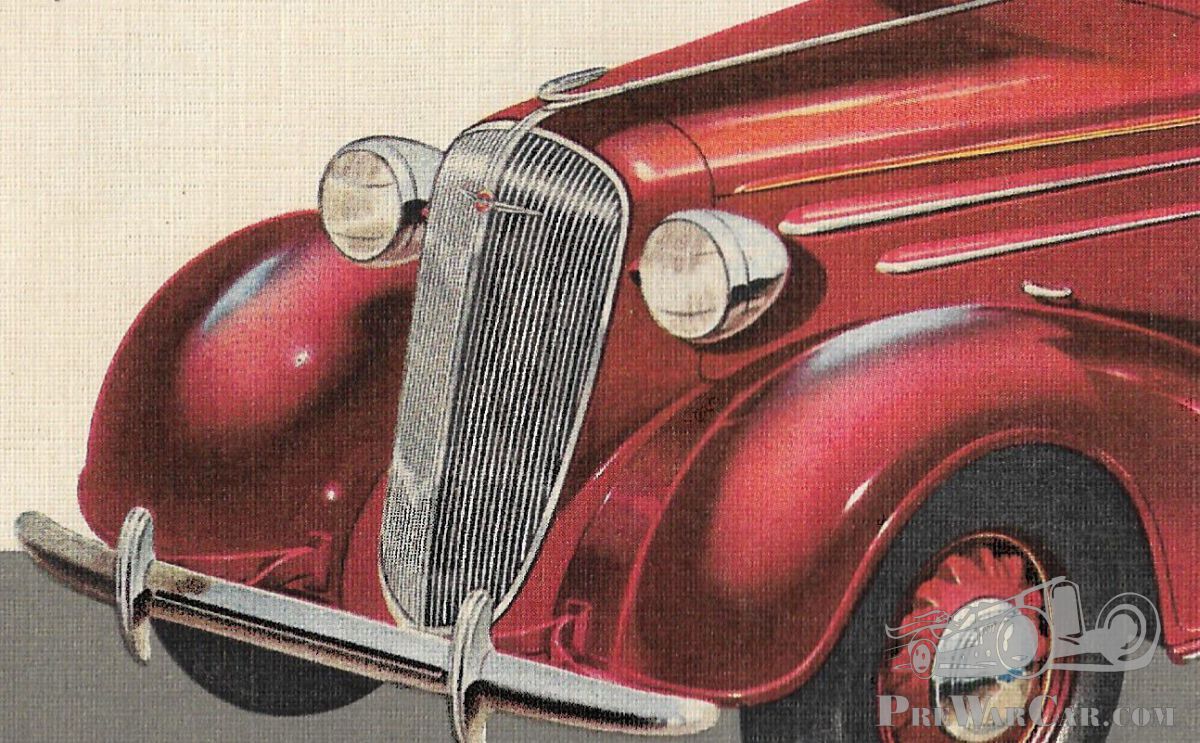
It is a 1935 Chevrolet Master Deluxe Series ED/EA. This car seems to have the larger boot/trunk and would therefore be either the two-door Town Sedan or the four-door Sport Sedan. The 1935 Series ED/EA featured the new "Turret Top" body from the Fisher Body Co., which was also available for the Standard Series FC from 1936, but then with the new Art Déco grille. The car had a 3.4-litre (206.8 c.i.) six-cylinder engine producing 80 b.h.p., three-speed gearbox and a 113-inch wheelbase.
Per saperne di più
Timo Laitinen
15 Giugno 2024, 09:32
A 1935, definitely. One difference: the vertical grille bars in the 1936 model are slightly curved; in the 1935 they are straight.
Per saperne di più
John Elema
10 Giugno 2024, 13:32
Chevrolet's 1935 and 1936 models were very similar. Nevertheless, I believe this one is from 1935 since it has a covered starting handle hole in its radiator cover. The 1936 models don't show this anymore. There were two- and four-door models, all part of what was called the Master de Luxe series.
Details from 'Sixty Years of Chevrolet' by George H. Dammann.
Per saperne di più
Details from 'Sixty Years of Chevrolet' by George H. Dammann.
Rutger Booy
10 Giugno 2024, 07:25
The license plate HZ-5147 was issued on December 31st, 1932, to Gerrit Cornelis van Kleij at Koninginneweg 192, IJsselmonde. Perhaps a relative?
Per saperne di più
Steve Diggins
10 Giugno 2024, 06:04
It is a 1936 Chevrolet, which would have been quite a large car in Europe.
Per saperne di più
Gerrit Cornelis van Kleij is not known to me. He would have been the first owner of the number plate in 1932? But the car is from a later date. I don't know precise how the registration system worked back then. Plates were personal and could be transferred to another vehicle, but if it was possible to sell the personal number plate I don't know.
Thanks and regards,
Vincent