La rivista e il marketplace globale per gli appassionati di auto d’epoca, creati da appassionati.
La rivista e il marketplace globale per gli appassionati di auto d’epoca, creati da appassionati.


Filter
Faccia la sua scelta
- Automobile
-
Marca >>
-
Anno >>
-
- Motociclette
-
Ubicazione >>
- Parti e altro
-
Marca dell'auto >>
-
Produttore >>
-
Categoria >>
- Biciclette
-
Anno >>
-
Paesi



Requesting information about pre-war cars converted to gas


This wonderful old black and white video shows a car converted to gas. Which leads us to the following message we received from Richard. He sent in the story below:
“MG 3880 is the registration plate of a PA M.G. rebuilt by my father in 1940 after she crashed into the back of an un-light tramcar while changing direction at the end of it’s run in the blackout. Father was very much a hands-on chap and I believe he rigged up the car to run on gas, probably cobbling together all sorts of bits and pieces.
I have seen many photos of vehicles with gas inflated bags on their roofs and I have wondered how father did it with bottled gas. Bags just deflate under gravity but bottles have to be pressurised, did my father buy commercial bottle gas or did he have the means to pressurise a cylinder? In the back of my mind, I seem to remember him telling me he ran the car on town gas.
One of the earliest photos of me is sitting at the wheel of MG 3880 and I have been looking for her for many years, last known in Essex back in the 60s but still recorded with DVLA, I live in hope.
I am a member of MGCC and owner of a couple of M.G.s, I have a posting on the MMM website and an article in Triple M Bulletin as yet nobody has sighted MG 3880 so I have been draughting a further article using the gas theme. I feel sure there will have been articles in the motoring press of the time about gas conversions that father more than likely may have read, though only the thought would get him designing his own system.”
Thank you, Richard, for your sharing. Now we are wondering if there is anyone who can help. We are looking for general information about pre-war cars converted to gas (during WW2). For instance material or instructions on how this was done and how the gas was controlled.
Help would be very much appreciated. Please comment below.
Words by the editor. Story sent in by Richard Verrill.
Pubblicato:
martedì ottobre 2nd, 2018
Facebook
LinkedIn
Twitter
WhatsApp
Email
Copy
Commenti
Arnoud van der Sman
03 Ottobre 2018, 10:30
gord french
02 Ottobre 2018, 20:40
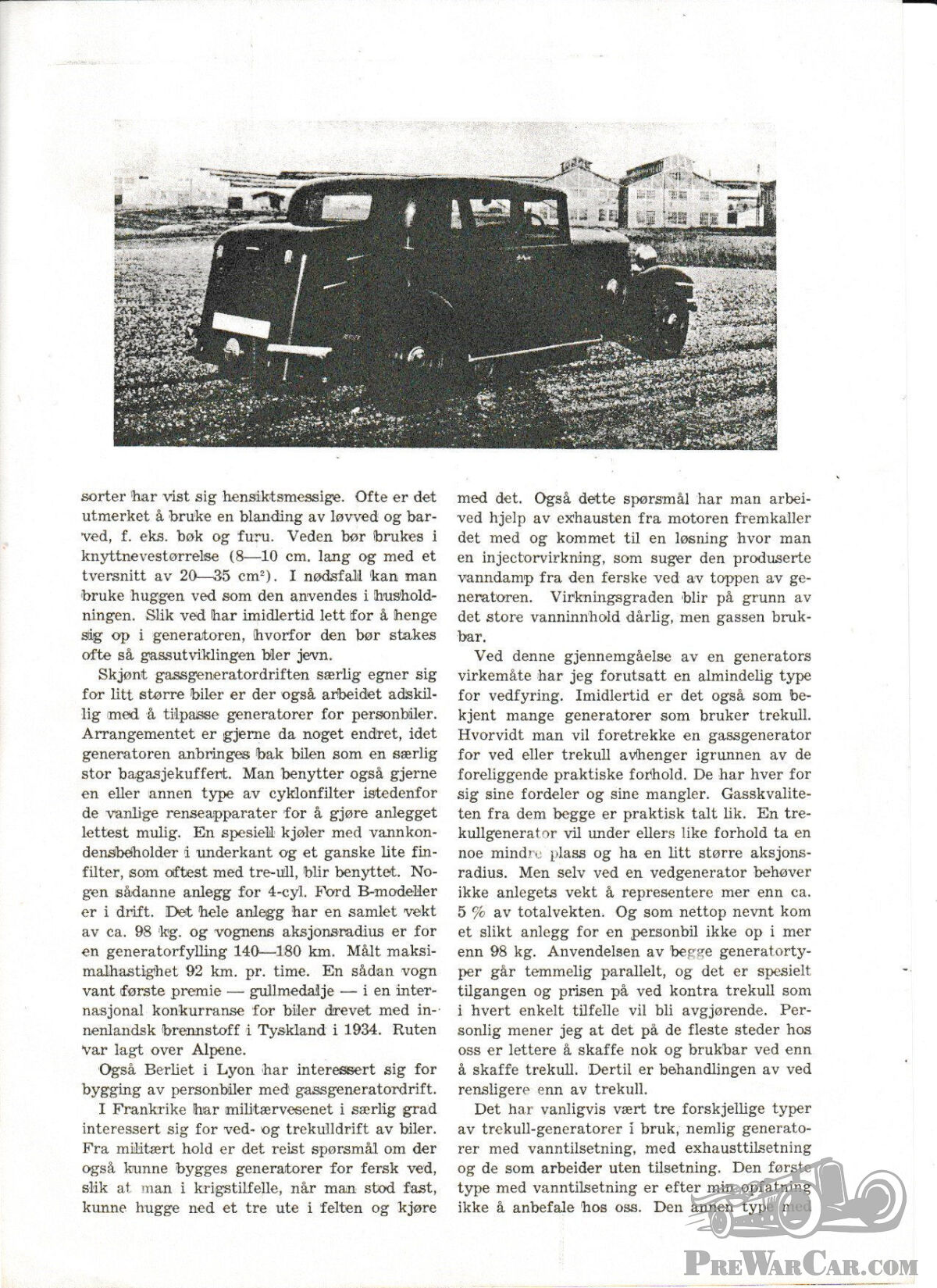
From Canada. I have a 26 page article on gas generators that appears to be war time. Unfortunately for me, it is, I think, Norwegian, but correct me if I'm wrong. Probably a gold mine for anyone researching this system. I have included a couple of sample pages. If anyone is interested contact me. I was given these by an older Danish fellow who worked for me in the 80's.
Per saperne di più
John Bates
02 Ottobre 2018, 11:51
If the car in the photo. is an M.G. PA, it looks to me like the Airline Coupe version.
Per saperne di più
Albert Baas Van Ittersum
02 Ottobre 2018, 09:29
I have somewhere in my just moved documentation a small leaflet, giving directions for a wood gasifier. I cant find it right now, but it detailed the making of wood gas and its use to keep motors running. It was a stencilled leaflet, possibly circulated by an amateur here in Holland. Already The gas resulting from such a contraption is a mix of carbon monoxide, combustible gas of methane and ethane and propane and alcoholic fractions, and steam. It could be used instantly, with a heavy and hot boiler type machine grafted to and spoiling your car, or it could be made in some containing vessel or pressurised container. Pressurising had some good effects, as it made the bad combusting bits trickle out as tarry goo. Putting it in a pressurised container could be done by feeding it through something as simple as an air compressor or tire pump. There were some safety thoughts, but, hey desperate times provoke desperate measures. People where struggling to keep their businesses and lively hood afloat.
Anyhow, you can conclude from the above, it was bad fuel obtained by hard graft and risks, but better than nothing when leftover petroleum was used up in petrol cars with a preheater carburetter and two headgaskets under the cylinder head to lower compression to avoid diesel pinking.
I have even heard of acetylene being used to carbonize engines to an early grave.
Remember, in the end even tyres were made of blocks of wood strapped together. People having handcart or horses were the only ones going on until famine and winter even got them. Automobiles are a high maintenance luxury, people will hang on right to the end, and sometimes beyond. We all know of the horse drawn luxury car pictures.
Per saperne di più
Anyhow, you can conclude from the above, it was bad fuel obtained by hard graft and risks, but better than nothing when leftover petroleum was used up in petrol cars with a preheater carburetter and two headgaskets under the cylinder head to lower compression to avoid diesel pinking.
I have even heard of acetylene being used to carbonize engines to an early grave.
Remember, in the end even tyres were made of blocks of wood strapped together. People having handcart or horses were the only ones going on until famine and winter even got them. Automobiles are a high maintenance luxury, people will hang on right to the end, and sometimes beyond. We all know of the horse drawn luxury car pictures.
if you google this you get enough information ( I'm sure I have documentation about is myself)
on the picture: I see a tank with legs , seems to be ex-household