La rivista e il marketplace globale per gli appassionati di auto d’epoca, creati da appassionati.
La rivista e il marketplace globale per gli appassionati di auto d’epoca, creati da appassionati.


Filter
Faccia la sua scelta
- Automobile
-
Marca >>
-
Anno >>
-
- Motociclette
-
Ubicazione >>
- Parti e altro
-
Marca dell'auto >>
-
Produttore >>
-
Categoria >>
- Biciclette
-
Anno >>
-
Paesi



Seeking id

Letter to the editor
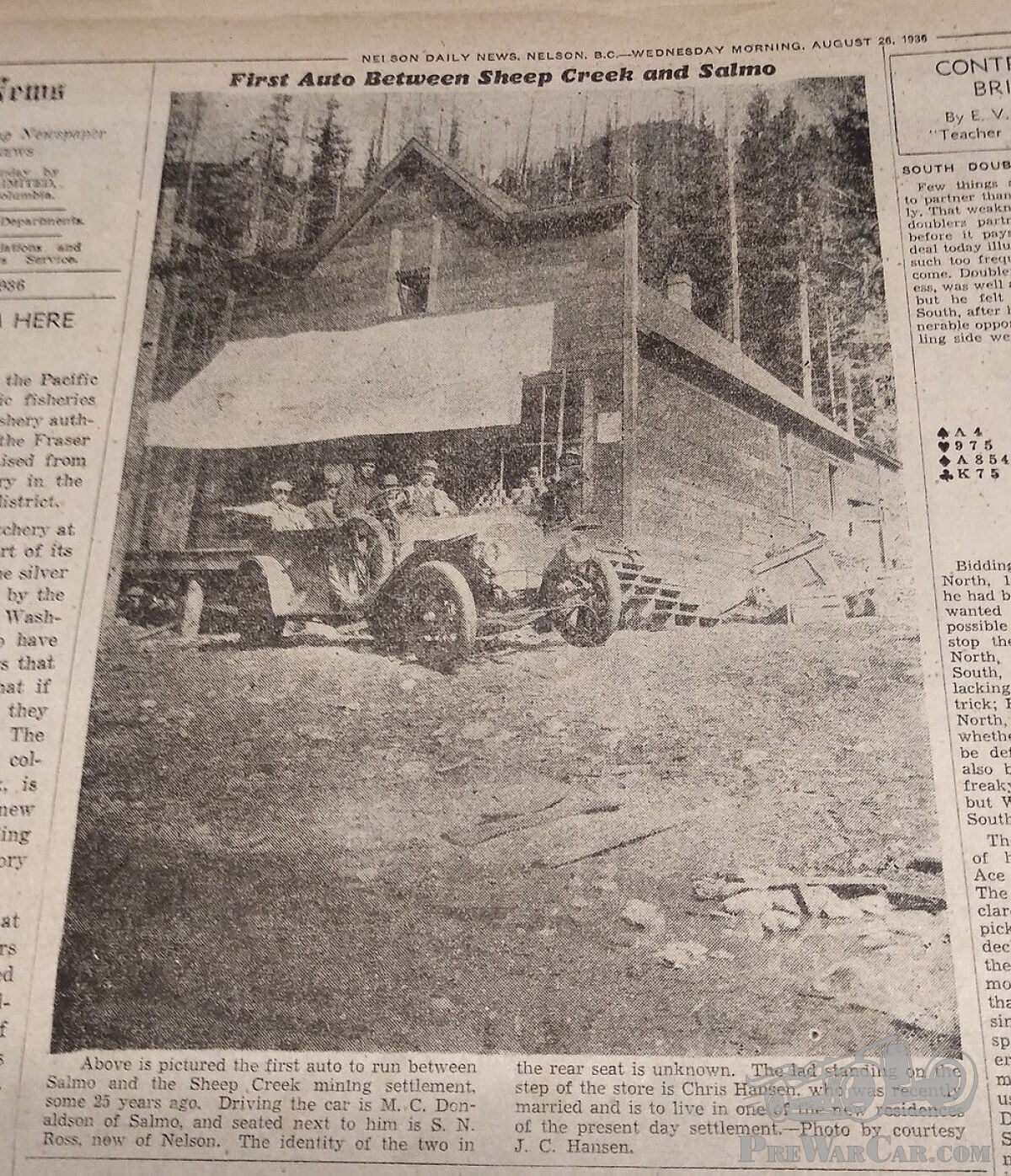
Here is a photo of a car taken around 1910. It has an interesting bit of history in the Kootenay region, which is in south east BC. This is a very rugged mountainous area, so the journey by car must have been areal challenge. Although the photo is not the best of quality I think it shows enough that an id can be made, ie, it looks to have a tall filler neck on theradiator and the steering linkage looks to be in front of the axle. It also looks expensive. The right front fender has hit something and is bent. So, what is it?
Thanks, Steve Diggins
Pubblicato:
sabato agosto 14th, 2021
Facebook
LinkedIn
Twitter
WhatsApp
Email
Copy
Commenti
Ariejan Bos
16 Agosto 2021, 10:29
Yes, indeed not a very sharp picture and definitely a challenge. Nonetheless many details are visible, which seem to make an identification feasible. An important detail is the segmented radiator: the amount of cars having used these is restricted. Other important details are the tie rod in front of the slightly bent front axle and the shape of front as well as the rear fenders. Unclear is the top of the radiator shell: is it flat or round? Isn't that a light badge on the radiator top? And indeed the rad filler tube seems to be a high one, although it is all a bit blurry over there.
I checked all cars with a segmented radiator and more or less similar rad shape in my archive between 1908 and 1911, like Amplex, Haynes, Locomobile, Stevens-Duryea, Stoddard-Dayton and Velie, but on the basis of the observed details none these showed a match.
However accepting that the top of the radiator with filler tube was too blurry to use for identification, the uploaded picture of a 1911 Stoddard-Dayton comes close, very close! And even the right front fender has been distorted in the same way ... It certainly is not an id with 100% certainty, but it is the best I can give for the moment.
Per saperne di più
I checked all cars with a segmented radiator and more or less similar rad shape in my archive between 1908 and 1911, like Amplex, Haynes, Locomobile, Stevens-Duryea, Stoddard-Dayton and Velie, but on the basis of the observed details none these showed a match.
However accepting that the top of the radiator with filler tube was too blurry to use for identification, the uploaded picture of a 1911 Stoddard-Dayton comes close, very close! And even the right front fender has been distorted in the same way ... It certainly is not an id with 100% certainty, but it is the best I can give for the moment.