La rivista e il marketplace globale per gli appassionati di auto d’epoca, creati da appassionati.
La rivista e il marketplace globale per gli appassionati di auto d’epoca, creati da appassionati.


Filter
Faccia la sua scelta
- Automobile
-
Marca >>
-
Anno >>
-
- Motociclette
-
Ubicazione >>
- Parti e altro
-
Marca dell'auto >>
-
Produttore >>
-
Categoria >>
- Biciclette
-
Anno >>
-
Paesi



The head shepherd was seen as a better matrimonial match than a driver
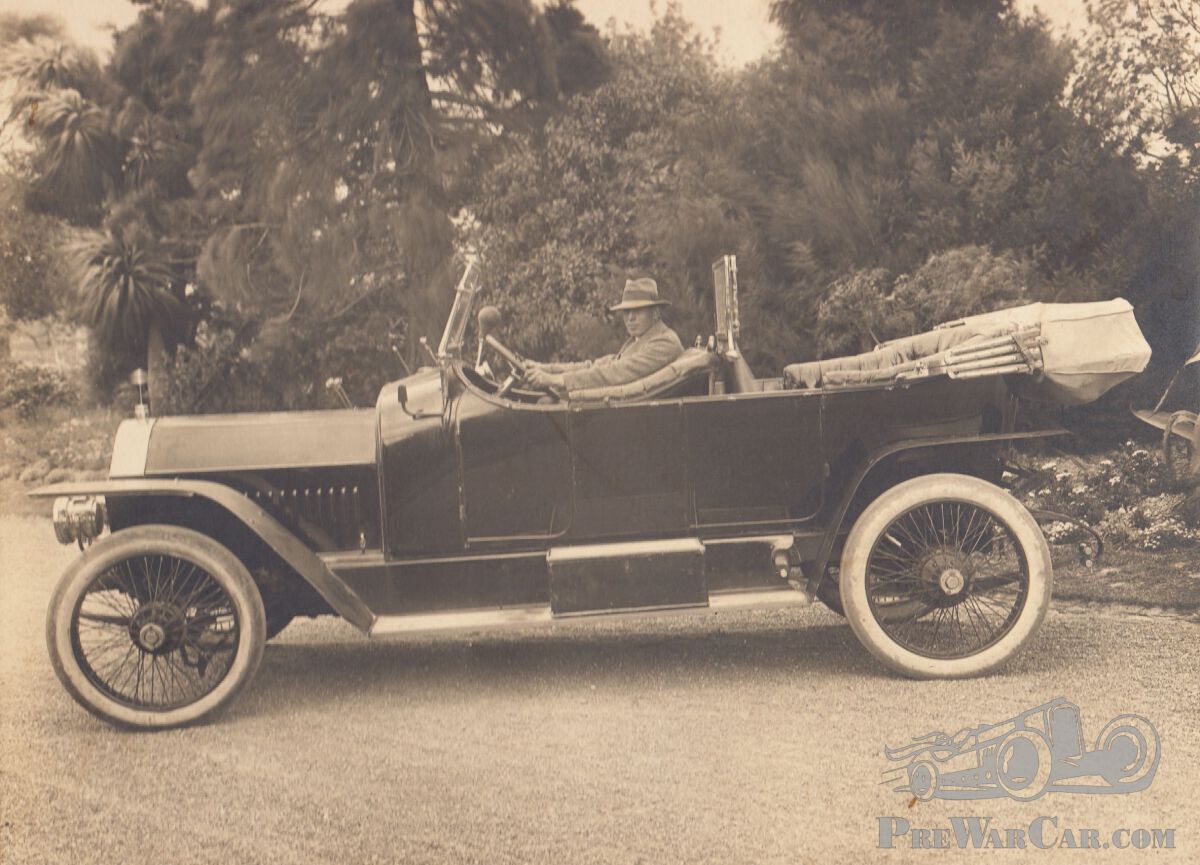

Brian Walker sent us this photograph of his great uncle. He was employed as a professional driver/mechanic for nearly ten years in the early part of last century. Most of this he worked at High Country sheep stations on the South Island of New Zealand.
The photo was taken on the 12th of March 1915 and shows his great uncle in a 20HP Henroid valved Darracq (?) at his last employed job. Soon after, he enlisted with the New Zealand Expeditionary Force and served in Belgium. He didn't need to enlist. And had eyes for the station owner’s daughter, but that relationship was thawted by her father. The head shepherd was seen as a better matrimonial match than a driver. Soon afterwards he was on a boat to Europe. Unfortunately, this was a one-way trip.
Thank you very much for sharing Brian. Can anyone tell us if there are any surviving 20HP Henroid valved Darracq examples, similar to the one in the picture, still around?
Pubblicato:
lunedì marzo 2nd, 2020
Facebook
LinkedIn
Twitter
WhatsApp
Email
Copy
Commenti
David GREEN
02 Marzo 2020, 19:51
David GREEN
02 Marzo 2020, 16:26
I need to correct myself. The transition from square front edge to a more rounded form seems to have occurred about 1914, and may have coincided with the switch from acetylene lamps to CAV electric headlamps.
Per saperne di più
David GREEN
02 Marzo 2020, 16:19
I doubt this is a Darracq. The immediate concern is the radiator, which clearly has a square front edge. That, together with its position well forward of the front axle, the tall radiator cap, and the long bonnet suggest it is a Napier. Darracq's from this period had round-edged radiators which sat slightly further back. However, I am not familiar with the hub-caps, which do not seem to be Napier.
If it is a Henriod-valved Darracq, its survival in functional order in 1915 would seem to be a minor miracle. The Henriod valve was a rotary valve that handled both inlet and exhaust, depending upon its rotational position. Darracq seems to have insisted that all engines after 1911 were fitted with the valve, but accounts suggest these engines were complete dogs. Darracq was forced out of the company bearing his name as a direct result, either in 1912 or 1913, and he appears to have sold out of the company at about the same time. A commercial rescue operation was mounted in which the engines were replaced by Rover engines. Apart from performance, the Henriod valve tended to seize. This is not surprising. A cross-sectional diagram in the Wikipedia article on Alexandre Darracq shows it to have a substantial area of contact with the cylinder it rotates in, and lubrication must have been a problem, particularly with the hot exhaust gases.
Per saperne di più
If it is a Henriod-valved Darracq, its survival in functional order in 1915 would seem to be a minor miracle. The Henriod valve was a rotary valve that handled both inlet and exhaust, depending upon its rotational position. Darracq seems to have insisted that all engines after 1911 were fitted with the valve, but accounts suggest these engines were complete dogs. Darracq was forced out of the company bearing his name as a direct result, either in 1912 or 1913, and he appears to have sold out of the company at about the same time. A commercial rescue operation was mounted in which the engines were replaced by Rover engines. Apart from performance, the Henriod valve tended to seize. This is not surprising. A cross-sectional diagram in the Wikipedia article on Alexandre Darracq shows it to have a substantial area of contact with the cylinder it rotates in, and lubrication must have been a problem, particularly with the hot exhaust gases.
Ariejan Bos
02 Marzo 2020, 14:35
At first I had serious doubts if this car was a Darracq. Then I decided that most of the car is Darracq, except for the bonnet and radiator. The radiator is too wide and is placed well ahead of the front axle, which you never see with a Darracq. So the question for me is: what happened? Accident perhaps? Or improved cooling?
Per saperne di più
How can successful car designer's make such terrible mistakes? It reminds me of William Morris' 6 cylinder bullnose, a beautifully-proportioned car of which 50 were made. Unfortunately, Morris decided to economise on the engine and used standard bullnose parts (nothing wrong there), but with a 2-bearing, 6-journal crankshaft. These cars could barely be started without their crankshafts breaking. Morris realised his mistake and sadly decided not to stabilise the crankshaft with extra bearings. The remaining cars were buried under the Cowley factory.