La rivista e il marketplace globale per gli appassionati di auto d’epoca, creati da appassionati.
La rivista e il marketplace globale per gli appassionati di auto d’epoca, creati da appassionati.


Filter
Faccia la sua scelta
- Automobile
-
Marca >>
-
Anno >>
-
- Motociclette
-
Ubicazione >>
- Parti e altro
-
Marca dell'auto >>
-
Produttore >>
-
Categoria >>
- Biciclette
-
Anno >>
-
Paesi


The perils of the road: reflections on an early accident
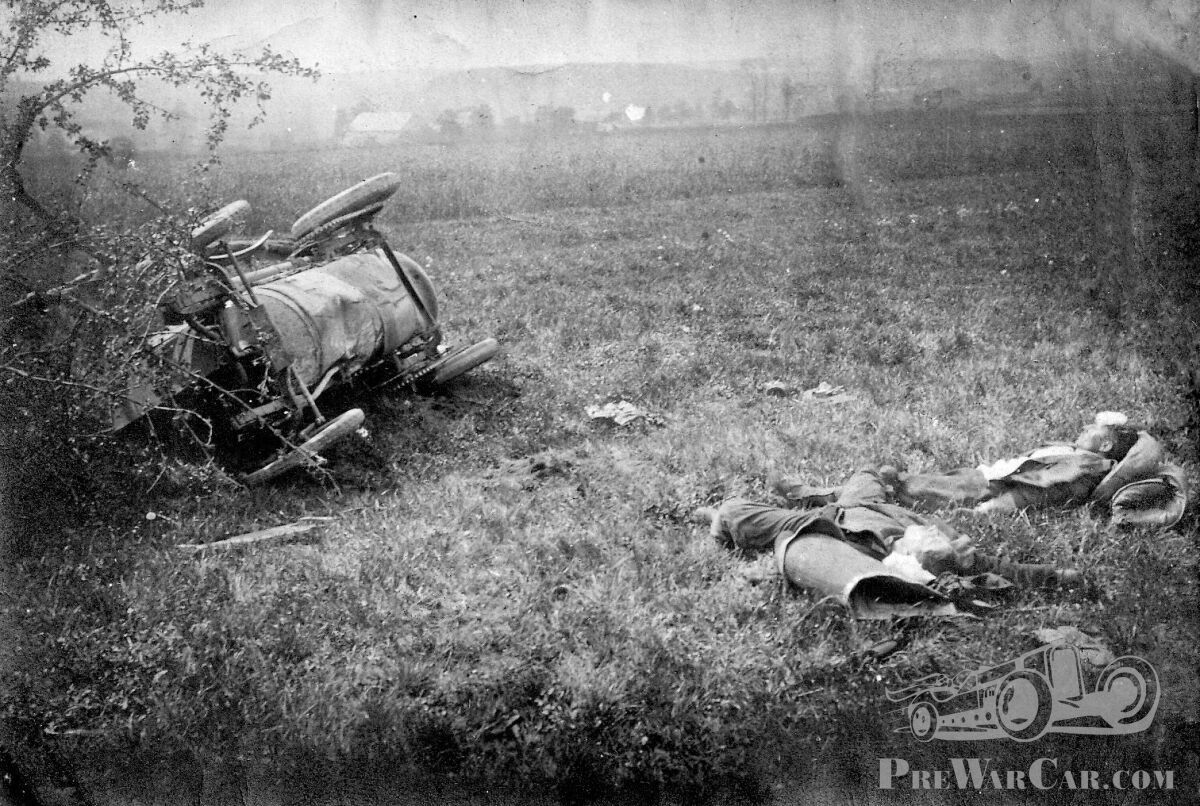

Photographs sometimes appear in the most unexpected places, and this one certainly came as a surprise when it was unearthed at a motorcycle autojumble in Europe by reader Luc Ryckaert. As with so many early motoring photographs, it raises a lot of questions.
It's probably pointless to ask what the car might be, as we're sure it must be beyond the identification of even our most expert readers, but we'll be pleased if anyone can prove us wrong. As for the location, we'd think it must be somewhere in Europe, possibly France or Belgium. A more pertinent question would be: how did this accident happen? What caused this terrible scene?
There are dozens of plausible answers to that question. The early days of automobile travel were fraught with hazards, especially on rough, unmade roads through rural regions. Accidents could be caused by potholes and other road defects, dust clouds, or wild animals and stray dogs in the road, to name some common dangers. It might have been that this particular one was the result of a mechanical failure, which could conceivably have stemmed from an earlier mishap. A collision with a stray dog, for instance, might not have been immediately catastrophic, but if the car's steering was damaged as a result then trouble might have occurred later on. Then again, it could well have been caused by a problem that certainly hasn't diminished as cars and roads have developed: that of driver error, whether through inattentiveness, over-exuberance or an innocent misjudgment.
What has been noted is the absence of any crowds attending to the car or its passengers, neither to help nor to gawp, although at least one of the occupants has received some attention. That doesn't tell us much, except that the accident probably did not occur during a race, and it must have happened a reasonable distance from the nearest village so as not to have attracted all the local gossips, for whom such a morbid scene might have provided a good week's worth of speculative chatter.
It would be our guess that a passing traveller, perhaps a farmer or agricultural labourer, chanced upon the accident and did the responsible thing in going as fast as possible to find the nearest police constable. Someone from the local constabulary probably took the photograph for official purposes and, 120 years later, it wound up at an autojumble.
Words: Zack Stiling; picture: Luc Ryckaert
Pubblicato:
martedì aprile 23rd, 2024
Facebook
LinkedIn
Twitter
WhatsApp
Email
Copy
Commenti
David Grimstead
29 Aprile 2024, 16:31
Michel Pilette
03 Maggio 2024, 17:46
Correct. The accident occurred on the return journey of my grandfather to Belgium after maintenance of the car in Germany. Thanks for the additional information, of which I was not aware.
Kind regards,
Michel Pilette
Per saperne di più
Kind regards,
Michel Pilette
Luc Ryckaert
25 Aprile 2024, 09:27
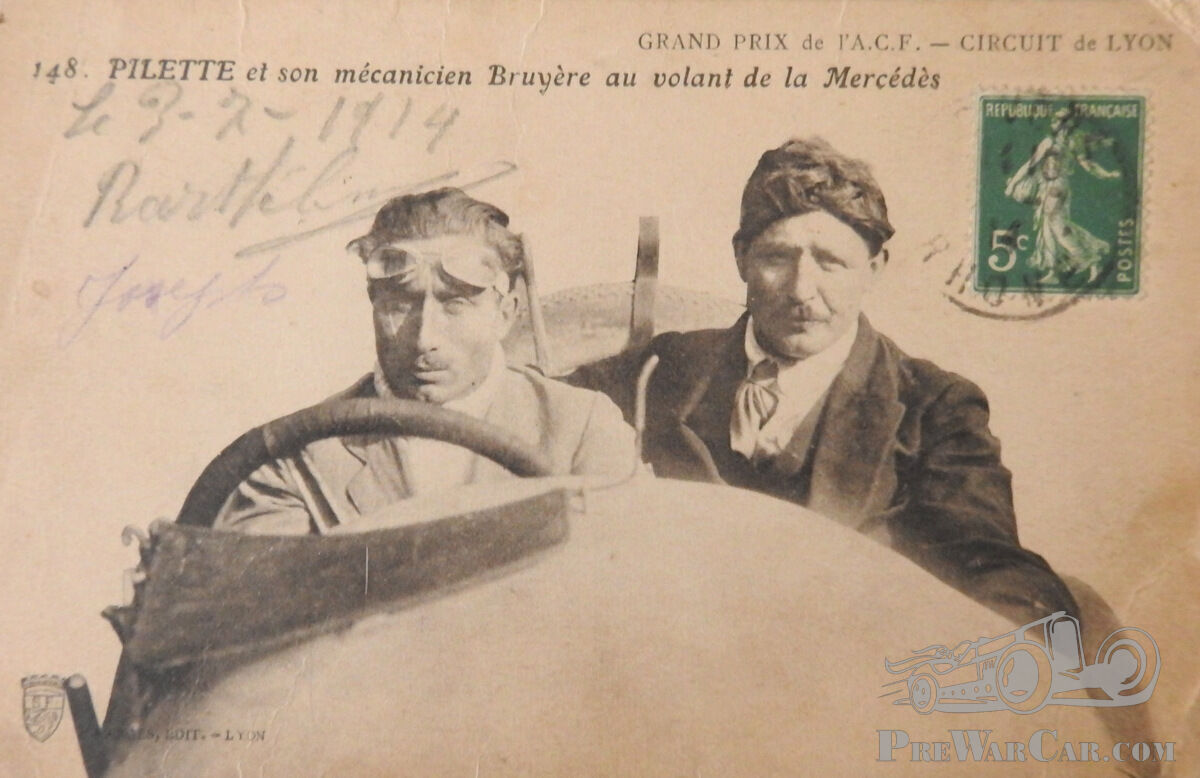
Thanks to Nick Jonckheere (The Automobile contributor), I know what happened before this sad photograph was taken. Théodore Eugène Pilette was a Belgian racing driver, that started racing in 1913 and was the first Belgian to race at the Indianapolis 500. Located in Brussels, he was the Belgian importer for Bugatti and Mercedes. In 1921, his Mercedes was entered for a race at Brooklands, that took place on May 15th. The week before, he and his mechanic Bruyère drove the car to Stuttgart, to have the final preparations done at the factory. The journey back started on Thursday, and on Friday 13th they arrived in Luxembourg, where it all went wrong around 10.00 a.m. Near Steinfort, the Mercedes left the road and hit a tree. The driver and passenger were thrown out of their car and later found unconscious. They never regained consciousness and died on the way to the hospital . Nevertheless, the passion for car racing remained in the Pilette family. Théodore was the father of auto racer André Pilette and grandfather of racer Teddy Pilette. Enclosed a picture of Pilette and his mechanic Bruyère taken at the Grand Prix de l'A.C.F., circuit de Lyon 1914.
Per saperne di più
Michel Pilette
03 Maggio 2024, 17:54
Thank you for the useful information. My grandfather's full name was Théodore Jean Henri Pilette, not Eugène. He started racing at the turn of the century, starting with a De Dion tricycle.
Per saperne di più
Graham Edwards
24 Aprile 2024, 08:15
Perhaps a ’staged’ photograph? I hope so! It appears well composed. Does look like a Mercedes radiator. Some kind of motorsport ’health and safety’ campaign shot??
Per saperne di più
Michel Pilette
03 Maggio 2024, 17:56
This is the copy of the original picture of the death of my grandfather.
Per saperne di più


Stuart Griffin
23 Aprile 2024, 21:48
Hi. A really interesting photo. I am concerned the two men I see in the photo are not in the best of health, and in fact may have departed this mortal coil, of their presumed injuries.
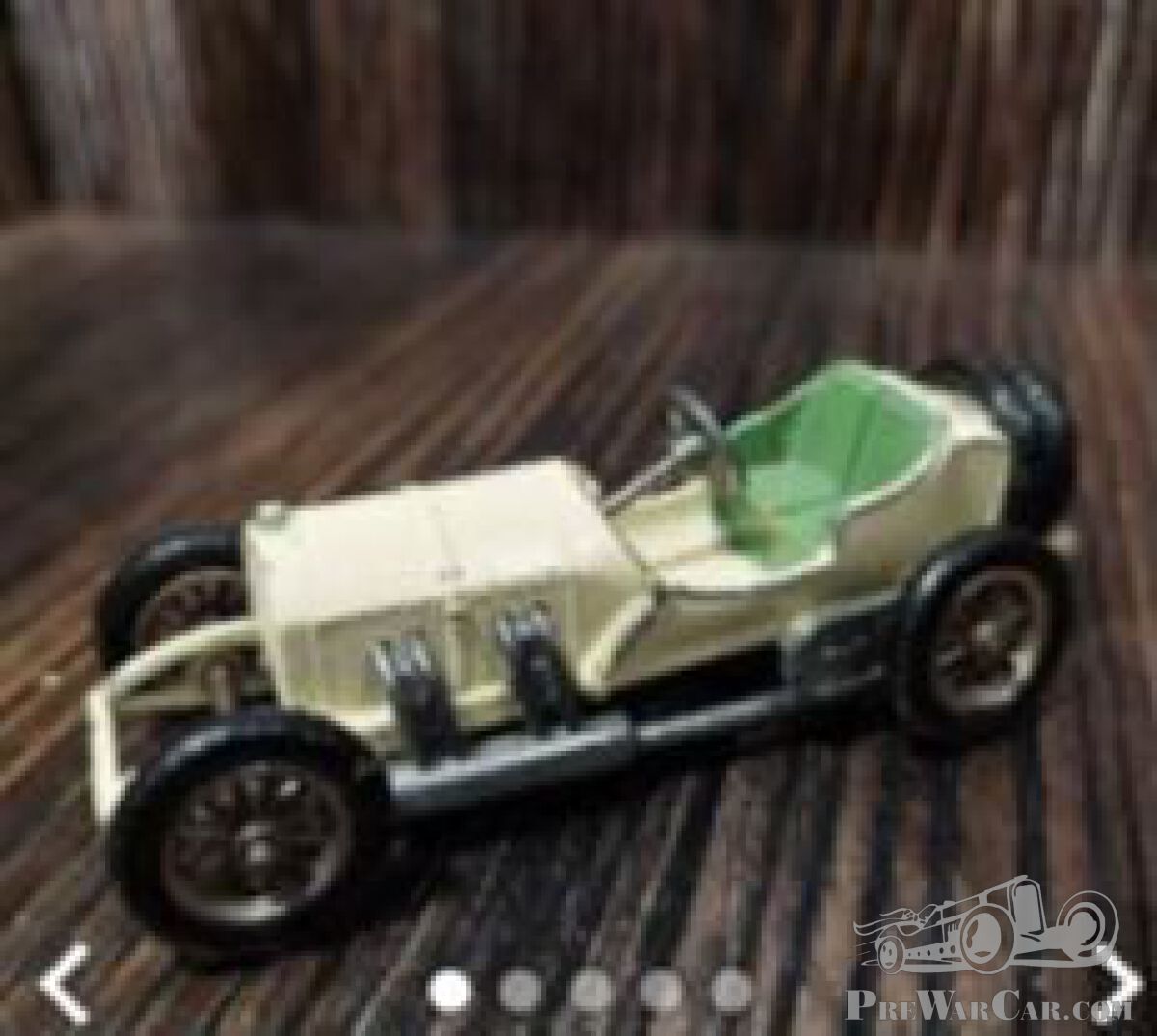
The bottom of the rolled car looks rather like the bottom of the 1908 Mercedes racer, in the Models of Yesteryear range, I played with as a child—possibly played with a little too much bearing in mind the time it spent upside down. Chain-drive with mighty drive sprockets, hefty and large diameter wheels and the underbody fairings throughout. It also featured a massive Left Hand external exhaust system and was right-hand drive.
Its has to be sobering to realise the carnage the early motorists endured, with awful roads, frequent punctures and mechanical reliability, brakes which were marginal at best and really no human protection.
No seat belts even, and yet it took a long time to realise being thrown from a couple of tons of high speed steel could rarely have a good outcome. Most sobering is to realise too many folk still seem to thing the most basic of safety measures don't really need to apply to them.
I am intrigued to know more of the true story, and hope my interpretation is complete nonsense, and the passengers are merely resting after a truly lucky escape,
Regards,
Stuart
Per saperne di più
The bottom of the rolled car looks rather like the bottom of the 1908 Mercedes racer, in the Models of Yesteryear range, I played with as a child—possibly played with a little too much bearing in mind the time it spent upside down. Chain-drive with mighty drive sprockets, hefty and large diameter wheels and the underbody fairings throughout. It also featured a massive Left Hand external exhaust system and was right-hand drive.
Its has to be sobering to realise the carnage the early motorists endured, with awful roads, frequent punctures and mechanical reliability, brakes which were marginal at best and really no human protection.
No seat belts even, and yet it took a long time to realise being thrown from a couple of tons of high speed steel could rarely have a good outcome. Most sobering is to realise too many folk still seem to thing the most basic of safety measures don't really need to apply to them.
I am intrigued to know more of the true story, and hope my interpretation is complete nonsense, and the passengers are merely resting after a truly lucky escape,
Regards,
Stuart
Ben Collings
23 Aprile 2024, 15:51
Looking at the picture I think it might be a Mercedes racing car from 1910/12 due to the distinctive front and rear axles, the narrow section chain with large sprockets, the outside exhaust collector tube and cable rear brakes.
It also appears to have a large vee-fronted radiator supported by a cross tube that drops down in the centre. I think it has wooden wheels (both of these things rule out the 1913 factory racers) as well as having a rear-mounted spare tyre. Maybe they were out road testing due to the front axle-mounted number plate?
Per saperne di più
It also appears to have a large vee-fronted radiator supported by a cross tube that drops down in the centre. I think it has wooden wheels (both of these things rule out the 1913 factory racers) as well as having a rear-mounted spare tyre. Maybe they were out road testing due to the front axle-mounted number plate?
Richard Smith
23 Aprile 2024, 22:36
The starting handle remains in place the shape of which might help with identification.
Per saperne di più
Steve Diggins
23 Aprile 2024, 09:12
It looks like the three people laying in the grass are alive and waiting for a medic.
Per saperne di più
Tony Press
24 Aprile 2024, 04:06
I can only see two unfortunates and both look to be rather in trouble :-(
Per saperne di più
Luc Ryckaert
23 Aprile 2024, 09:00
In the meantime, thanks to Nick Jonckheere, I know the true facts of this photo. I will send my comment later, but first I'm too curious to see what the other PreWarCar readers think...
Per saperne di più
Richard Smith
23 Aprile 2024, 08:35
The car has chain drive, a full under tray, no wings and a side mounted exhaust pipe which suggests a racing car. Also notable for a smash-up of the day is that all four wheels appear to have survived the experience relatively intact.
Per saperne di più
“The day before the race Pilette, driving a Grégoire racer around the circuit for the last time before the contest, took a corner too fast at Longlier and crashed with terrific force against the roadside, which was made of rock. The automobile was broken to pieces and Pilette had his right arm crushed. His goggles were shattered into a thousand fragments and pieces of glass entered his eyes and forehead. His physician takes a hopeful view of his condition.”
Recovered from these injuries he competed there again in 1907 in a Vivinus (Liederkerke Cup) and a Mercedes (Circuit des Ardennes). From then he was a successful car agent and amateur racer for the latter until—déjà vu—May, 1921. Then, driving perhaps a version of the 9.2-litre 90 h.p. Type G-4F four-cylinder aero-engined and chain-drive G.P. Mercedes that he had driven to third place at Le Mans in 1913 and with little time left on the 13th of the month to get to Brooklands, he crashed near Steinfort/Capellen just 30 miles south-east of Longlier on the route back from Luxembourg to Brussels.
He and Bruyère died in futile preparation for a four-car wager race scheduled to run at the end of the May 16th, 1921, the Brooklands Whitsun Bank Holiday Monday meeting; to the winner, it was worth 80 guineas (approx. £5,153 today). It was unlikely that Pilette knew it had already been cancelled after Capt. John Hartshorne Cooper died crashing his Clerget-engined Mercedes in testing there on Thursday, May 12th, nor that Philip Rampon’s Martin-Arab (11.8-litre Sunbeam) had failed scrutineering, leaving just Count Zborowski’s Chitty-Bang-Bang. There was much reporting in Britain about Cooper’s demise but not Pilette’s, and much about the danger of hybrid aero-engined racers.