La rivista e il marketplace globale per gli appassionati di auto d’epoca, creati da appassionati.
La rivista e il marketplace globale per gli appassionati di auto d’epoca, creati da appassionati.


Filter
Faccia la sua scelta
- Automobile
-
Marca >>
-
Anno >>
-
- Motociclette
- Parti e altro
-
Marca dell'auto >>
-
Produttore >>
-
Categoria >>
- Biciclette
-
Anno >>
-
Paesi



Troopers' tourer: who can help with this Pyrenean wartime mystery?
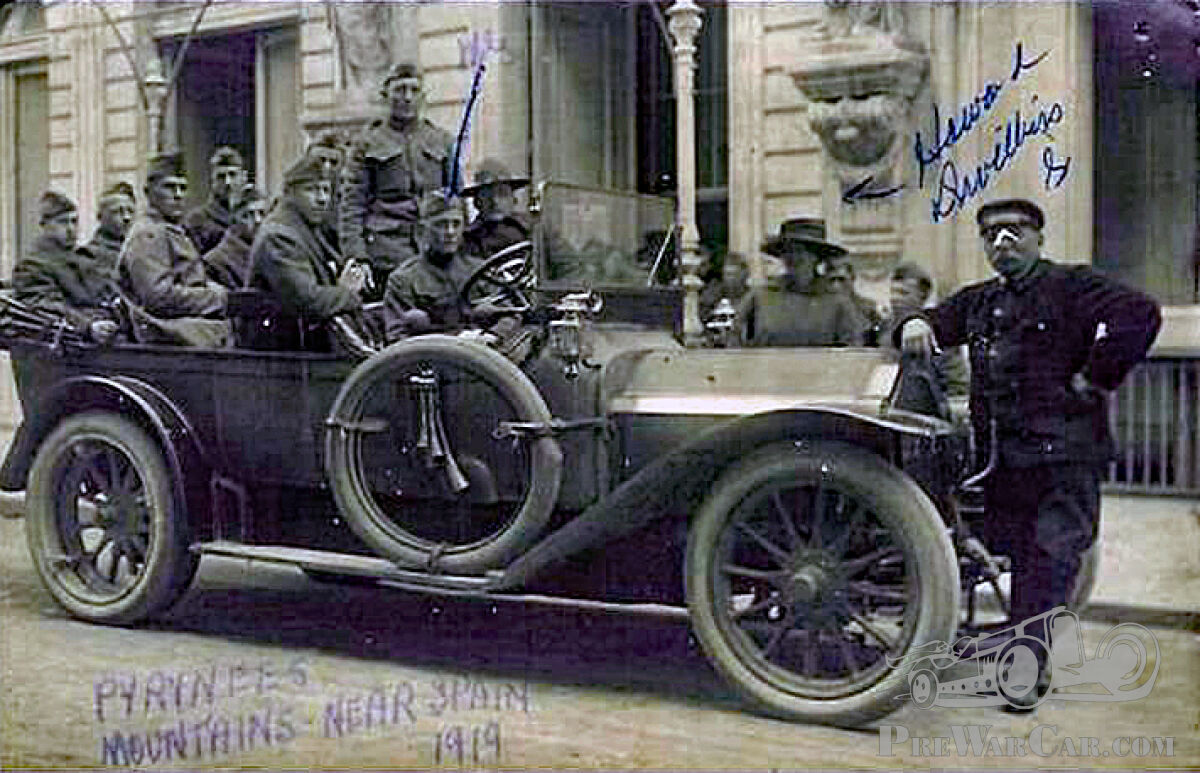

We have been pleased to receive a note from Lynn Divelbiss, who has unearthed this photograph of her grandfather, Howard Divelbiss Sr., and is curious to know more about it, including the identity of the car he's driving. As the caption to the photograph states, he was serving in the 333rd Regiment of the 84th Infantry Division of the U.S. Army. As we also know from the caption, the picture was taken in France, very close to the Pyrenees and the border with Spain.
It is undated, but those facts alone tell us that must date from very near the end of the Kaiser War. The 84th Division came into being at Camp Taylor, Kentucky, in September, 1917, where it remained in training until August, 1918. It was not despatched to France until October, where it would exist as a training formation for troops ultimately destined for the Western Front, but on November 11th the armistice was signed and, in January, 1919, the division was called home without any of its troops having seen front-line combat.
That's all very interesting, but it doesn't tell us much about the troop car, which we presume to be French. It's only really distinguishing feature seems to be it's extremely long body, but it's difficult to identify the chassis based on that. If we assume that it's construction dates from circa 1912, the French motor industry was booming at that point and there were dozens of manufacturers making large, handsome touring cars like this one. We'd hate to end this article without having a guess ourselves, though, and after a bit of thought, we've decided it's most likely a Peugeot.
What do you think? Let us know below...
Words: Zack Stiling; photograph: Lynn Divelbiss
Pubblicato:
lunedì marzo 25th, 2024
Facebook
LinkedIn
Twitter
WhatsApp
Email
Copy
Commenti
David Grimstead
28 Marzo 2024, 02:15
Lynn Divelbiss
21 Aprile 2024, 23:45
Mr. Grimstead: I cannot thank you enough for your comments. You have helped fill in several "pieces of the puzzle" of my grandfather's life! I recently came across a newspaper article of a letter he had written his mother. He entered France from Belgium and appears to have travelled the length of the country, through Paris, Versailles and down to the Pyrenees. We do not have dates attached to his comments, so your timeline is also helpful. Thank you!
Per saperne di più
David Grimstead
27 Aprile 2024, 23:33
Lynn,
Thank you. Researching is a pleasure, knowing the information helped with family history is icing on the cake. If you want to find the whole history of the 333rd Regiment it is in the record book of the WWI American Expeditionary Force, Volume 2, 1988, fully viewable on-line. The section covering the 84th Division, 167th Brigade and 33rd Infantry Division is on pages 366-371.
Per saperne di più
Thank you. Researching is a pleasure, knowing the information helped with family history is icing on the cake. If you want to find the whole history of the 333rd Regiment it is in the record book of the WWI American Expeditionary Force, Volume 2, 1988, fully viewable on-line. The section covering the 84th Division, 167th Brigade and 33rd Infantry Division is on pages 366-371.
Tim Hewitt
26 Marzo 2024, 00:20
You say it's undated! What enough the date, 1919, below the Pyrenees description clearly visible on the actual photo?I
Per saperne di più
Keith Kuehn
25 Marzo 2024, 23:31
I've got that horn here at home, still trying to get the durn thing to toot right... Some progress...
Per saperne di più
Jean de Suremain
25 Marzo 2024, 02:08
BJ
Ça ressemble a un bus torpédo Lorraine Dietrich 1907. Les roues sont idem capot jonction capot carrosserie et calandre.
---------------------------------------------------------------
Hello,
It looks like a 1907 Lorraine Dietrich torpedo bus. The wheels are the same, as are the junctions of the body, bonnet and radiator.
Per saperne di più
Ça ressemble a un bus torpédo Lorraine Dietrich 1907. Les roues sont idem capot jonction capot carrosserie et calandre.
---------------------------------------------------------------
Hello,
It looks like a 1907 Lorraine Dietrich torpedo bus. The wheels are the same, as are the junctions of the body, bonnet and radiator.
Another report in July, 1919, said: “DOUGHBOY'S MITE AT LOURDES. A large number of American soldiers made a pilgrimage to Lourdes recently. They attended Mass on their arrival at the shrine of Our Lady, then visited the Grotto and Shrine. and in the evening chanted a solemn Vespers and the Rosary. On their departure they suggested that each would give a Doughboy's mite, and the proceeds will be used towards placing a statue of Joan of Arc above the Rosary Church."
Howard Divelbiss Sr’s 333rd Regiment was part of the 167th Infantry Brigade of the 84th Division of the US National Army, which arrived in Liverpool between 6 September and 25 October 1918. Parts of the Division moved to Le Havre (25 September), to Neuvic, Dordogne (28th September), Le Mans, Sarthe (6 November), Camp de Souge, Gironde (25 November) and lastly, awaiting repatriation, Bordeaux (26 November 1918).
As it relocated, the Division was broken up and elements such as some artillery, machine-gunners and engineers were reassigned as replacements in other divisions but the untested remainder boarded ships at Brest and Bordeaux to return to Camp Taylor, Kentucky between 31st December 1918 and 26th July 1919. Its Trench Mortar Battery left Brest first, the Divisional Headquarters staff left from Bordeaux on the SS Wilhelmina on the 6th January 1919, arriving home via Hoboken, New Jersey by 26th January. Ammunition handlers left Bordeaux 2nd February, signallers 21st April and the remaining engineers from there reached New York 18th July 1919.
It's unlikely Divelbiss did the driving. In the photo, there is a liveried chauffeur leaning on the car’s radiator who, having ten passengers on board, has taken the precaution of fitting a detachable dual-tyre rim at the rear.
One legacy the American Army left in France, apart from an extensive telephone network, several new docks and the world’s most powerful radio transmitter at Bordeaux, was reportedly 100,000 automobiles, which the French government refused to allow to be sold to the public—they were all burned to scrap.