La rivista e il marketplace globale per gli appassionati di auto d’epoca, creati da appassionati.
La rivista e il marketplace globale per gli appassionati di auto d’epoca, creati da appassionati.


Filter
Faccia la sua scelta
- Automobile
-
Marca >>
-
Anno >>
-
- Motociclette
-
Ubicazione >>
- Parti e altro
-
Marca dell'auto >>
-
Produttore >>
-
Categoria >>
- Biciclette
-
Anno >>
-
Paesi



Da Torino a Brighton: una Fiat dal passato britannico
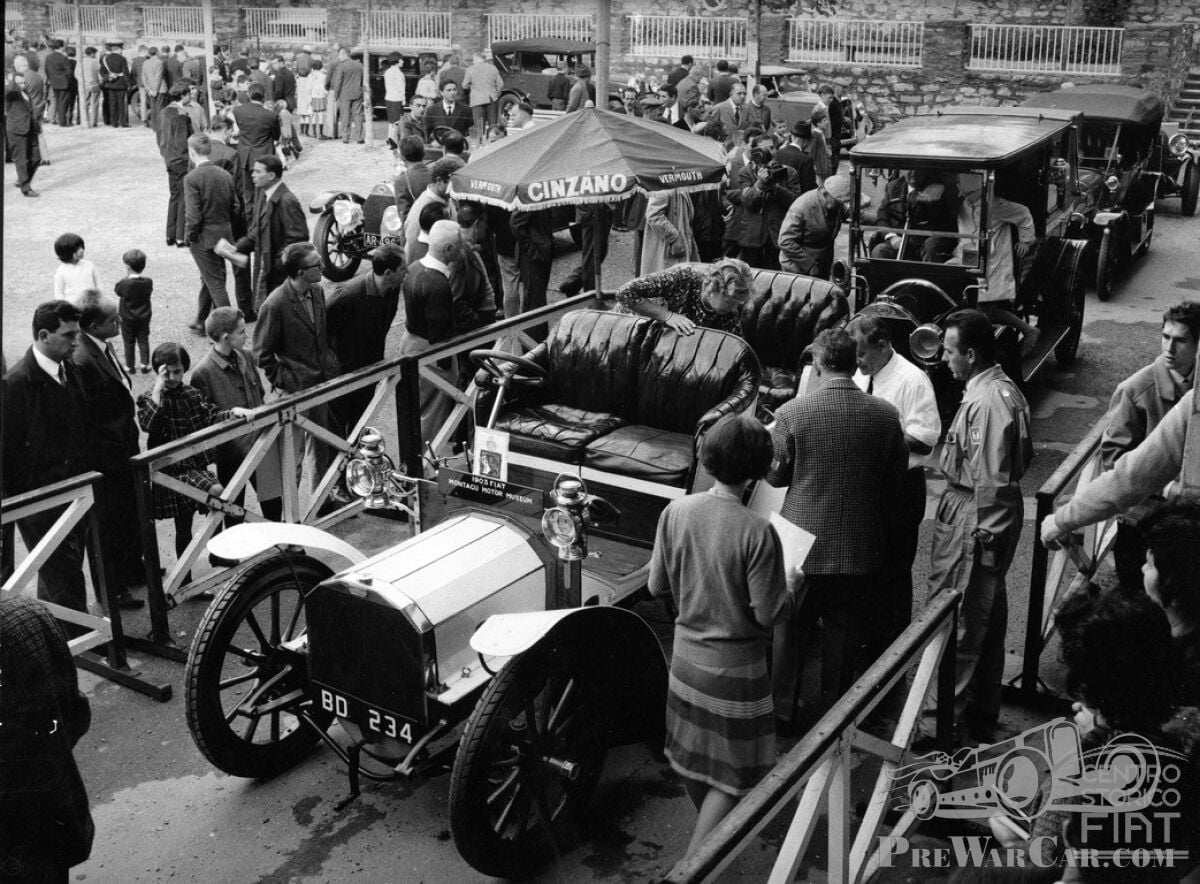
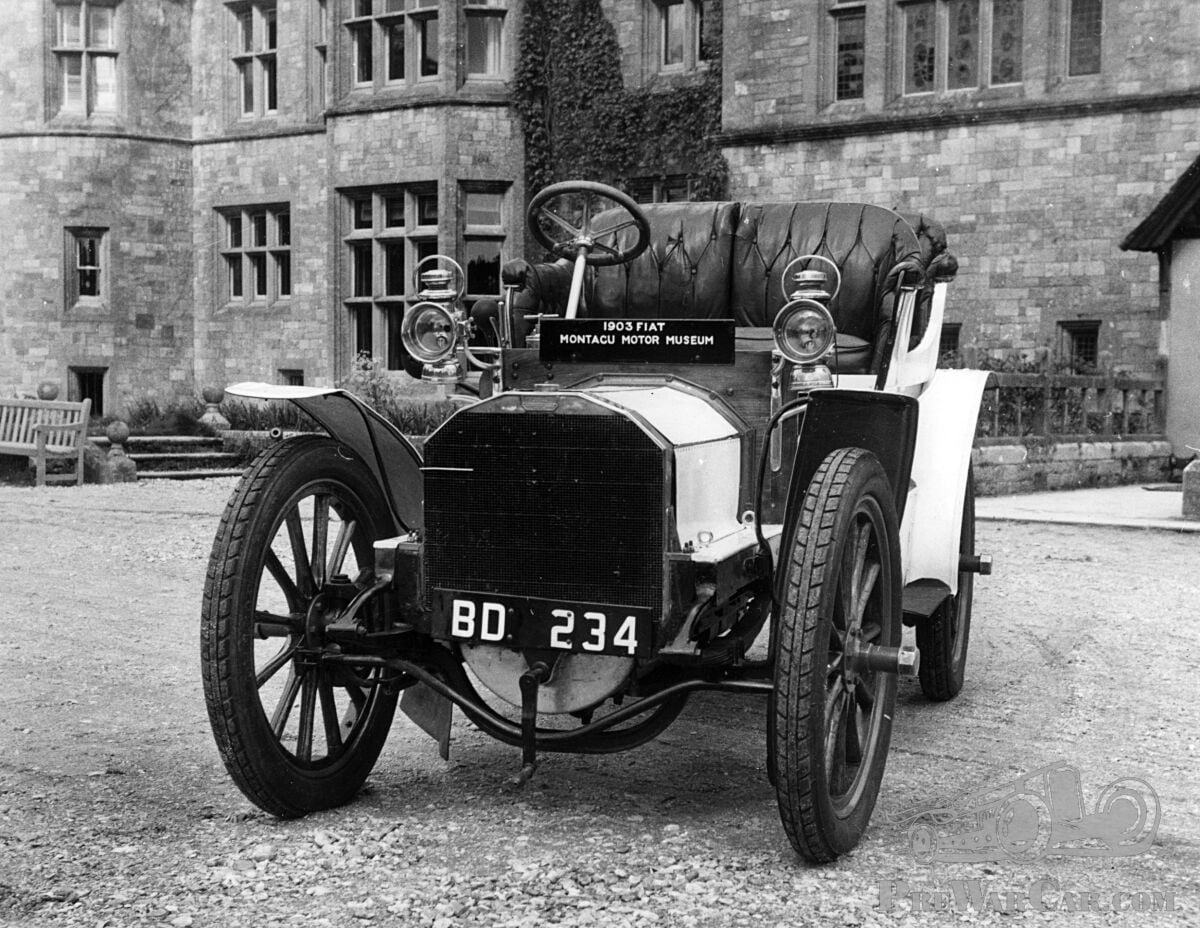
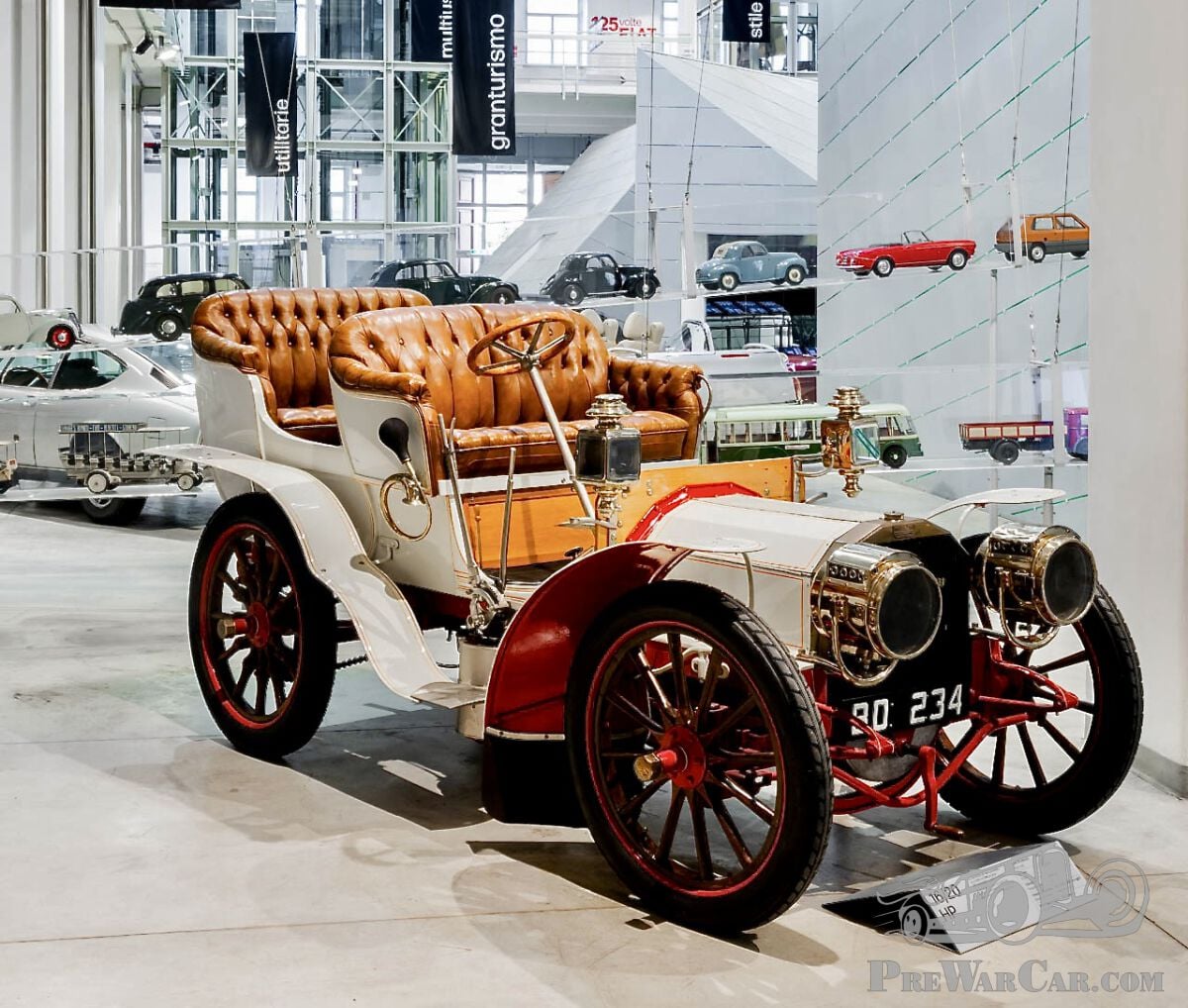
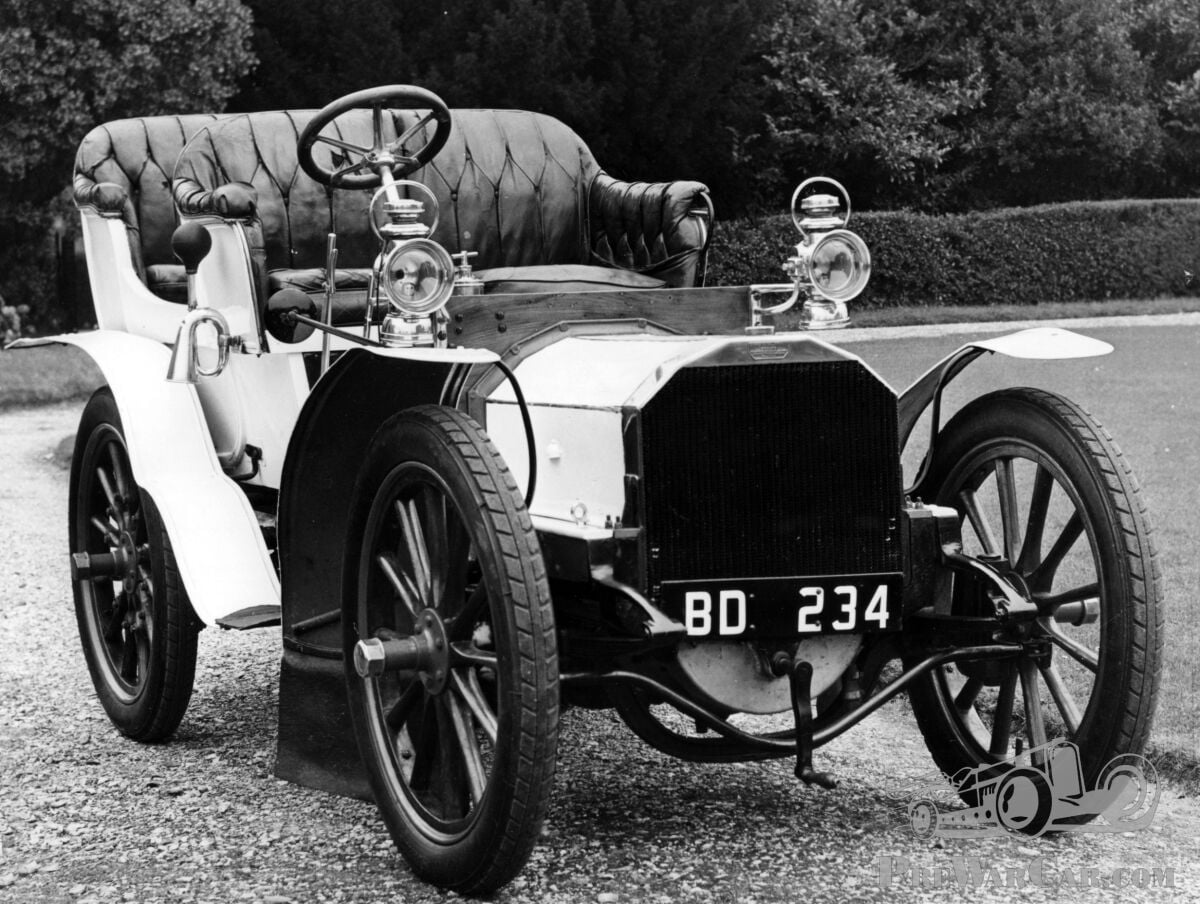
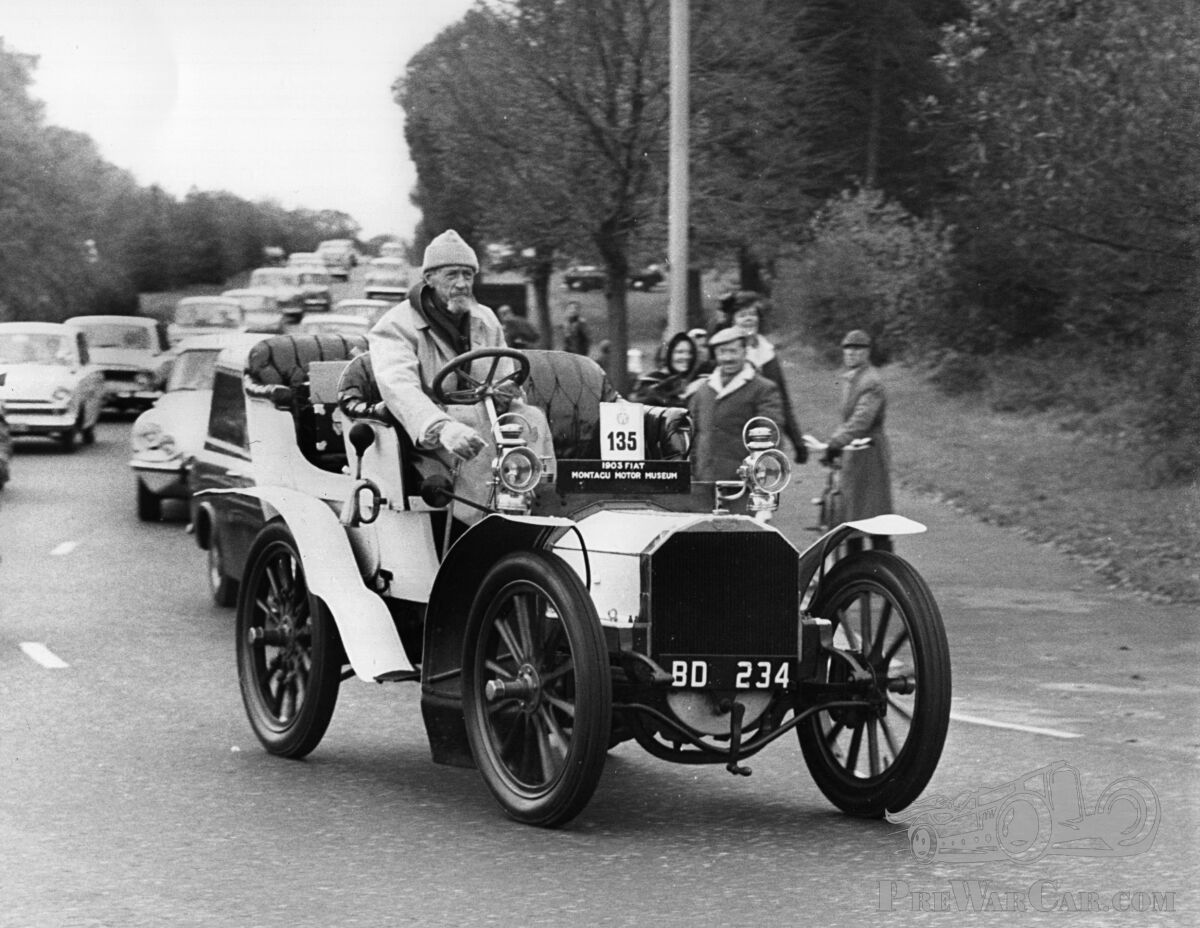


Alcune automobili conoscono la strada per Brighton da più tempo di quanto molti degli attuali partecipanti siano al mondo. Questa Fiat 16-20HP affrontò il percorso per la prima volta nel 1930 e domenica 1° novembre tornerà alla London to Brighton Veteran Car Run. MAUTO la riporterà in Inghilterra da Torino, nel Paese in cui si svolse gran parte della sua storia. Un’italiana che probabilmente riconoscerà la sensazione di tornare a casa.
La storia comincia nel 1903. Nel gennaio di quell’anno, la direzione della Fiat decise di inviare a Londra il telaio numero 599. Qui ricevette una carrozzeria realizzata da Rothschild. Meccanica italiana con una carrozzeria costruita a Londra: questa Fiat dimostra quanto il mondo dell’automobile fosse internazionale già allora.
La 16-20HP era un’automobile di notevole sostanza. La prima versione disponeva di un motore a quattro cilindri da 4.179 cm³, con i cilindri fusi in due blocchi separati. La potenza era di circa 20 CV a soli 1.200 giri/min, mentre il cambio offriva quattro rapporti. Sono dati che richiedono un po’ di prospettiva: venti cavalli possono sembrare pochi, ma una cilindrata superiore ai quattro litri conferiva a questa Fiat capacità molto diverse da quelle delle piccole voiturette dello stesso periodo.
La vettura rimase in uso fino al 1912. In seguito fu messa in deposito, per essere ritrovata soltanto molti anni dopo da Fiat UK nel Northamptonshire. Le sue condizioni erano evidentemente così buone che nel 1930 fu esposta sullo stand Fiat all’Olympia Show. I visitatori giunti per ammirare le automobili più recenti potevano così incontrare una loro antenata, ormai divenuta essa stessa parte della storia.
Nello stesso anno, Sir Maxwell Monson la guidò fino a Brighton, facendo registrare una velocità media di oltre 34 km/h. Nel 1931 partecipò nuovamente. La Fiat rimase attiva anche nei primi anni Cinquanta, fra gli altri con il pilota di Brooklands Antony Powys-Lybbe al volante.
La sua sopravvivenza non fu tuttavia priva di interruzioni. Nel 1956 e nel 1957, la vettura fu parzialmente smontata per una revisione approfondita. Le difficoltà nell’ottenere i permessi di lavoro per i meccanici italiani portarono poi alla sospensione dei lavori. Una partecipante ormai nota della Brighton Run scomparve così nuovamente dalla scena.
Nel 1959 Michael Sedgwick, conservatore del Montagu Motor Museum, la trovò in un capannone dietro al vecchio deposito Fiat di Wembley. Un anno più tardi fu concessa in prestito a Beaulieu e tornò ancora una volta a Brighton. Il redattore di Autocar Maurice Smith la guidò in quell’edizione e descrisse un’automobile vivace, capace di superare gli 80 km/h. Dopo ulteriori partecipazioni nel 1965 e nel 1966, la Fiat tornò infine a Torino. Qui entrò a far parte del Centro Storico Fiat, pur continuando a comparire in occasione di alcuni eventi italiani, fra cui le celebrazioni per il centenario della Fiat nel 1999.
Ora la strada da Londra alla costa la attende ancora una volta. Per il pubblico sarà un’occasione per vedere in movimento una straordinaria Fiat dei primordi. Per gli appassionati di automobili pioniere, il fascino risiede soprattutto nella sua lunga storia d’impiego: questa vettura è stata guidata, ricoverata, ritrovata, riparata e infine guidata nuovamente. Presto vi si aggiungerà un altro capitolo, su una strada che conosce da quasi un secolo.
La RM Sotheby’s London to Brighton Veteran Car Run conclude la London Motor Week del Royal Automobile Club. Il programma comprende inoltre i Motoring Book Awards del Club, la mostra ‘Art of Motoring’ e il St James’s Motoring Spectacle, un evento a ingresso gratuito organizzato a Pall Mall, nel centro di Londra. Il fine settimana si concluderà con la RM Sotheby’s London Sale, in programma sabato 31 ottobre presso il prestigioso Peninsula Hotel, e naturalmente, la domenica, con la RM Sotheby’s London to Brighton Veteran Car Run.
Pubblicato:
mercoledì ottobre 7th, 2026
Facebook
LinkedIn
Twitter
WhatsApp
Email
Copy
Commenti
Ariejan Bos
09 Ottobre, 16:42
Jeroen Booij
08 Ottobre, 09:27
That's Fyfe Robertson in picture 5. Possibly for a BBC television report that he drove the car? If so that must have been lovely surely!
Per saperne di più
Ariejan Bos
07 Ottobre, 17:27
When reading the story about this car and when trying to confirm the facts with the information in my archive, I got a bit confused. The bonnet top with the striking edgy profile was indeed used by Fiat during about a year, but as far as I could check the Fiat bonnets end of 1902 and beginning of 1903 where still flat with round or flattened shoulders. This is endorsed by the models, shown at the Fiat stand at the Paris show in December 1902. The first time I see these profiled bonnet tops is in the Paris-Madrid race in May 1903, where two Fiats were entered. In both cases these were 24 hp models. In the Italian Susa-Moncenisio race in June 1903 next to a 24hp model also a 16hp with similar bonnet type participated.
So in my opinon a Fiat with this bonnet type didn’t exist yet in the first months of 1903. This is supported by the fact that Mercedes showed a similar bonnet style for the first time end of december 1902 at the Paris show. It is common knowledge, that Fiat followed Mercedes design in several aspects, and apparently they copied the bonnet style in the course of 1903.
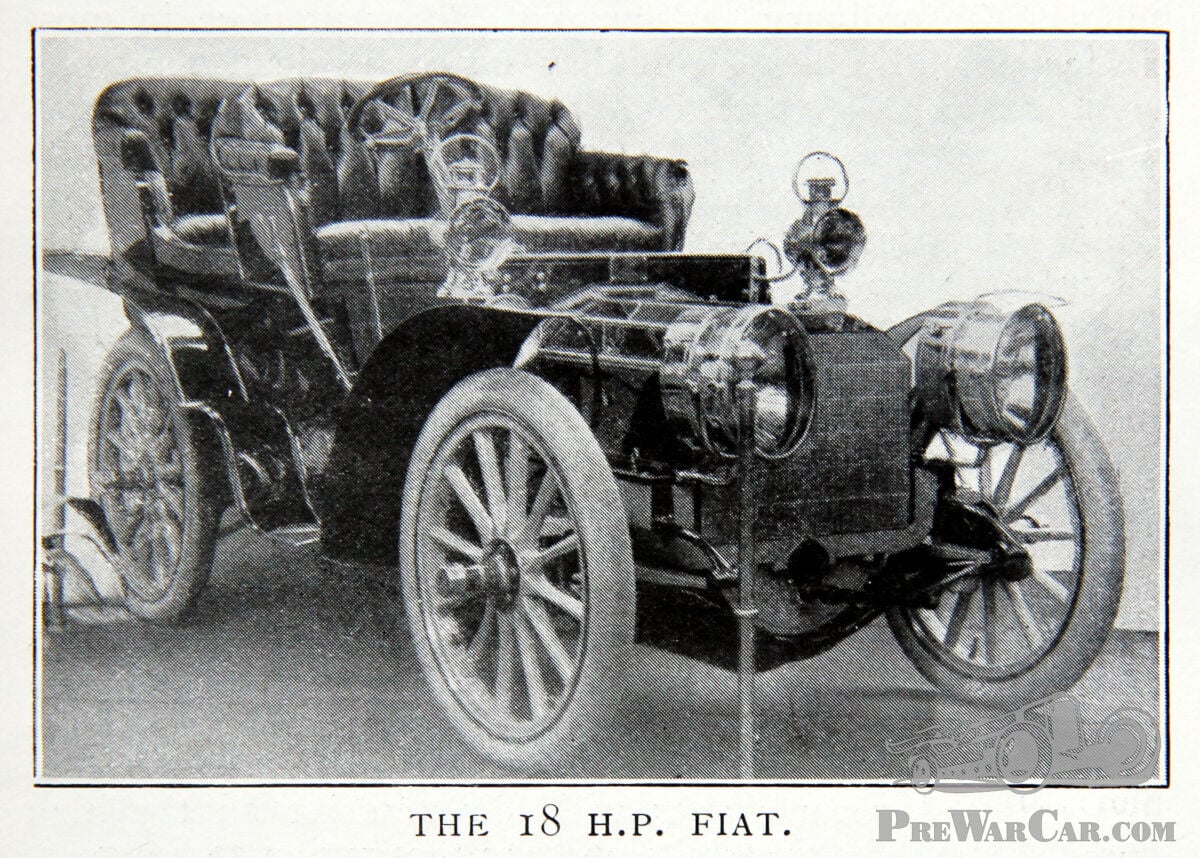
Now it seems that exactly the same Fiat as described in the above post could be seen at the Crystal Palace show in february 1904 (see upload). Although the caption describes it as an 18 hp (typing errors were made also then!), for me there is little doubt that it is the same car given the body style. It seems odd, that an early 1903 model would be presented for the first time a year later on a car show, when developments were fast.
My explanation would be that the chassis was not sent early 1903, but a year later to Rothschild, where undoubtedly in a month a body could be built that was shown at Crystal Palace.
Per saperne di più
So in my opinon a Fiat with this bonnet type didn’t exist yet in the first months of 1903. This is supported by the fact that Mercedes showed a similar bonnet style for the first time end of december 1902 at the Paris show. It is common knowledge, that Fiat followed Mercedes design in several aspects, and apparently they copied the bonnet style in the course of 1903.
Now it seems that exactly the same Fiat as described in the above post could be seen at the Crystal Palace show in february 1904 (see upload). Although the caption describes it as an 18 hp (typing errors were made also then!), for me there is little doubt that it is the same car given the body style. It seems odd, that an early 1903 model would be presented for the first time a year later on a car show, when developments were fast.
My explanation would be that the chassis was not sent early 1903, but a year later to Rothschild, where undoubtedly in a month a body could be built that was shown at Crystal Palace.
The car must have been confused with another, older Fiat, which has been for a long time part of the Montague Motor Museum collection. This 3.5hp rear-engined Fiat from 1899 was also rediscovered in the late 1920s in England: it was found in parts at a farm, the engine being used for a sheep-shearing machine. Owned by Powys-Lybbe, he drove the car himself in the 1932 London-Brighton run. The Fiat was then still dated 1900. In the 1946 run he drove the car again, now dated 1901, as well as in 1949, when the car was dated 1900 again. Next the car was for a long time absent from the run, but it participated as an 1899 model in the centenary run in 1996.
The 16hp Fiat is first mentioned as a participant in the 1930 London–Brighton run with Messrs. Fiat Ltd. named as the owners, but dated as a 1900 model with the note: ‘In continuous use until 1912, when stored in a barn and forgotten until this year (i.e. 1930).’ The car reappeared in 1931, still with Fiat Ltd. and now dated 1901, with the note: ‘In continuous use until 1914, when it was abandoned in a barn until discovered in 1929.’ In 1932, the car, now owned by R.S.C. Beresford, was still dated 1901 with the note: ‘Was stored for 16 years in a barn’ Both in 1953 and 1955 the only Fiat participant was a 1904 16hp tonneau entered by A.C. Westwood. This must have been ‘our’ car without doubt. In 1956 and 1957 the car was entered as a 1903 16hp tonneau, in 1956 owned by John Skinner, but in 1957 it had moved back to Fiat (England) Ltd.. The car is then absent for years and reappears in the run of 1964, now with the Montague Motor Museum and Fiat (England) Ltd. as the entrants, and Sir Norman Joseph [?Wisdom] as the driver. He also drove the car in 1965, in 1966 the car was driven by Fyfe Robertson, in 1967 by Lord Montague.
The fact that both cars were at some time dated 1900 must have contributed to the confusion, as well as the continuous changing in the dating of the cars, but it must be clear now that Powys-Libbe never drove the 16hp Fiat.