La rivista e il marketplace globale per gli appassionati di auto d’epoca, creati da appassionati.
La rivista e il marketplace globale per gli appassionati di auto d’epoca, creati da appassionati.


Filter
Faccia la sua scelta
- Automobile
-
Marca >>
-
Anno >>
-
- Motociclette
-
Ubicazione >>
- Parti e altro
-
Marca dell'auto >>
-
Produttore >>
-
Categoria >>
- Biciclette
-
Anno >>
-
Paesi


Croydon in the age of Edwardian elegance
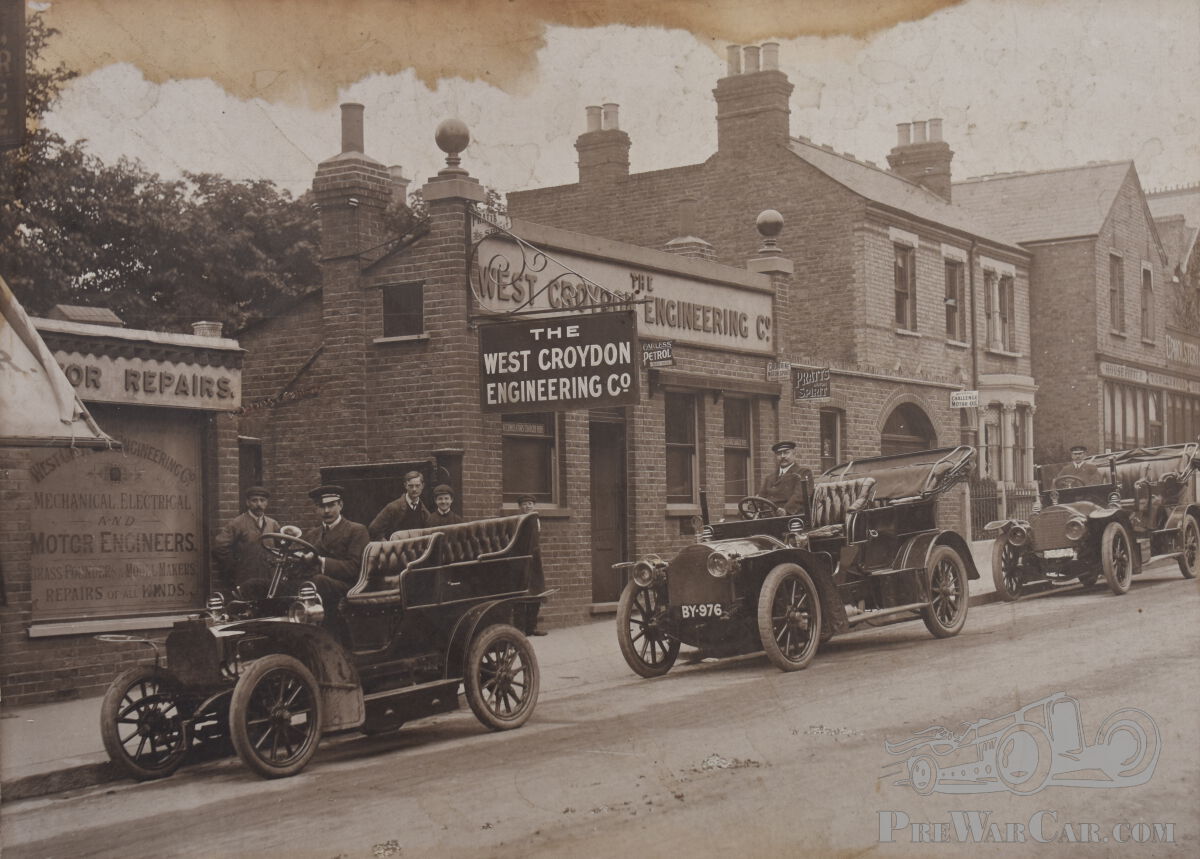

One doesn't like to be unkind, but it would be fair and accurate to say that modern-day Croydon, a large town just beyond the reaches of London, is characterized more than anything by its proliferation of jackbooted skyscrapers and dubious fried-chicken shops. It wasn't always thus. Our Victorian and Edwardian ancestors expected beauty to be present in all works, and Croydon was built up in accordance with that standard.
Consequently, we have a most attractive scene here, with the West Croydon Engineering Co. taking centre stage. If you were a motorist in Croydon during King Edward's reign, it must have been a very useful firm to know as it operated as 'Mechanical, Electrical and Motor Engineers, Brass Founders and Model Makers'. It was located at 4A St. Michael's Road and was known to have existed at least from 1906 to 1910.
Around the back, there was a very well-equipped machine shop. In addition to general engineering, West Croydon Engineering Co.'s entry in Ward's Croydon Directory mentioned that it also maintained cars for sale or hire, and we wonder if we may be looking at its hire fleet here. All the cars are impressive, especially the larger ones with Roi-des-Belges coachwork, and each has its own smartly turned-out chauffeur.
Unfortunately, we're struggling with identification. The car in the foreground isn't quite so difficult. It's clearly a Peugeot and with tourer rather than tonneau bodywork it's probably slightly post-Veteran, of 1906 manufacture or thereabouts. The other two cars, however, are another matter altogether. We can't think of anything British which springs to mind immediately. Could they be one of the prestigious Italian marques, perhaps? We'll leave it for you to puzzle over.
Incidentally, Croydon would go on to develop much stronger ties to the motor-car as a number of car-manufacturers sprung up during the Veteran, Edwardian and Vintage years, but the only one to have any lasting success would be Trojan, which lasted until 1965, by which time its only products were the Trojan 200 bubble car (a licence-built Heinkel) and the Elva Courier.
Words: Zack Stiling; photograph: Stiling Collection
Pubblicato:
martedì giugno 6th, 2023
Facebook
LinkedIn
Twitter
WhatsApp
Email
Copy
Commenti

Henk Brauer
11 Giugno 2023, 12:13
Interesting photo, story and question. I hope you will get more information and will go on to develop much stronger ties to the motor-car as Croydon had a number of car manufacturers Veteran, Edwardian and Vintage, plus Trojan and Elva. There's enough information and energy to write articles and organize a Croydon car manufacterers memorial event. We do in the Netherlands a memorial event for the first car in the Netherlands 130 years ago and the first dutch motorist. More information is available on request, or look up Borderline-Oldtimer-Grens/zland.
Per saperne di più
David Grimstead
08 Giugno 2023, 15:01
A forerunner company at this address first appeared as Hirst’s Steam Cycle Works, St. Michael's Road, West Croydon, in mid-1887 and was most likely started by Arthur William Hirst, who in 1885 ran the Alhambra Bicycle Works in nearby Poplar Walk. He was a cyclist and photographer who made his own equipment.
It remained as a bicycle and tricycle works until advertised from at least 1892 as “Hirst and Co. Ltd., Mechanical Engineers, Brassfounders &c., Steam Works and Offices St. Michael’s-road, West Croydon. Brass and gunmetal castings to customer’s own patterns. Manufacturers of all kinds of photographic equipment”. It had updated its capabilities by 1896 when it was advertised as “Mechanical and Electrical Engineers, Brassfounders, &c. – small power gas engines a speciality.” The company installed the lighting system at Croydon’s new Theatre Royal and Ward’s Photographic Studio in 1899 but went downhill thereafter and after a court case over electric lamps in April 1900, A. W. Hirst’s company was reported bankrupt in July.
It was bought by Messrs. Henry and William Hilton La Motte, the latter an electrical engineer, who perhaps then renamed it West Croydon Engineering Co., which as such in 1901 made an application for a petroleum storage licence for St. Michael’s Road – hence the “Pratt’s Spirit”, “Carless Petrol” and “Moebius Challenge Motor Oil” signs in the photo. “Hirst, Croydon” was retained as its telegraphic address. In 1902 it advertised: “Engines, shafting, pulleys, brackets, etc., supplied and fixed. Repairs of all kinds. Motor car repairs”. Initially, car repairs and rentals seem to have remained a small part of its operation; the company erected the complete plant for Carl Hentschel Colortype Ltd. in West Norwood in January 1902.
During 1906, Messrs. La Motte put the business up for sale and Ernest Strutt of Thornton Heath bought the site’s lease for £300, with a £250 loan from a speculating Purley builder, George Bates. Strutt was its owner/manager from September 1906 but the loan contract was onerously flawed and he ended in court in early 1908 resisting threatened foreclosure. He lost but the business survived.
A new partnership was formed between Strutt and Gerald Howard Gardner for 1908, which advertised that West Croydon Engineering was “The Recognised Motor Works.” Not everyone recognised the quality of the work and that year they had to sue a travelling sales rep for non-payment for repairs to “a very old Panhard.” After operating those Peugeots and Martinis identified by Ariejan, Renault - "quiet, silent, flexible" - was the make of rental car the company offered “for weekends” or “by the day, week or month” during 1909. However, Strutt and Gardner’s partnership as “Motor, Electrical and General Engineers” at West Croydon Engineering Company was dissolved by mutual agreement in November 1910, with the former again keeping the business.
From 1911, Strutt entered a short-term partnership with T. W. Elsdon, who then sold Strutt half his shares and another with Albert Atkinson, which ended in court action. In 1913 Ernest Strutt, now the sole proprietor of West Croydon Engineering Ltd., personally took a repaired car out on test with Mr. Bucher, its dissatisfied owner, at the hazardous time of 11:45 pm on a Saturday in November and collided with a horse-drawn taxicab on Wimbledon Common. The cab company legally sought recompense and a judge concluded Strutt drove carelessly, awarding £30 damages against him and his company; he had to pay his and Bucher’s defence costs too.
Nothing relevant to the St. Michael's Road factory was reported after that but Strutt, still living in Thornton Heath, was fined in spring 1925 for driving at Leatherhead with no front number plate and in summer 1932 escaped prosecution for a collision at Gadbrook Crossroads – in court he said on oath that he was 61, had been driving for 32 years and “I am one of the oldest drivers in the country, with an absolutely clean driving record…”
Finally, an inevitable, sad but apposite post-script: Ernest Strutt, described by his brother as a retired widower motoring expert, died aged 69 in February 1939 after catching what proved to be a lethal chill driving “an old crock” in the very wet November 1938 London-Brighton run...
Per saperne di più
It remained as a bicycle and tricycle works until advertised from at least 1892 as “Hirst and Co. Ltd., Mechanical Engineers, Brassfounders &c., Steam Works and Offices St. Michael’s-road, West Croydon. Brass and gunmetal castings to customer’s own patterns. Manufacturers of all kinds of photographic equipment”. It had updated its capabilities by 1896 when it was advertised as “Mechanical and Electrical Engineers, Brassfounders, &c. – small power gas engines a speciality.” The company installed the lighting system at Croydon’s new Theatre Royal and Ward’s Photographic Studio in 1899 but went downhill thereafter and after a court case over electric lamps in April 1900, A. W. Hirst’s company was reported bankrupt in July.
It was bought by Messrs. Henry and William Hilton La Motte, the latter an electrical engineer, who perhaps then renamed it West Croydon Engineering Co., which as such in 1901 made an application for a petroleum storage licence for St. Michael’s Road – hence the “Pratt’s Spirit”, “Carless Petrol” and “Moebius Challenge Motor Oil” signs in the photo. “Hirst, Croydon” was retained as its telegraphic address. In 1902 it advertised: “Engines, shafting, pulleys, brackets, etc., supplied and fixed. Repairs of all kinds. Motor car repairs”. Initially, car repairs and rentals seem to have remained a small part of its operation; the company erected the complete plant for Carl Hentschel Colortype Ltd. in West Norwood in January 1902.
During 1906, Messrs. La Motte put the business up for sale and Ernest Strutt of Thornton Heath bought the site’s lease for £300, with a £250 loan from a speculating Purley builder, George Bates. Strutt was its owner/manager from September 1906 but the loan contract was onerously flawed and he ended in court in early 1908 resisting threatened foreclosure. He lost but the business survived.
A new partnership was formed between Strutt and Gerald Howard Gardner for 1908, which advertised that West Croydon Engineering was “The Recognised Motor Works.” Not everyone recognised the quality of the work and that year they had to sue a travelling sales rep for non-payment for repairs to “a very old Panhard.” After operating those Peugeots and Martinis identified by Ariejan, Renault - "quiet, silent, flexible" - was the make of rental car the company offered “for weekends” or “by the day, week or month” during 1909. However, Strutt and Gardner’s partnership as “Motor, Electrical and General Engineers” at West Croydon Engineering Company was dissolved by mutual agreement in November 1910, with the former again keeping the business.
From 1911, Strutt entered a short-term partnership with T. W. Elsdon, who then sold Strutt half his shares and another with Albert Atkinson, which ended in court action. In 1913 Ernest Strutt, now the sole proprietor of West Croydon Engineering Ltd., personally took a repaired car out on test with Mr. Bucher, its dissatisfied owner, at the hazardous time of 11:45 pm on a Saturday in November and collided with a horse-drawn taxicab on Wimbledon Common. The cab company legally sought recompense and a judge concluded Strutt drove carelessly, awarding £30 damages against him and his company; he had to pay his and Bucher’s defence costs too.
Nothing relevant to the St. Michael's Road factory was reported after that but Strutt, still living in Thornton Heath, was fined in spring 1925 for driving at Leatherhead with no front number plate and in summer 1932 escaped prosecution for a collision at Gadbrook Crossroads – in court he said on oath that he was 61, had been driving for 32 years and “I am one of the oldest drivers in the country, with an absolutely clean driving record…”
Finally, an inevitable, sad but apposite post-script: Ernest Strutt, described by his brother as a retired widower motoring expert, died aged 69 in February 1939 after catching what proved to be a lethal chill driving “an old crock” in the very wet November 1938 London-Brighton run...
Ariejan Bos
06 Giugno 2023, 13:42
Interesting photo, which I have seen before. As can easily be observed, the Peugeot lacks chain-drive leaving only a few possibilities: probably it is a 1905 Model 68, a one-cylinder model with Cardan drive. The other two cars are both Martinis from the 1905 to 1907 period. The front car is the older one, ca.1905, and the other one probably 1906-1907.
Per saperne di più