La rivista e il marketplace globale per gli appassionati di auto d’epoca, creati da appassionati.
La rivista e il marketplace globale per gli appassionati di auto d’epoca, creati da appassionati.


Filter
Faccia la sua scelta
- Automobile
-
Marca >>
-
Anno >>
-
- Motociclette
-
Ubicazione >>
- Parti e altro
-
Marca dell'auto >>
-
Produttore >>
-
Categoria >>
- Biciclette
-
Anno >>
-
Paesi



What is it? Quiz #408
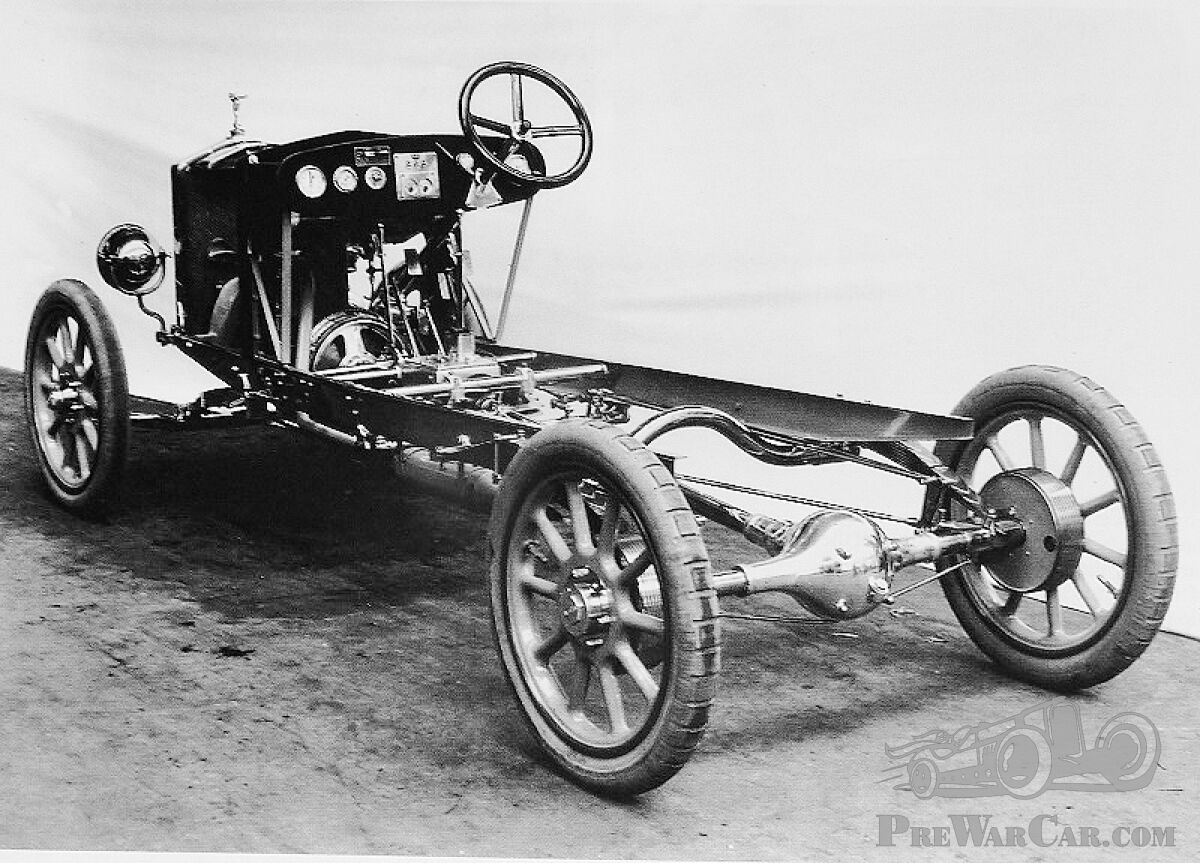

We do not often see expensively nickel-plated rear axles because, of course, this English-made chassis was prepared for the Motor Show at Olympia to attract customers. We'll tell you it was 1919, the first year of production, but you have to tell us which make. That first year saw almost no production, the early cars having faults which earned them a poor reputation, with 'weak rear axles,poor brakes and unsatisfactory steering'. Nevertheless, a sports model was bought by a famous pioneer aviator who once attempted (unsuccessfully) to fly the Atlantic. The more details you can give us about this car, its engine lubrication, starting arrangements and the company's destiny, the more likely you are to WIN.
We now ask you to please log in here before posting your answers to the quiz (the amount of spam comments have become intolerable).
Answers in the comment box please. Post that before Monday November 23rd and you may become the winner of this week's pre-war Quiz and will get the infamous PreWarCar T-shirt. Be careful though, check the Rules under 'Read More' first. Results and source of photo will be published next Saturday, November 28th. Enjoy the weekend!
Pubblicato:
venerdì novembre 20th, 2015
Facebook
LinkedIn
Twitter
WhatsApp
Email
Copy
Commenti
Peter Ransom
23 Novembre 2015, 03:58
Stuart Penketh
22 Novembre 2015, 16:00
What is it Quiz#408
1919 A6A Farman (RAC rating 37.2hp) (Design by Charles Waseige)
Debuted at the 1919 Paris Salon, and London Motor Shows (either at Olympia or the White City) ‘til 1926. A polished chassis or engine was always featured on the stand.
Six-cylinder engine, bore 100mm. x stroke 140 mm. (6597cc), 100 bhp at 2800 rpm.
Four-speed gearbox, 2nd and 3rd pinions with helical teeth for silent running, mounted separately from the engine.
Cone clutch, dual ignition, 3 Main bearing crankshaft,
Semi-elliptic springs at front and cantilevers to rear.
Rear wheel brakes only, plus transmission brake.
Four-bladed fan, with a dashboard lever operated clutch, to disable fan if temperature drops too much for maximum efficiency.
Wheelbase 11 ft. 11 in (3632mm). and track 4 ft. 8 in. (1422mm)
Touring, and sports models were offered, the maximum speeds claimed being 70 and 90 mph respectively.
Vehicles manufactured in France although the Farman brothers, had English parents.
Farman's had their own coach building department, but also used other coachbuilders, on the Farman chassis.
At the 1919 Olympia Motor Show the price of the chassis was quoted at £1900, compared with £1575 asked for the Rolls-Royce Silver Ghost.
“The Farman seems to have been a rather glorious failure. Every enthusiast admired it, and the motoring press was full of praise for the brilliance of its engineering, but very, very few people were prepared to buy it”
Jury member
Per saperne di più
1919 A6A Farman (RAC rating 37.2hp) (Design by Charles Waseige)
Debuted at the 1919 Paris Salon, and London Motor Shows (either at Olympia or the White City) ‘til 1926. A polished chassis or engine was always featured on the stand.
Six-cylinder engine, bore 100mm. x stroke 140 mm. (6597cc), 100 bhp at 2800 rpm.
Four-speed gearbox, 2nd and 3rd pinions with helical teeth for silent running, mounted separately from the engine.
Cone clutch, dual ignition, 3 Main bearing crankshaft,
Semi-elliptic springs at front and cantilevers to rear.
Rear wheel brakes only, plus transmission brake.
Four-bladed fan, with a dashboard lever operated clutch, to disable fan if temperature drops too much for maximum efficiency.
Wheelbase 11 ft. 11 in (3632mm). and track 4 ft. 8 in. (1422mm)
Touring, and sports models were offered, the maximum speeds claimed being 70 and 90 mph respectively.
Vehicles manufactured in France although the Farman brothers, had English parents.
Farman's had their own coach building department, but also used other coachbuilders, on the Farman chassis.
At the 1919 Olympia Motor Show the price of the chassis was quoted at £1900, compared with £1575 asked for the Rolls-Royce Silver Ghost.
“The Farman seems to have been a rather glorious failure. Every enthusiast admired it, and the motoring press was full of praise for the brilliance of its engineering, but very, very few people were prepared to buy it”
Jury member
James
21 Novembre 2015, 18:51
I believe the car shown in the picture is a Varley Woods, produced by the High Speed Tool company Acton London. Chassis' were sourced from Turner, and engines 1794cc engines from Dorman and launched at the1919 Motor Show at Olympia. There were three models, a 2-seater, priced at £540, a 4-seater tourer, priced at £660, and a coupé, priced at £760. Roughly 150 cars were built with Dorman engines as the company suffered with financial problems. I believe only one of these cars survives today.
Once production came to an end, Varley moved to a cottage in Cornwall, while Woods travelled to Nyasaland, where he was eaten by a lion.
Per saperne di più
Once production came to an end, Varley moved to a cottage in Cornwall, while Woods travelled to Nyasaland, where he was eaten by a lion.
I'm a jury member.
This very nice picture appears on page 17 of Nick Baldwin's "A-Z of Cars of the 1920s". It'a 1921 11.9 hp Albert (sold as the 12HP) made by Gwynne, who had bought out the original manufacturers in 1920. Apparently well made but with design flaws that gave the cars a bad name that took the company into receivership. Total production is thought to be about 1800.